



Skip to content
  • Facebook
  • X
  • Linkedin
  • WhatsApp
  • Associate Journalism
  • About Us
  • Privacy Policy
  • 033-46046046
  • editor@artifex.news
Artifex.News

Artifex.News

Stay Connected. Stay Informed.

  • Breaking News
  • World
  • Nation
  • Sports
  • Business
  • Science
  • Entertainment
  • Lifestyle
  • Toggle search form
  • Gujarat Titans vs Punjab Kings, IPL 2024: Match Preview, Fantasy Picks, Pitch And Weather Reports Sports
  • Disappointed British Man Leaves Granddaughters 50 Pounds Each From His 500,000 Pounds Fortune In Will World
  • Government Urged To Remove Designated Rooms In Hotels, Airports Nation
  • Ukraine faces twin challenges of fighting Russia and shifting political sands in the U.S. World
  • Who Is Russia’s New Defence Minister Andrei Belousov, Putin’s Surprise Pick World
  • Study traces Turkey quake to interrupted ‘chat’ between fault lines Science
  • Less Than 10 Percent Indian Arbitrators On International Panels Are Women Nation
  • Harmanpreet Kaur Sees Ongoing Series vs South Africa As Beneficial Ahead Of ODI World Cup Sports

Flying by Saturn and Neptune, eight years apart

Posted on August 24, 2024 By admin


On four occasions every 700 years, the planets align in a particular way. No, we aren’t taking to horoscopy all of a sudden. This rare planetary configuration that takes place once in every 175 years enables scientists to best utilise gravity assists.

The Voyager 2, which was in fact the first of the two Voyager spacecrafts to be launched, made use of exactly this. By making use of the gravity of one planet to sling itself to the next planet, Voyager 2 not only visited its initial targets of Jupiter and Saturn, but also made its way to Uranus and Neptune as well.

Image from August 1977 shows engineers working on the Voyager 2 spacecraft weeks before its launch on August 20.
| Photo Credit:
AP Photo/NASA

Launched on August 20, 1977, Voyager 2 sped past the asteroid belt between December 1977 and October 1978. During this period, its primary radio receiver failed in April 1978, and Voyager 2 has been operating using its backup receiver since then.

Jupiter encounter

Months after Voyager 1 made its closest approach to Jupiter, Voyager 2 made its closest approach of the planet on July 9, 1979 as part of a four-month encounter with the solar system’s largest planet. It then set out on its 29-month journey to Saturn, using Jupiter for a gravity assist.

As Voyager 1 had already had its successful encounter with Saturn, Voyager 2 was put to the task of studying some of Saturn’s moons that its twin couldn’t, before speeding towards Uranus and then Neptune. Long-range observations of Saturn began on June 5, 1981. As it got closer, the quality of images sent back kept getting better, including those of Saturn’s satellites Prometheus, Pandora, Iapetus, Hyperion, Titan, Enceladus, Janus, and Tethys.
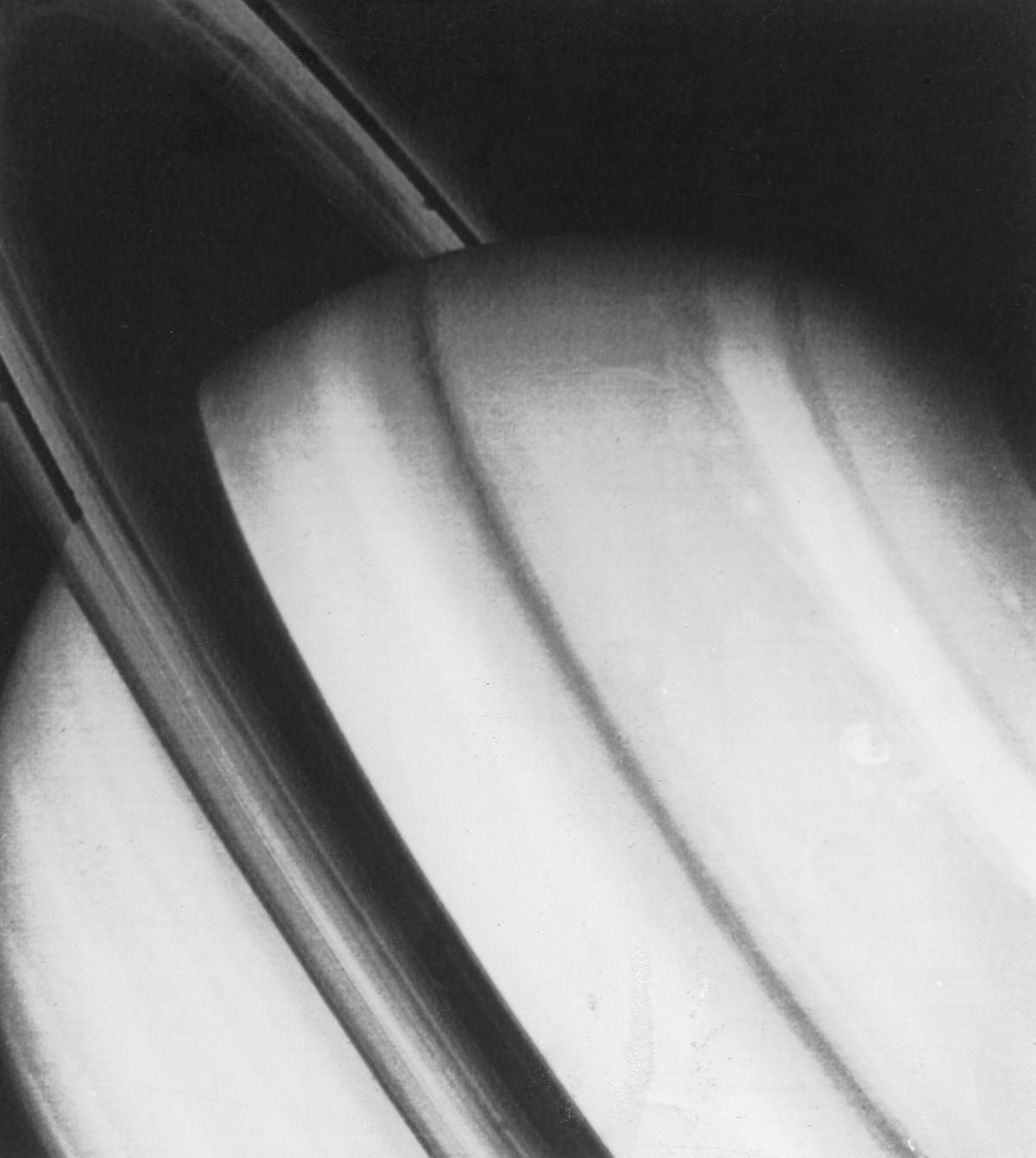
Voyager 2’s view of Saturn and its ring system taken on August 11, 1981, when the spacecraft was 8.6 million miles away from the planet. The ring system’s shadow is clearly cast in the equatorial region.

Voyager 2’s view of Saturn and its ring system taken on August 11, 1981, when the spacecraft was 8.6 million miles away from the planet. The ring system’s shadow is clearly cast in the equatorial region.
| Photo Credit:
AP / THE HINDU ARCHIVES

Looks back at Saturn

Three days after making its closest approach – on August 25, 1981 – Voyager 2 turned its cameras on Saturn and returned spectacular images of the partially backlit planet. By September 28, when Voyager 2’s observations of the Saturn system was completed, the spacecraft had returned 16,000 images that included those of the planet, its rings and satellites.

The next day, Voyager 2 fired its thrusters, which enabled a course correction to send it towards Uranus. More than four years later, in January 1986, Voyager 2 became the first, and so far only, spacecraft to visit Uranus and its system, coming within 81,500 km of the planet’s cloud tops during closest approach. Before picking up a gravity assist from Uranus and heading off towards its final planetary encounter, Voyager 2 had discovered 10 new moons for Uranus, to go along with two new rings and magnetic field stronger than that of Saturn.

Low light challenge

Nearly 30 times as far from the sun as the Earth is, Neptune receives about one-thousandths the amount of sunlight that the Earth does. This posed a challenge for Voyager 2, as its camera would require longer exposures to get good images in such low light. The spacecraft’s speed meant that such long exposures would make the image blurry. To tackle this problem, the team programmed Voyager 2’s thrusters to fire gently during the close approach, in addition to rotating the spacecraft to allow the camera to stay focussed on its target, without actually changing the spacecraft’s speed and direction.
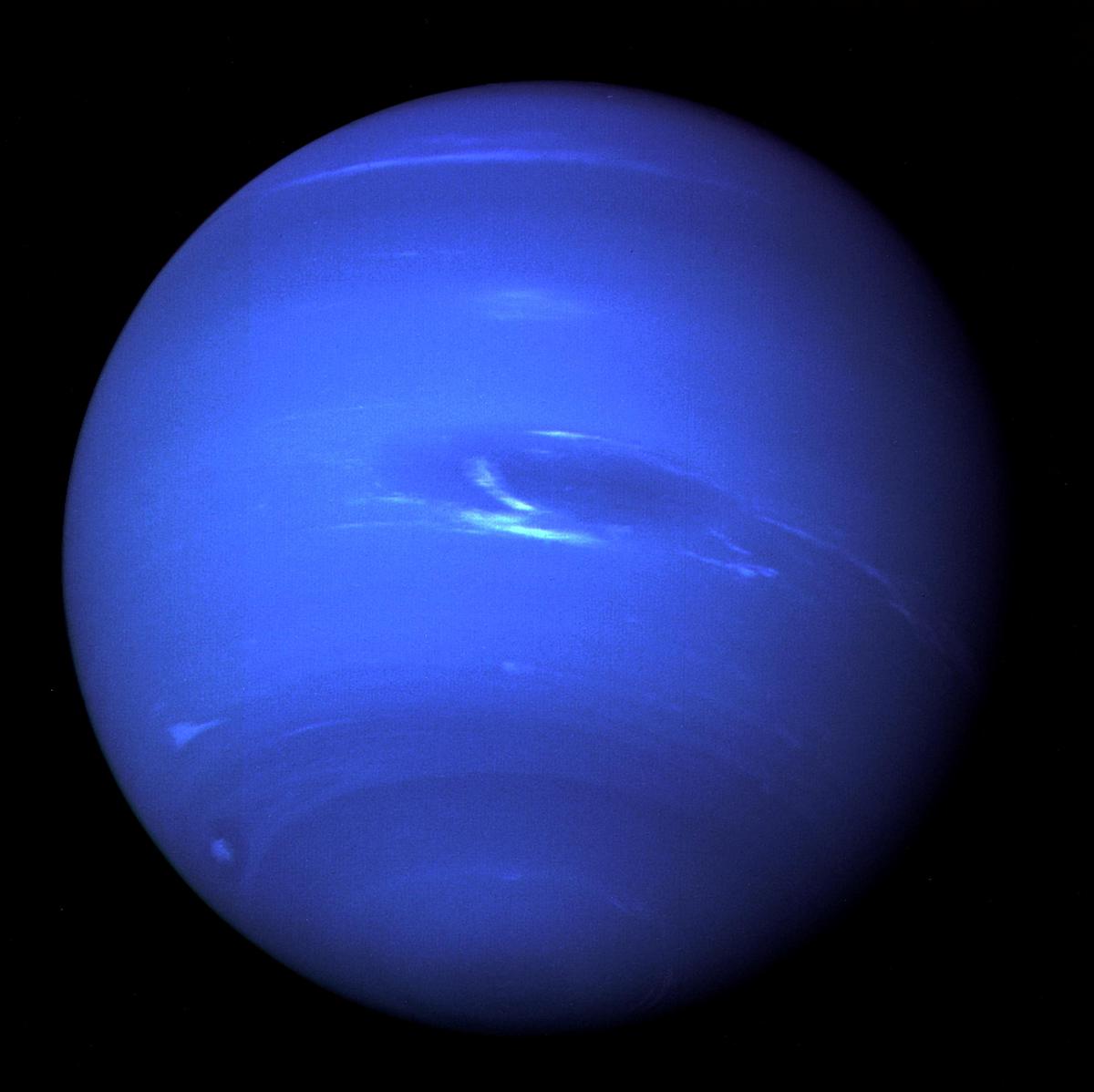
The “Great Dark Spot”, a storm in the atmosphere and the bright, light-blue smudge of clouds that accompanies the storm is seen on the planet Neptune, taken by the Voyager 2 less than five days before its closest approach of the planet on August 25, 1989.

The “Great Dark Spot”, a storm in the atmosphere and the bright, light-blue smudge of clouds that accompanies the storm is seen on the planet Neptune, taken by the Voyager 2 less than five days before its closest approach of the planet on August 25, 1989.
| Photo Credit:
NASA/JPL-Caltech/Handout via REUTERS

With the Deep Space Network that was used to communicate with the Voyagers expanding its dishes, engineers could not only hear Voyager 2 clearly despite the huge distance, but also receive more data from the spacecraft during the Neptune flyby. Despite coming in the pre-internet era, the team involved made it a point to give the public frequent updates in the week leading up to the historic August 1989 flyby. What’s more, a programme called “Voyager All Night” broadcast regular updates on the day it made its closest approach.

First to Neptune

On August 25, 1989 – exactly eight years after a similar flyby with Saturn – Voyager 2 made its closest approach of Neptune, giving us humans the first glimpse ever of the eighth, and now, farthest planet, in the solar system. Voyager 2 showed that Neptune was a lot like Jupiter and Saturn, just with a blue-hue owing to the presence of methane. Six new satellites and four rings were discovered, in addition to a massive storm that was called the “Great Dark Spot,” similar to Jupiter’s Great Red Spot. Voyager 2 also made a close flyby of Triton, Neptune’s largest moon.
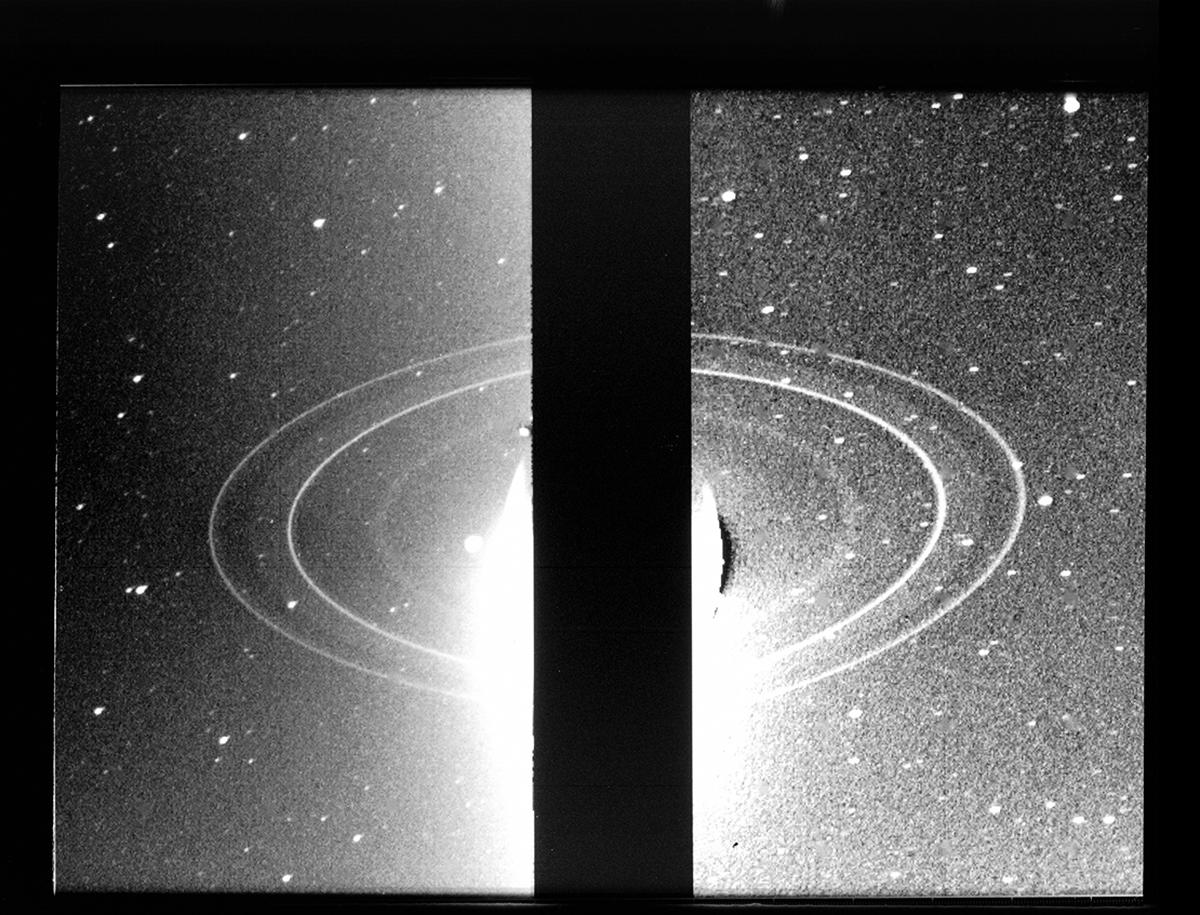
Two 10 minute exposures of Neptune’s rings clearly show the two main rings , as well as the inner faint ring and the faint band that extends planetward from roughly halfway between the two bright rings. These images were taken 1 hour and 27 minutes apart, using the clear filter on Voyager 2’s wide angle camera.

Two 10 minute exposures of Neptune’s rings clearly show the two main rings , as well as the inner faint ring and the faint band that extends planetward from roughly halfway between the two bright rings. These images were taken 1 hour and 27 minutes apart, using the clear filter on Voyager 2’s wide angle camera.
| Photo Credit:
Voyager 2 for NASA

The success story of Voyager 2 stretches way beyond August 25s and the flyby of Saturn and Neptune. The only spacecraft to visit each of the gas giants, Voyager 2 has now entered interstellar space to join its twin in an uncharted space. Both probes continue to report back to Earth, helping humanity to learn about a region where no other spacecraft have flown.

Source link

Science

Post navigation

Previous Post: Man, 72, Sexually Assaults 7-Year-Old Girl In Delhi, Arrested: Police
Next Post: Paetongtarn Shinawatra | Rise of the scion

Related Posts

  • Right against climate change a distinct fundamental and human right, SC judgment Science
  • IISc researchers develop sustainable method to remove heavy metal contaminants from groundwater Science
  • Sci-Five | The Hindu Science Quiz: On Asteroids Science
  • India seeks to boost rooftop solar, especially for its remote areas Science
  • ISRO will launch first dedicated SSLV commercial mission in 2026  Science
  • Warming climate intensifies flash droughts worldwide Science

More Related Articles

Quantum gates: Devices that translate quantum effects to computing awesomeness Science
COVID-19: anosmia as a marker for susceptible brain damage Science
Race for Sun heats up: These are various solar missions Science
Hidden dangers of irrational use of antibiotics on microbiome Science
Quiz | Easy like Sunday morning: Space and beyond Science
America’s first Black astronaut candidate finally goes to space 60 years later on Bezos rocket Science
SiteLock

Archives

  • August 2024
  • July 2024
  • June 2024
  • May 2024
  • April 2024
  • March 2024
  • February 2024
  • January 2024
  • December 2023
  • November 2023
  • October 2023
  • September 2023
  • August 2023
  • July 2023
  • June 2023
  • May 2023
  • April 2023
  • March 2023
  • February 2023
  • January 2023
  • December 2022
  • November 2022
  • October 2022
  • September 2022
  • August 2022
  • July 2022
  • June 2022
  • May 2022

Categories

  • Business
  • Nation
  • Science
  • Sports
  • World

Recent Posts

  • PM Narendra Modi, Amit Shah At Party Panel Meet To Decide On J&K Poll Candidates
  • Hamas Rejects New Conditions In US-Led Gaza Ceasefire Talks
  • Arne Slot Enjoys Perfect Anfield Start As Liverpool Ease Past Brentford
  • 70-Year-Old Woman Raped At Her Residence By Man, 23, In Kerala: Cops
  • After 11-hour Search At Kolkata Doctor’s House, CBI Seizes Documents

Recent Comments

  1. TpeEoPQa on UP Teacher Who Asked Students To Slap Muslim Classmate
  2. xULDsgPuBe on UP Teacher Who Asked Students To Slap Muslim Classmate
  3. KyJtkhneiLmcq on UP Teacher Who Asked Students To Slap Muslim Classmate
  4. mOyehudovB on UP Teacher Who Asked Students To Slap Muslim Classmate
  5. GFBvgSrWPcsp on UP Teacher Who Asked Students To Slap Muslim Classmate
  • India’s May palm oil imports reach 4-month high on price drop-dealers Business
  • India’s T20 World Cup Super 8 Schedule: Opponents, Dates, Match Timing, Venues Sports
  • India Records Highest Percentage In World Anti-Doping Agency’s Offenders’ List Sports
  • Nearly 250 Students From 20 Ashram Schools Fall Ill After Dinner In Maharashtra Nation
  • Max Verstappen Matches Ayrton Senna Pole Record At Imola Sports
  • Akhilesh Yadav May Skip Summons In Illegal Mining Case, Says Samajwadi Party Nation
  • Canada Beat Bermuda To Qualify For T20 World Cup For First Time Sports
  • Health sector can’t ignore telemedicine’s green gains, study shows Science

Editor-in-Chief:
Mohammad Ariff,
MSW, MAJMC, BSW, DTL, CTS, CNM, CCR, CAL, RSL, ASOC.
editor@artifex.news

Associate Editors:
1. Zenellis R. Tuba,
zenelis@artifex.news
2. Haris Daniyel
daniyel@artifex.news

Photograher:
Rohan Das
rohan@artifex.news

Artifex.News offers Online Paid Internships to college students from India and Abroad. Interns will get a PRESS CARD and other online offers.
Send your CV (Subjectline: Paid Internship) to internship@artifex.news

Links:
Associate Journalism
About Us
Privacy Policy

News Links:
Breaking News
World
Nation
Sports
Business
Entertainment
Lifestyle

Registered Office:
72/A, Elliot Road, Kolkata - 700016
Tel: 033-22277777, 033-22172217
Email: office@artifex.news

Editorial Office / News Desk:
No. 13, Mezzanine Floor, Esplanade Metro Rail Station,
12 J. L. Nehru Road, Kolkata - 700069.
(Entry from Gate No. 5)
Tel: 033-46011099, 033-46046046
Email: editor@artifex.news

Copyright © 2023 Artifex.News Newsportal designed by Artifex Infotech.