




Skip to content
  • Facebook
  • X
  • Linkedin
  • WhatsApp
  • Associate Journalism
  • About Us
  • Privacy Policy
  • 033-46046046
  • editor@artifex.news
Artifex.News

Artifex.News

Stay Connected. Stay Informed.

  • Breaking News
  • World
  • Nation
  • Sports
  • Business
  • Science
  • Entertainment
  • Lifestyle
  • Toggle search form
  • Lok Sabha And Rajya Sabha To Discuss Union Budget Nation
  • “Rattled His Stumps, Hope He Remembers”: Wasim Akram On Bowling To Current IPL Captain Sports
  • Suspended Spanish FA Chief Luis Rubiales Says He Will Resign Over Kiss Scandal Sports
  • Air India Cancels Flight To Israel’s Tel Aviv After Attack By Hamas Nation
  • Thousands protest across Middle East over Israeli airstrikes on Gaza World
  • Bangladesh Schools Reopen After Searing Heatwave Decline World
  • 8 Indians Rescued From Myanmar Scam Centre Nation
  • Cricket World Cup 2023 | Australia will not risk taking the Netherlands lightly Sports

On the physics of pressure: how the microscopic world interacts with us

Posted on August 7, 2024 By admin


We again have a leopard visiting us on the IIT Kanpur campus. We already have porcupines, a million dogs, nilgais, snakes, and scorpions. Leopards are a new addition to this thriving ecosystem. It’s probably something about the wet monsoon air of Kanpur that beckons these creatures, as well as the students and faculty members. The courses are starting again now after the summer break, as is the grind. As students old and new gather, the academic pressure begins to rise.

Pressure is an interesting thing: we often don’t like it and try to avoid it, but it is indispensable. It’s everywhere and there is a bit of wonderful physics hiding in it.

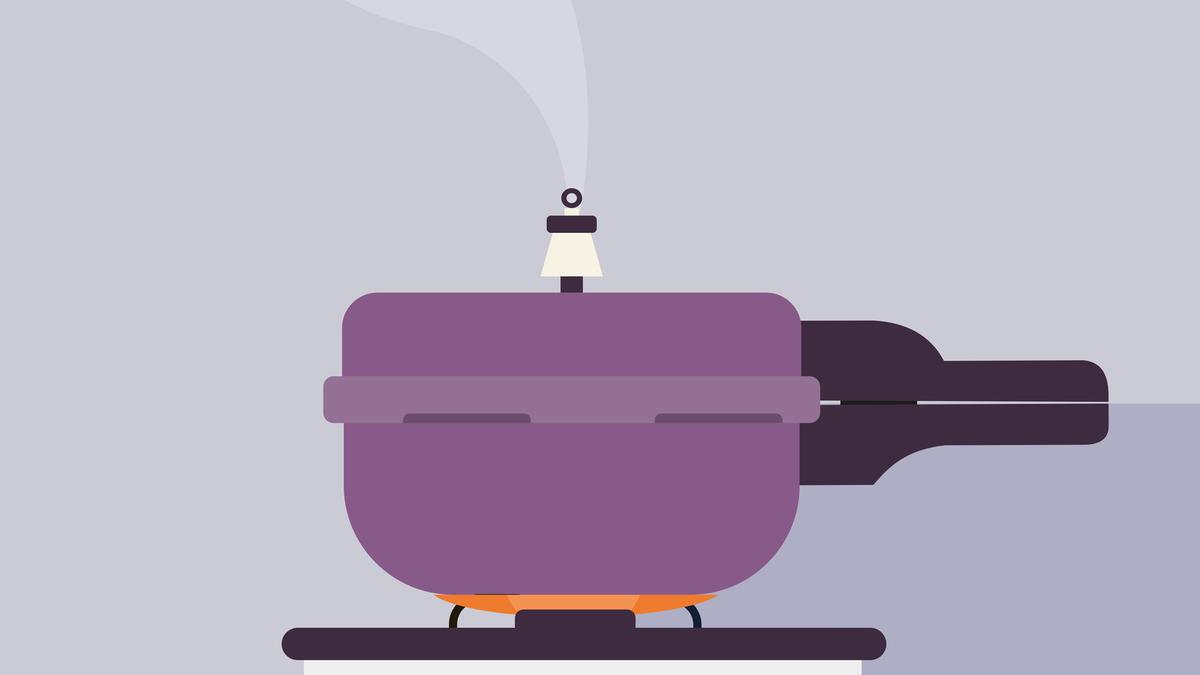
Pressure is how the microscopic world interacts with us. We don’t see billions of atoms and molecules around us in the air but they hit us continuously all the time, creating what we call air pressure. When you are taking a flight, if there is a risk of the number of air molecules reducing around you, the flight host tells you “the pressure may fall, please use an oxygen mask”. If you want to cook something where you want these air molecules to be more energetic — to strike your vegetables better — you use a pressure cooker. In fact, before putting your vegetables in the cooker, you add water. These water molecules become hot and impact your carrots and potatoes, breaking their molecular bonds and cooking your food. You keep all these molecules locked in a strong metal vessel they can’t escape, increasing the pressure.

But what really is pressure?

Of forces and apples

Pressure and force are deeply related. You may have heard of Isaac Newton as just another of those long-haired physicists, but the basic unit of force is named in his honour: newton (N). A unit is a thing you use to measure quantities or other aggregates of some entity. For example, we measure distances in metres, weights in kilograms, and the amount of milk in litres. Likewise, force — such as when you push or pull a door — can be ‘counted’ in newtons. A fruit, like a small apple, weighs roughly 100 g and will exert a force of about 1 N on your hand. In fact, after a bout of intermittent fasting, if you weigh unreasonably low — like 50 kg — you can instead say you weigh 500 N.

Pressure is the average force spread over any area. Imagine a heavy book is resting on your palm. Now imagine you’re holding the same book up with just one finger. The weight of the book remains the same but it feels heavier because it rests on a tinier region.

A pascal (Pa) is a unit of pressure. One pascal is really a very small amount of pressure. For instance, the same apple on your hand exerts a pressure of about 500 Pa. All the air on top of our heads, right up to space, exerts a pressure of 100,000 Pa — like about 200 apples on your hand!

Like air, all fluids have pressure, too, including our blood. The molecules of blood hit the walls of our arteries at different speeds, creating pressure. When you get your blood pressure measured, the doctor will give you a number like 120/80. These numbers also denote pressure, but not in pascals.

Blood pressure

Just like the atmospheric pressure of air is equivalent to around 200 small apples, it is also equivalent to some amount of liquid. For example, if you are about 10 m underwater, the pressure the water creates on you (aside from the psychological pressure of being unable to breathe) is equivalent to that of the atmosphere.

When you measure blood pressure, if you notice carefully, the doctor will place a cuff around your upper arm and start pumping air. The idea is to bring the pressure of the air around your arm close to that of the pressure of the blood flowing in your arteries, then release it slowly. In older pressure machines, this pressure in the cuff was balanced using a column of liquid in a tube.

The pressure in our blood is about one-fifth that of atmospheric pressure, so if you want to measure with water, you will need two metres of water. That’s very inconvenient to carry around. People therefore looked for a liquid that was heavier than water, thus requiring a smaller quantity of it, which would allow doctors to carry the blood-pressure machines around easily. Mercury is about 15-times heavier than water, so small amounts suffice to balance the cuff pressure. And the 120/80 doctors say is actually 120 mm or 80 mm of mercury: the former is the pressure when your heart beats and the latter, when your heart rests between beats.

How does the pressure machine — or a sphygmomanometer — know when the pressure of the cuff around your arm matches that of the blood in your arteries? This bit of beautiful physics is for another day. If you are interested in learning more, consider taking a physics course.

Pressure cooker

Once you start seeing the effects of pressure somewhere, you will start realising it is actually everywhere. The water in your tap, the clouds that suddenly appear on a sunny day, or the fact you can drive your bike or car on those wheels.

The next time you hear a pressure cooker’s whistle in the kitchen closest to you, don’t just thank yourself or the person cooking your food. Thank the pressure cooker as well.

The author is an assistant professor of physics at IIT Kanpur.


Source link

Science

Post navigation

Previous Post: On Fan’s ‘Virat Kohli Ke Do Chakke Yaad Aate?’ Query, Haris Rauf’s Reaction Is Viral
Next Post: Waqf (Amendment) Bill Likely To Be Introduced In Lok Sabha, Rajya Sabha Today

Related Posts

  • Why does our hair grow and become grey?  Science
  • The problem with the physics question in the NEET-UG paper Science
  • Can meteorite strikes cause quakes on Mars? Science
  • Russia to launch Angara rocket for first time from Vostochny Cosmodrome Science
  • 2023 Nobel Prize in Physics: Seeing electrons through brief pulses of light | Explained Science
  • RRI researchers develop new algorithm which can produce better images to study ultracold atoms Science

More Related Articles

Neural circuitry of mouse mothers to pups’ calls deciphered Science
Do wild chimpanzees seek out medicinal plants to treat illness and injuries? Science
India’s first solar observatory mission Aditya-L1 to be launched at 11.50 a.m. on September 2, 2023 Science
Clues to ancient Kosi superflood say it could happen again today Science
Scientists solve Manipur salamander ‘puzzle’ Science
ISRO’s Gaganyaan mission: PM Modi announces Indian astronaut designates Science
SiteLock

Archives

  • August 2024
  • July 2024
  • June 2024
  • May 2024
  • April 2024
  • March 2024
  • February 2024
  • January 2024
  • December 2023
  • November 2023
  • October 2023
  • September 2023
  • August 2023
  • July 2023
  • June 2023
  • May 2023
  • April 2023
  • March 2023
  • February 2023
  • January 2023
  • December 2022
  • November 2022
  • October 2022
  • September 2022
  • August 2022
  • July 2022
  • June 2022
  • May 2022

Categories

  • Business
  • Nation
  • Science
  • Sports
  • World

Recent Posts

  • News Analysis: U.K. riots bring racism, policing, disinformation, migration into focus
  • Haircut, No Water Or Food For Days: What Vinesh Phogat Did To Compete In Lower Weight Category
  • Tom Cruise To Perform Deadly Stunts For Paris Olympics Closing Ceremony
  • India evacuates non-essential staff from its embassy, consulates in Bangladesh: Official sources
  • Non-Essential Staff Of High Commission In Dhaka Returning To India

Recent Comments

  1. TpeEoPQa on UP Teacher Who Asked Students To Slap Muslim Classmate
  2. xULDsgPuBe on UP Teacher Who Asked Students To Slap Muslim Classmate
  3. KyJtkhneiLmcq on UP Teacher Who Asked Students To Slap Muslim Classmate
  4. mOyehudovB on UP Teacher Who Asked Students To Slap Muslim Classmate
  5. GFBvgSrWPcsp on UP Teacher Who Asked Students To Slap Muslim Classmate
  • PM Narendra Modi To Witness Tri-Services’ Firepower Bharat Shakti Near Pakistan Border In Rajasthan Pokhran Today Nation
  • Ravichandran Ashwin Calls Gautam Gambhir ‘Most Misunderstood Cricketer In India. Reason Is… Sports
  • Syed Mushtaq Ali T20 Tournament | Saurashtra rides on Harvik’s ton to beat Manipur Sports
  • Google Asked To Pay $155 Million Over Location Tracking World
  • Prolific Yashasvi Jaiswal Wins ICC Player Of Month Award Sports
  • Mallikarjun Kharge completes one year as party chief, Congress says it made ‘significant progress’ under him Nation
  • How MS Dhoni Played A Big Role In Swapnil's Journey To Rare Olympics Feat Sports
  • Launch was critical for Chandrayaan-3 success: ISRO chairman Somanath Science

Editor-in-Chief:
Mohammad Ariff,
MSW, MAJMC, BSW, DTL, CTS, CNM, CCR, CAL, RSL, ASOC.
editor@artifex.news

Associate Editors:
1. Zenellis R. Tuba,
zenelis@artifex.news
2. Haris Daniyel
daniyel@artifex.news

Photograher:
Rohan Das
rohan@artifex.news

Artifex.News offers Online Paid Internships to college students from India and Abroad. Interns will get a PRESS CARD and other online offers.
Send your CV (Subjectline: Paid Internship) to internship@artifex.news

Links:
Associate Journalism
About Us
Privacy Policy

News Links:
Breaking News
World
Nation
Sports
Business
Entertainment
Lifestyle

Registered Office:
72/A, Elliot Road, Kolkata - 700016
Tel: 033-22277777, 033-22172217
Email: office@artifex.news

Editorial Office / News Desk:
No. 13, Mezzanine Floor, Esplanade Metro Rail Station,
12 J. L. Nehru Road, Kolkata - 700069.
(Entry from Gate No. 5)
Tel: 033-46011099, 033-46046046
Email: editor@artifex.news

Copyright © 2023 Artifex.News Newsportal designed by Artifex Infotech.