


Skip to content
  • Facebook
  • X
  • Linkedin
  • WhatsApp
  • YouTube
  • Associate Journalism
  • About Us
  • Privacy Policy
  • 033-46046046
  • editor@artifex.news
Artifex.News

Artifex.News

Stay Connected. Stay Informed.

  • Breaking News
  • World
  • Nation
  • Sports
  • Business
  • Science
  • Entertainment
  • Lifestyle
  • Toggle search form
  • Access Denied World
  • Access Denied World
  • No Bail For Tahir Hussain, Ex-AAP Leader And Delhi Riots Case Accused
    No Bail For Tahir Hussain, Ex-AAP Leader And Delhi Riots Case Accused Nation
  • Access Denied
    Access Denied Nation
  • Access Denied
    Access Denied World
  • Congress Ujjain Candidate Mahesh Parmar Sits In Drain Water, Takes A Dip In Polluted River
    Congress Ujjain Candidate Mahesh Parmar Sits In Drain Water, Takes A Dip In Polluted River Nation
  • Access Denied
    Access Denied Nation
  • Many participate in pallankuzhi contest in Mylapore
    Many participate in pallankuzhi contest in Mylapore Nation
Clues to ancient Kosi superflood say it could happen again today

Clues to ancient Kosi superflood say it could happen again today

Posted on September 29, 2023 By admin


At Rajiv Sinha’s laboratory in IIT Kanpur lie soil, sand, and rocks drilled out from across thousands of metres under the Karnali, Ganga, and Kosi rivers. Each sample, called a “sedimentary core” is held in a container 7.6 cm wide; together, they create snapshots of the rivers’ ancient history.

Every centimetre of these cores reveals the size and kind of sediment that the rivers were carrying at a point in time. The cores thus show how the composition of these sediments changed over time.

New study

These cores have proved crucial to Prof. Sinha and a team of geologists from the Universities of Edinburgh and Glasgow, who are reconstructing river floods in the Gangetic plain between 23 and 5 million years ago, in the Miocene era.

Based on these studies, the researchers have reported that climate-change-related and seismic events ravaging the planet today could create super-floods that could be catastrophic for people in the Gangetic plain, in a paper published in the journal Communications Earth and Environment on August 23.

The findings signal that we need to urgently update India’s disaster management strategy to account for what Prof. Sinha calls “cascading hazards”: natural disasters that are triggered by other disasters.

Delayed transition

The study began with a peculiar observation.

As rivers flow from their origins in the mountains to the plains, they carry rocks, gravel, and sand. The heavier particles – rocks and gravel – settle down earlier in the river’s trajectory whereas the lighter particles settle later. The part of the river’s path where there is a gradual transition from heavier to lighter particles on the riverbed is called the gravel-sand transition.

With the river Ganga, for example, Prof. Sinha said that larger particles are restricted to the areas around Haridwar and Rishikesh, in Uttarakhand. In normal circumstances, large particles should not be usually found in downstream areas.

But in a 2014 study, Prof. Sinha and colleagues reported that, around 11,000 years ago, in the Holocene era, there was coarse gravel in the Kosi river some 30-40 km downstream of the current gravel-sand transition. His team inferred this from sedimentary cores.

At the Mohand anticline

The team’s investigation of this anomaly – such large particles downstream of the current transition spot – took the team to the Mohand anticline in Uttarakhand, around 45 km southwest of Dehradun.

An anticline is a fold in a sedimentary rock that bulges outwards. Older layers of sediments are found towards the centre and the younger ones are located towards the exterior.

At the Mohand anticline, the team documented all the layers and recorded the size and type of the sediments in each. The researchers estimated when each sediment layer was deposited based on how deep it was. By combining this data with that obtained from the drilled cores, they could compute the rivers’ flow at different times.

An ancient event

That’s how they landed at one potential reason the coarse gravel in the Kosi was so far away from the modern gravel-sand transition: an “extreme monsoon event” leading to a flood that occurs every 200-1,000 years.

This extreme event is expected to have occurred along with a complementary cause called hyperconcentrated flows. Hyperconcentrated flows occur when some event – a trigger, like a landslide or a glacial lake outburst – causes the river to carry more sediments than usual. In such conditions, “high concentrations of sediments are distributed through the water column,” according to the paper.

Hyperconcentrated flows can change the way rivers flow, so they often have devastating consequences.

“A major landslide combined with a heavy monsoon can generate hyperconcentrated flows, which can actually move very large particles further downstream,” Prof. Sinha said. As a result, the river could be clogged, the water level could rise to dangerous levels, and cause a flood.

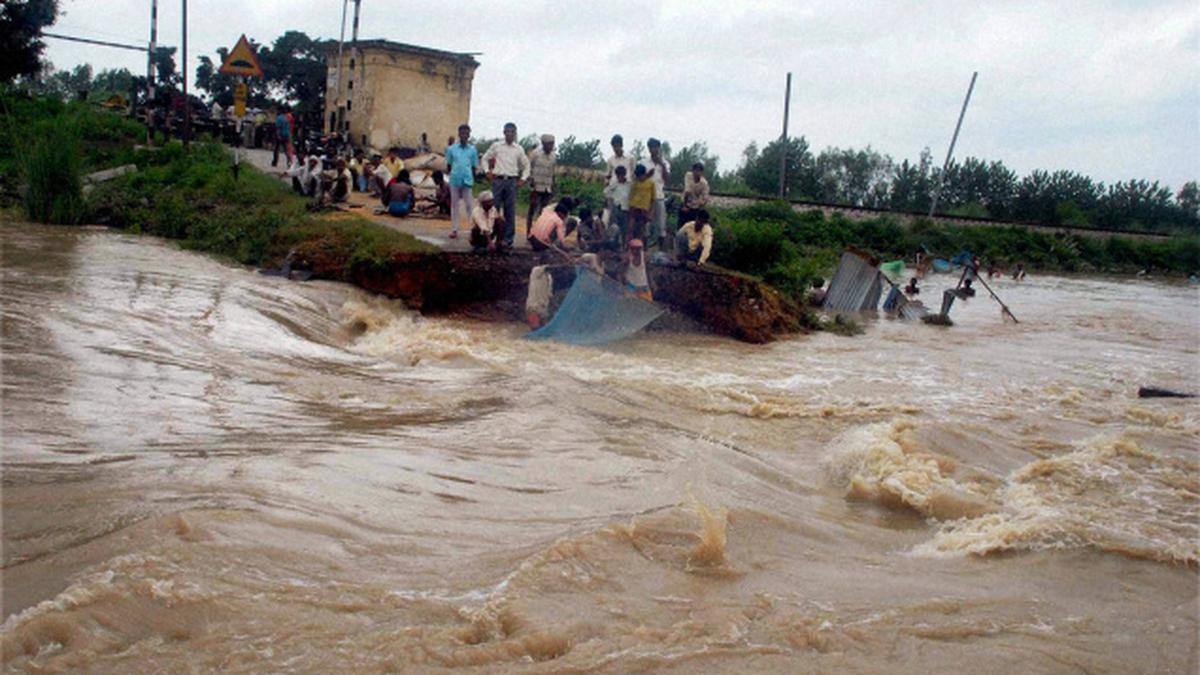
Hyperconcentrated flows can also change the course of the river in a process called avulsion, forcing thousands of people to move. When the Kosi river avulsed in 2008, it deposited around 2 metres of sediment in the surrounding land, inundated and destroyed crops, left the soil infertile, and created conditions conducive to the spread of disease.

Old threat, new risk

In early 2021, a large rock and ice avalanche triggered a disastrous flood in Chamoli district, leaving more than 200 people dead or missing. According to Prof. Sinha, the incident, like several others in Himachal Pradesh and Uttarakhand in 2023, is a reminder of how areas prone to landslides and heavy monsoons are especially vulnerable to hyperconcentrated flows.

The odds of an extreme monsoon event in the same regions are expected to increase due to climate change. According to a 2021 study in western Nepal, the chance could increase by as much as 60%. More extreme rains could also mean more landslides, which in turn could mean hyperconcentrated flows leading floods downstream in the plains.

‘Cascading hazards’

Prof. Sinha and his colleagues wrote in their paper that accounting for hyperconcentrated flows in “future disaster risk management strategies remains an important and major challenge”. This is because, he added, India’s disaster management strategy relies largely on a “compartmentalised” understanding of disasters, where how one disaster leads to the other is not taken into consideration.

“If we keep looking at these hazards in an isolated and compartmentalised way, we will never be able to understand the entire cascading effect of a disaster,” he said. Instead, we need an “integrated disaster management approach” where the relationship between instances of earthquakes, landslides, and floods – along with the individual incidents themselves – is used to frame risk-mitigation plans.

Sayantan Datta (they/them) are a queer-trans freelance science writer, communicator and journalist. They are currently a faculty member at Krea University and tweet at @queersprings.


Source link

Science Tags:extreme monsoon event, Holocene era, hyperconcentrated flows, IIT Kanpur, Kosi avulsion, Kosi river, Miocene era

Post navigation

Previous Post: Rupee gains 9 paise against dollar in early session
Next Post: SEBI asks MCX to put launch of new platform on hold

Related Posts

  • Sci-Five | The Hindu Science Quiz: On Dormancy
    Sci-Five | The Hindu Science Quiz: On Dormancy Science
  • Britain’s climate change plan challenged in landmark court case
    Britain’s climate change plan challenged in landmark court case Science
  • Lab-grown human ‘embryo’ created without eggs or sperm
    Lab-grown human ‘embryo’ created without eggs or sperm Science
  • ‘We look forward to work with ISRO and get the Indian astronaut into space’
    ‘We look forward to work with ISRO and get the Indian astronaut into space’ Science
  • Countdown begins for NISAR satellite launch on July 30, 2025
    Countdown begins for NISAR satellite launch on July 30, 2025 Science
  • ISRO will launch first dedicated SSLV commercial mission in 2026 
    ISRO will launch first dedicated SSLV commercial mission in 2026  Science

More Related Articles

Brazil’s Amazon fires off to record 2024 start as green union blames firefighting budget cut Brazil’s Amazon fires off to record 2024 start as green union blames firefighting budget cut Science
Estivation: The summer’s urge to nap Estivation: The summer’s urge to nap Science
How plastics affect our daily life How plastics affect our daily life Science
New chemical pathway found to worsen air quality in harsh winters New chemical pathway found to worsen air quality in harsh winters Science
Why are some people mosquito magnets? Why are some people mosquito magnets? Science
Nobel Prize in Physiology or Medicine 2024: What is the research that won the prize? | Explained  Science
SiteLock

Archives

  • May 2026
  • April 2026
  • March 2026
  • February 2026
  • January 2026
  • December 2025
  • November 2025
  • October 2025
  • September 2025
  • August 2025
  • July 2025
  • June 2025
  • May 2025
  • April 2025
  • March 2025
  • February 2025
  • January 2025
  • December 2024
  • November 2024
  • October 2024
  • September 2024
  • August 2024
  • July 2024
  • June 2024
  • May 2024
  • April 2024
  • March 2024
  • February 2024
  • January 2024
  • December 2023
  • November 2023
  • October 2023
  • September 2023
  • August 2023
  • July 2023
  • June 2023
  • May 2023
  • April 2023
  • March 2023
  • February 2023
  • January 2023
  • December 2022
  • November 2022
  • October 2022
  • September 2022
  • August 2022
  • July 2022
  • June 2022
  • May 2022

Categories

  • Business
  • Nation
  • Science
  • Sports
  • World

Recent Posts

  • Learn from Sri Lanka’s experience on impact of fertilizer supply chains: experts
  • Sewage pollution of Cooum, groundwater depletion raise alarm
  • Netanyahu’s office says he visited UAE secretly during the Iran war
  • Device with low-grade explosives found inside private hospital in Pune; ATS joins probe
  • Punjab Kings seeks turnaround against Mumbai Indians

Recent Comments

  1. RichardClage on UP Teacher Who Asked Students To Slap Muslim Classmate
  2. JeffryFok on UP Teacher Who Asked Students To Slap Muslim Classmate
  3. DerrickSef on UP Teacher Who Asked Students To Slap Muslim Classmate
  4. Leonardren on UP Teacher Who Asked Students To Slap Muslim Classmate
  5. NathanQuins on UP Teacher Who Asked Students To Slap Muslim Classmate
  • Very hopeful that Dhoni will be available for CSK next year: CEO Kasi Viswanathan
    Very hopeful that Dhoni will be available for CSK next year: CEO Kasi Viswanathan Sports
  • Eight Palestinians killed in Israeli air strike on Gaza school, health officials say
    Eight Palestinians killed in Israeli air strike on Gaza school, health officials say World
  • Ask Us: On investment – The Hindu
    Ask Us: On investment – The Hindu Business
  • Yemen’s Houthis Attack Liberia-flagged Vessel For Second Time In Gulf Of Aden
    Yemen’s Houthis Attack Liberia-flagged Vessel For Second Time In Gulf Of Aden World
  • Budget must address fundamental questions, why is private investment very sluggish: Congress
    Budget must address fundamental questions, why is private investment very sluggish: Congress Business
  • Helicopter crashes into hotel roof in Australian resort town, killing pilot
    Helicopter crashes into hotel roof in Australian resort town, killing pilot World
  • Morning Digest | 10 civilians dead, 22 army men still missing in Sikkim, rescue operations on; Media bodies write to CJI, call for norms on interrogation of journalists and more
    Morning Digest | 10 civilians dead, 22 army men still missing in Sikkim, rescue operations on; Media bodies write to CJI, call for norms on interrogation of journalists and more World
  • Ex-Supreme Court Judge And Former Colleague
    Ex-Supreme Court Judge And Former Colleague Nation

Editor-in-Chief:
Mohammad Ariff,
MSW, MAJMC, BSW, DTL, CTS, CNM, CCR, CAL, RSL, ASOC.
editor@artifex.news

Associate Editors:
1. Zenellis R. Tuba,
zenelis@artifex.news
2. Haris Daniyel
daniyel@artifex.news

Photograher:
Rohan Das
rohan@artifex.news

Artifex.News offers Online Paid Internships to college students from India and Abroad. Interns will get a PRESS CARD and other online offers.
Send your CV (Subjectline: Paid Internship) to internship@artifex.news

Links:
Associate Journalism
About Us
Privacy Policy

News Links:
Breaking News
World
Nation
Sports
Business
Entertainment
Lifestyle

Registered Office:
72/A, Elliot Road, Kolkata - 700016
Tel: 033-22277777, 033-22172217
Email: office@artifex.news

Editorial Office / News Desk:
No. 13, Mezzanine Floor, Esplanade Metro Rail Station,
12 J. L. Nehru Road, Kolkata - 700069.
(Entry from Gate No. 5)
Tel: 033-46011099, 033-46046046
Email: editor@artifex.news

Copyright © 2023 Artifex.News Newsportal designed by Artifex Infotech.