


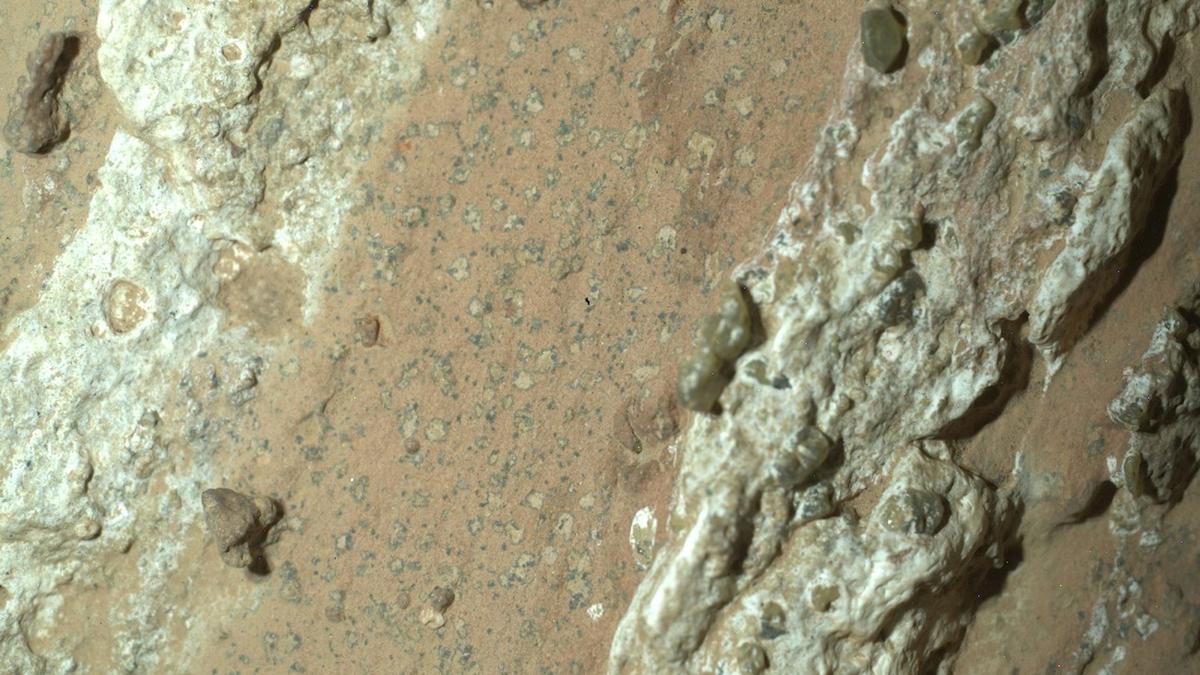
NASA has announced the first detection of possible biosignatures in a rock on the surface of Mars. The rock contains the first martian organic matter to be decisively detected by the Perseverance rover, as well as curious discoloured spots that could indicate the past activity of microorganisms.
Ken Farley, project scientist on the mission, has called this “the most puzzling, complex, and potentially important rock yet investigated by Perseverance”.
Perseverance is part of Mars 2020, the first mission since Viking that is explicitly designed to seek life on Mars (officially, to “search for potential evidence of past life using observations regarding habitability and preservation as a guide”). Arguably, that objective has now been achieved: potential evidence for past life has been found. But much more work is needed to test this interpretation of the data. Here’s what we do know.
Since landing in Jezero crater a few years ago, Perseverance has traversed a series of rocks formed nearly four billion years before present. Mars back then was far more habitable than the cold, dry, toxic red planet of today.
There were thousands of rivers and lakes, a thick atmosphere, and comfortable temperatures and chemical conditions for life. Many of the rocks in Jezero are sedimentary: mud, silt and sand dumped by a river flowing into a lake.
The new discovery concerns one of these rocks. Informally named “Cheyava Falls” (a waterfall in Arizona), it is a small reddish block of what looks like a mudstone, enriched with organic molecules. The rock is also laced with parallel white veins. Between the veins are millimetre-scale whitish spots with dark rims. For an astrobiologist, all these features are intriguing. Let’s take them one-by-one.
First, “organic molecules”, are made of carbon and hydrogen (commonly with sulphur, oxygen or nitrogen as well). Examples include the proteins, fats, sugars, and nucleic acids from which all life as we know it is constructed.
Organic matter is common in rocks on the earth, most of it derived from the remains of ancient organisms. But the term “organic” is slightly misleading: such molecules can also be produced by non-biological reactions (in fact, we know this was happening four billion years ago on Mars).
Simple non-biological organic molecules are common in the universe, and NASA’s Curiosity rover already found them in mudstones in Gale Crater. They were also reportedly detected by Perseverance in Jezero crater last year.
Nevertheless, Ken Farley considers the new observation the first truly “compelling detection” of organics made by Perseverance. NASA has not told us which types of organic molecules are actually present in Cheyava Falls, so it is hard to evaluate their origins. They could turn out to be biological, but a full analysis using laboratories on the earth would be needed to settle this question.
Next, the veins. These are composed of calcium sulphate, which precipitated like limescale when liquid water ran along fractures in the subsurface. Veins like these are common in Martian sedimentary rocks (Curiosity saw plenty of them), and of course they are not “biosignatures” even though they normally represent habitable conditions.
My own work has shown that microorganisms inhabiting subsurface fractures can produce chemical fossils that get trapped in calcium sulphate veins. Strangely, however, the veins in Cheyava Falls also contain olivine, an igneous mineral. This might suggest that the water was injected at temperatures too high for life. We need more data to know one way or the other.
Finally, what about those whitish, discoloured spots? These look like the “reduction spots”, also called “leopard spots”, commonly seen in red sedimentary rocks on the earth. Such rocks are rusty-red because they contain an oxidised form of iron. When chemical reactions modify the iron to a less oxidised state, it becomes soluble. Water carries the pigment away leaving a bleached spot behind.
On the earth, these reactions are often driven by subsurface-dwelling bacteria. They use the oxidised iron as a source of energy, just as you and I use oxygen in the air. On Mars, bacteria-like organisms could have used the organic matter in the rock to complete the reaction (just as we use glucose from the food we eat).
Reduction spots haven’t been seen before on Mars, although bleached linear “halos” observed by Curiosity in Gale crater are somewhat similar. As one of the few astrobiologists to have studied reduction spots on the earth – and found evidence for biological processes within them – I am personally delighted. But as ever, caution is needed.
Potential non-biological causes need to be explored and ruled out. Iron-dissolving reactions can and do happen in sedimentary rocks without life. The dark margins of the Cheyava Falls spots are enriched in both iron and phosphate, an association previously suggested to occur around some calcium sulphate veins on Mars. This observation is consistent with life, but also with chemical reactions driven by acidic fluids.
The new findings will nevertheless embolden those calling on NASA and the European Space Agency to proceed with the troubled multi-billion-dollar sample retrieval programme, which Perseverance was supposed to begin. The rover has now cored out a piece of the Cheyava Falls rock. If current plans are realised – a big if – then future spacecraft will collect this piece (and others) and bring it to the earth.
It will then be analysed in state-of-the-art laboratories far more capable than the instruments aboard Perseverance. Until that happens, we cannot be sure whether Perseverance has really found fossils of ancient life on Mars. The evidence so far is not definitive, but it is certainly tantalising.
Sean McMahon is reader in astrobiology, University of Edinburgh. This article is republished from The Conversation.