






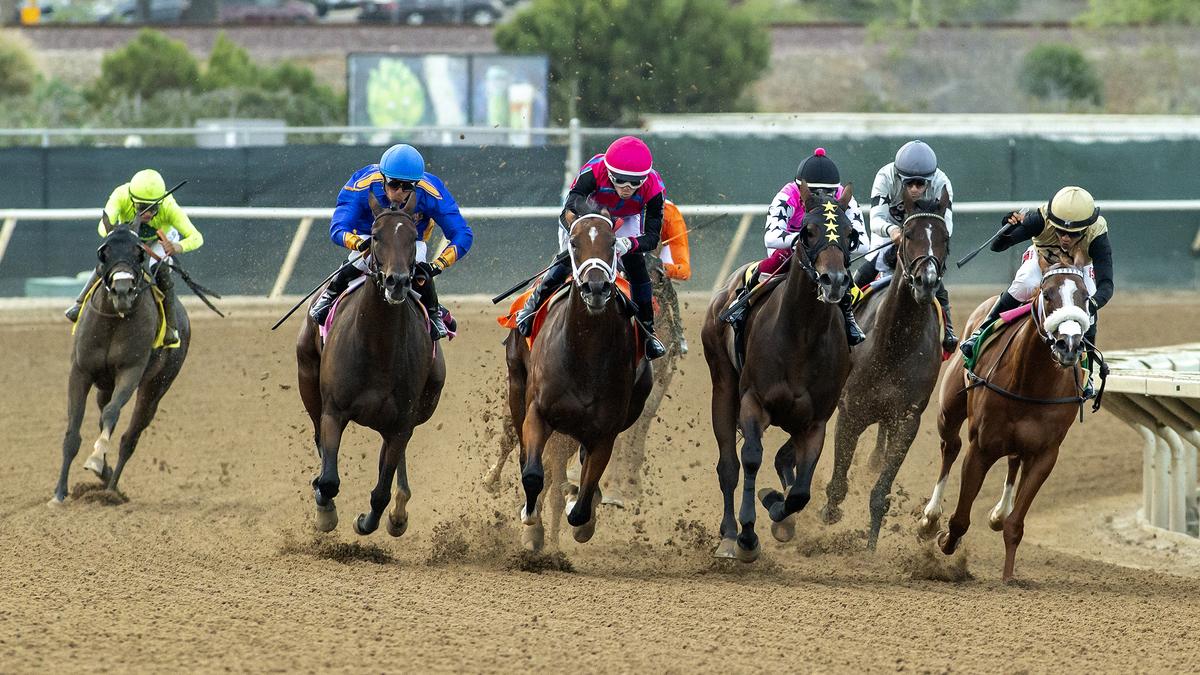
Humans have entertained themselves with horse racing for hundreds of years. Even so, who would have guessed that some day the sport might help us understand how our blood pressure is regulated during exercise?
On June 17, researchers from the Swedish University of Agricultural Sciences in Uppsala reported discovering a DNA sequence in horses that underlies superior racing performance. The sequence influenced levels of two proteins involved in regulating blood pressure. Their results were published in the journal PLoS Genetics.
“By shedding light on the intricate mechanisms governing blood pressure modulation, the findings hold promise for advancing our understanding of cardiovascular health and disease,” the researchers wrote in their paper. They added that the implications also encompass “a myriad … physiological processes influenced by hormone signalling”.
Six years ago, the researchers had reported that horses with the genomic region ran faster. But at the time they couldn’t link the region to any underlying physiological trait. This has changed now.
Cold- and hot-blooded equines
The North Swedish draught horse is a sturdy breed people in the Nordic region use for farm and forestry work. It is ‘cold-blooded’, in this context meaning a large, heavy horse with an easy-going temperament. Faster, lighter, more energetic, and temperamentally more skittish horses are said to be ‘hot-blooded’. (The actual body temperature of all horses is 37.5-38.5 degrees C.)
By the early 1800s, people began to use the North Swedish horse in harness races, where the horse pulls a two-wheeled cart with a seat for the jockey. At first they used the farm horses, but inevitably, to gain a leg up, breeders began illegally crossbreeding the North Swedish horse with a hot-blooded American harness-racing breed called the standardbred.
Faced with this fait accompli, racing authorities divided the North Swedish into two new breeds: the North Swedish draught horse for farm work and the cold-blooded trotter for racing. Cold-blooded trotters share much of their genome with the North Swedish draught horse, but they also contain segments from the standardbred that enhance their racing ability.
The promoter and the enhancer
The horse genome has 32 chromosomes. Each chromosome is defined by a DNA molecule that runs throughout its length. Chromosomal proteins and RNA organise the DNA and regulate its expression.
Different cell types have different chromosomal proteins and RNA, but their DNA content remains constant. Each horse cell, like each human cell, contains two sets of the genome distributed in 64 chromosomes. One set is inherited from the father’s sperm and the other set from the mother’s egg.
The DNA molecule is like a ladder whose rails are made of a long series of alternating units of phosphate and deoxyribose (a sugar). Each deoxyribose unit is bonded to one of four chemical bases: adenosine (A), cytosine (C), guanine (G), and thymine (T). The As and Cs on one sugar-phosphate rail form hydrogen bonds with the Ts and Gs on the other, making up the DNA ladder’s rungs. The A-T and G-C base-pairs hold the two strands together as one large molecule.
In this way, each set of 32 chromosomes contains a little less than 3 billion base-pairs and code for just over 20,000 genes. Different horse breeds share much the same DNA sequence — just that about one in every few hundred base-pairs is different, giving rise to the breed’s variations.

A gene is a stretch of a few thousand base-pairs. A cell ‘reads’ this sequence as an instruction to make a specific protein. Next to the protein-coding sequence is another sequence called the promoter. The promoter allows the cell to express the relevant gene. Other sequences called enhancers, located tens to thousands of base-pairs away from the gene, influence the activity of nearby promoters.
These promoter-enhancer interactions influence gene expression in different types of cells.
The prize-money enhancer
The Swedish Trotting Association has recorded data about the racing performance of all competing horses, including the prize money earnt per race. The researchers collected DNA from blood and hair samples of 400 cold-blooded trotters that ran races between 2003 and 2015. In these DNA, they identified genes that both the cold-blooded trotters and the standardbreds shared but which trotters and draught horses didn’t.
Next, by examining the racing performance data, they found that trotters that had a sequence derived from standardbred horses on one or both copies of one chromosome performed much better in races and won more money.
This gene, associated with superior racing performance, had 5,564 base-pairs. It was different from the ‘non-enhanced’ version by virtue of possessing different base-pair combinations in 14 positions on the DNA ladder.
When two DNA sequences are mostly identical and only a few base-pairs differ, the alternative versions are called haplotypes. Haplotypes are defined by listing the bases differing on one DNA strand. The ‘élite’ and the ‘sub-élite’ haplotypes were respectively called EPH and SPH.
Effects on blood pressure genes
Trotters with the EPH haplotype had significantly lower blood pressure during and after exercise than trotters with the SPH haplotype. There was no difference before exercise, which suggested to the researchers that the EPH’s blood pressure regulation was related to exercise.
They also found the EPH haplotype decreased the levels of endothelin1 (EDN1) and increased the levels of endothelin3 (EDN3) — two proteins involved in regulating blood pressure — in the blood.
The EPH/SPH gene was located around 50,000 base-pairs away from the gene that made the EDN3 protein, so the researchers surmised the haplotype served as an enhancer.
That is, if the EPH and the SPH haplotypes enhanced the expression of the EDN3 expression in different ways, they could result in different blood pressure regulation pathways, leading to the differences in racing performance.
Taking the rough with the smooth
The researchers found the EPH/SPH haplotype gene was located in chromosome 22 in horse cells and in chromosome 20 in human cells. They conducted an experiment using human heart tissue to identify the promoters that interacted with the corresponding human sequence.

They found all the promoters that interacted with this sequence belonged to known blood pressure genes. Some of the proteins encoded by these genes also interacted with the EDN3 gene. Thus, the researchers were able to confirm the human counterpart of the horses’ ‘racing’ gene had a role in regulating blood pressure.
“These results are key to understanding the biological mechanisms behind blood pressure regulation in both human and horse elite athletic performance,” the researchers wrote in their paper.
Had the Nordic breeders been more scrupulous, they may not have allowed the EPH haplotype to be smuggled into the cold-blooded trotter’s genome. Had the race stewards been less scrupulous, corrupt practices such as doping or throwing the race might have made it harder to detect the superior performance because of EPH in the racing data. In this instance, the combination of human foibles and rectitude was just right.
D.P. Kasbekar is a retired scientist.