






Scientists at the world’s largest physics experiment have reported the most precise measurement yet of the most massive subatomic particle we know. The finding sounds esoteric but it wouldn’t be an understatement to say it has implications for the whole universe.
The Greek philosopher Empedocles surmised 2,400 years ago that matter could be broken up into smaller and smaller pieces until we’re left with air, earth, fire, and water. Since the early 20th century, physicists have broken up matter into smaller and smaller pieces to find many different subatomic particles instead — as many as to fill a zoo.
The top quark
Rather than a ‘smaller’ particle, contemporary particle physicists are concerned with elusive particles.
More energetic particles often break down into ones with less energy. The greater the difference in energy between that of a particle and the products of its decay, the less time the particle exists in its original form and more quickly it breaks down. By the mass-energy equivalence, a more massive particle is also a more energetic particle. And the most massive particle scientists have found to date is the top quark.
It is 10-times heavier than a water molecule, about three-times as much as a copper atom, and 95% as much as a full caffeine molecule.
As a result, the top quark is so unstable that it could break up into lighter, more stable particles in less than 10−25 seconds.
The top quark’s mass is very important in physics. A particle’s mass is equal to the sum of masses contributed from multiple sources. An important source for all elementary particles is the Higgs field, which pervades the entire universe. A ‘field’ is like a sea of energy and excitations in the field are called particles. This way, for example, an excitation of the Higgs field is called the Higgs boson just as an electron can be considered to be an excitation of an ‘electron field’.
All these fields engage with each other in specific ways. When the ‘electron field’ interacts with the Higgs field at energies much less than 100 GeV, for example, the electron particle will acquire some mass. The same thing goes for other elementary particles. (GeV, or giga-electron-volt, is a unit of energy used in the context of subatomic particles: 1 joule = 6.24 billion GeV.) Elucidating this mechanism won François Englert and Peter Higgs the 2013 physics Nobel Prize.
If the top quark is the most massive subatomic particle, it is because Higgs bosons interact most strongly with it. By measuring the top quark’s mass as precisely as possible, then, physicists can learn a lot about the Higgs boson as well.

“Physicists are intrigued by the top quark mass as there is something peculiar about it,” Nirmal Raj, particle theorist and assistant professor at the Indian Institute of Science, Bengaluru, told The Hindu. “On the one hand, it is the one closest to the Higgs boson’s mass, which is what one would ‘naturally’ expect before measuring it. On the other, all other [particles like it] are much, much lighter, making one wonder if the top quark is actually an oddball, not a ‘natural’ species.”
The universe as we know it
But the rabbit hole goes deeper.
Physicists are keen to study the Higgs boson also because of its own mass, which it acquires by interacting with other Higgs bosons. Importantly, the Higgs boson is more massive than expected — which is to say the Higgs field is more energy-laden than expected. And because it pervades the universe, the universe can be said to be more energetic than expected. This ‘expectation’ comes from calculations physicists have performed and they don’t have reason to believe they are wrong. Why does the Higgs field have so much energy?
Physicists also have a theory as to how the Higgs field originally formed (at the birth of the universe). If they are right, there is a small yet non-zero chance that one day in future, the field could go through a sort of self-adjustment that reduces its energy and modifies the universe in drastic ways.
They know the field has some potential energy today and there is a way it could shed some of it to have less and become more stable. There are two ways to get to this stable state. One is for the field to gain some energy first before losing it and more, like climbing one side of a mountain to get into a deeper valley on the other side. The other is if an event called quantum tunnelling happens, whereby the field’s potential energy would ‘tunnel’ through the mountain instead of having to climb over it and drop into the valley yonder.
This is why Stephen Hawking said in 2016 the Higgs boson could spell the “end of the universe” as we know it. Even if the Higgs field is slightly stronger than it is now, the atoms of most chemical elements will be destroyed, taking stars, galaxies, and earthlife with them. But while Hawking was technically correct, other physicists quickly said the frequency of the tunnelling event was 1 in 10100 years.
The Higgs boson’s mass — 126 GeV/c2 (a unit used for subatomic particles) — is also just about enough to keep the universe in its current state; anything else and the “end” would happen. Such a finely tuned value is obviously curious and physicists would like to know which natural processes contribute to it. The top quark is part of this picture by virtue of being the most massive particle, in a sense the Higgs boson’s closest friend.
“Measuring the top quark mass precisely has implications for whether our universe will tunnel out of existence,” Dr. Raj said.

Finding the top quark
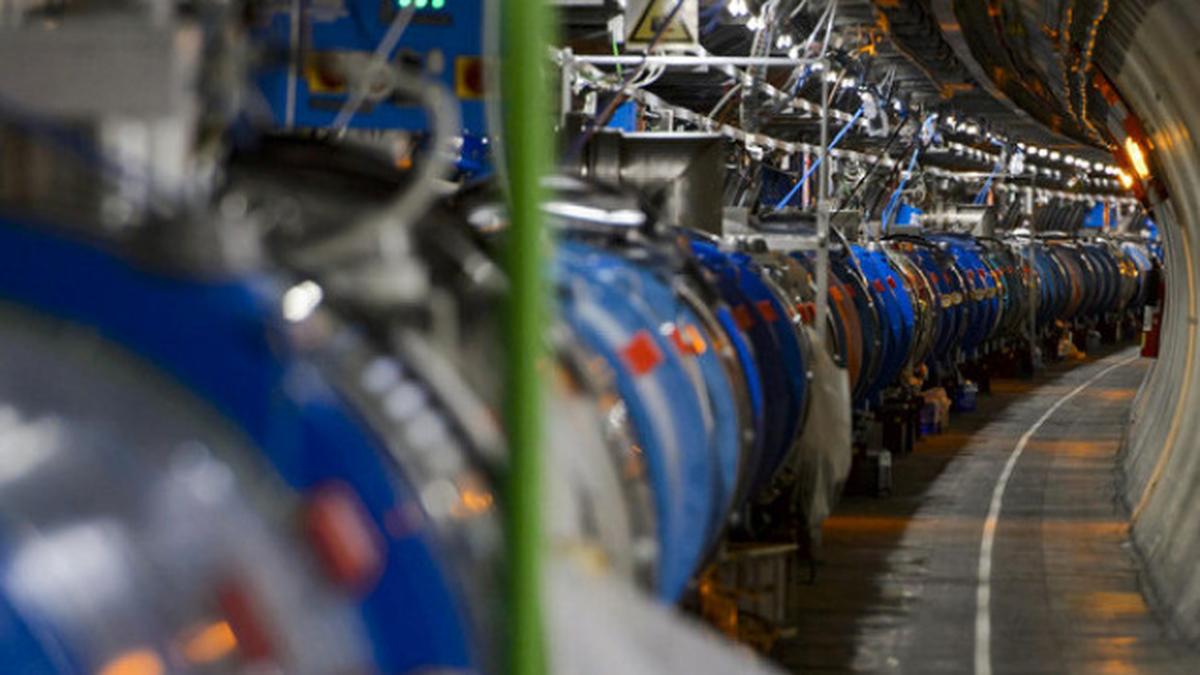
Physicists discovered the top quark in 1995 at a particle accelerator in the US called the Tevatron, measuring its mass to be 151-197 GeV/c2. The Tevatron was shut down in 2011; physicists continued to analyse data it had collected and updated the value three years later to 174.98 GeV/c2. Other experiments and research groups yielded more precise values over time. On June 27, physicists at the Large Hadron Collider (LHC) in Europe reported the most precise figure yet: 172.52 GeV/c2.
Measuring a top quark’s mass is difficult when its lifetime is around 10-25 seconds. Typically, a particle-smasher will produce an ultra-hot soup of particles. If a top quark is present in this soup, it will quickly decay into specific groups of lighter particles. Detectors look out for these events, and when they happen track and record their properties. Finally, computers collect this data and physicists analyse them to reconstruct the physical properties of the top quark.
Scientists learn what to expect at each point of this process based on sophisticated mathematical models and must contend with many uncertainties. Many of the devices used in these machines also incorporate state of the art technologies; when engineers improve them further, the physicists results also improve that much.
Now researchers will incorporate the top quark’s mass measurement into calculations that inform our understanding of our universe’s particles. Some of them will use it to also quest for an even more precise value. According to Dr. Raj, precisely measuring the top quark’s mass is also key to knowing whether some other particle with mass close to that of the top quark could be hiding in the data.