


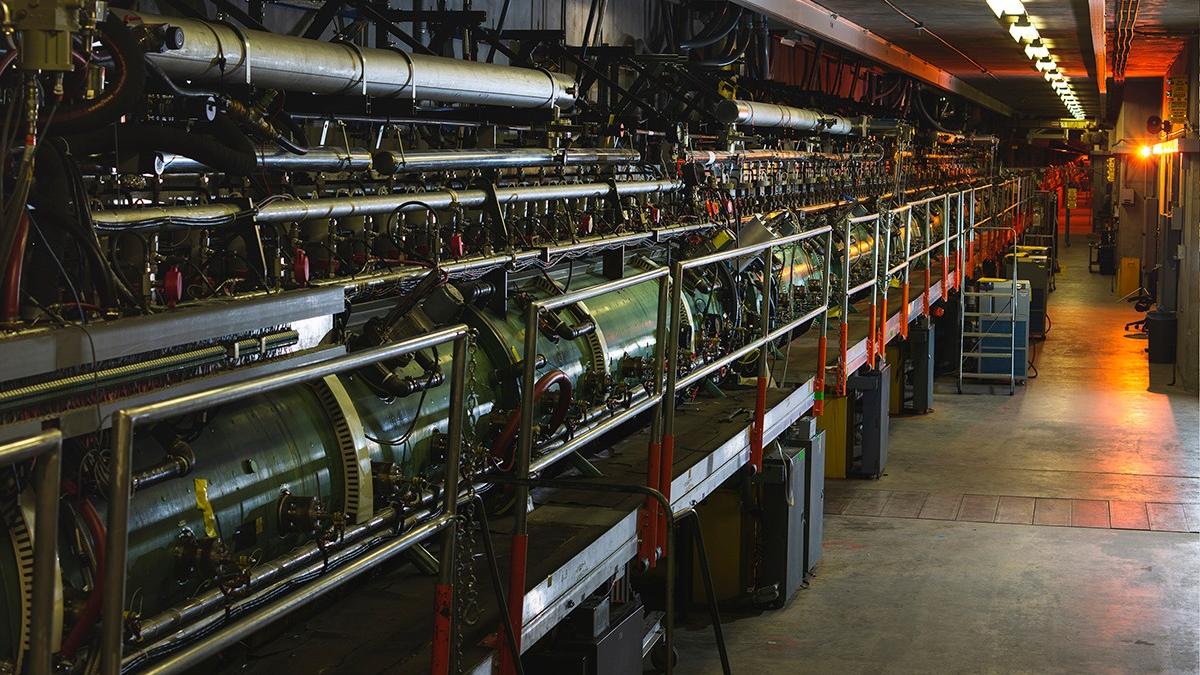
On March 4 this year, India stepped on the threshold of the second stage of its nuclear power programme when engineers started the core-loading process of the prototype fast breeder reactor (PFBR) at the Madras Atomic Power Station, Kalpakkam. While the first stage used uranium isotopes as nuclear fuel in pressurised heavy-water reactors to produce plutonium-239 (Pu-239) and energy, the second stage is more concerned with plutonium fission.
When a Pu-239 nucleus captures a neutron, it has a 27-38% chance of becoming Pu-240 instead of undergoing fission. It is thus present in many nuclear reactors and in the fallout of nuclear weapon tests. When Pu-240 captures a neutron, it most often turns into Pu-241. On the off chance it does undergo fission, however, there is a significant amount of uncertainty about the energy carried away by its fission products. Researchers currently use models that incorporate several complicated calculations based on theory to estimate the output.
Only the second time
A part of the fission energy carried away by neutrons is called the prompt fission neutron spectrum (PFNS). The ‘prompt’ stands for neutrons a Pu-240 nucleus might emit right after it has captured a neutron with enough energy to destabilise it, but before the nucleus has reached a stable (or equilibrium) state.
So far there has only been one study that attempted to study the PFNS of induced fission in Pu-240, where neutrons that bombarded the Pu-240 nuclei had an energy of 0.85 mega-electron-volt (MeV). Recently, researchers in the U.S. reported only the second attempt ever to measure the PFNS of induced fission in Pu-240, and the first to use neutrons of energy greater than 0.85 MeV.
Their findings, reported in the journal Physical Review C on June 13, note significant differences between the predicted and the measured PFNS after induced fission. This information will be useful for researchers in various fields, from reactor designers to practitioners of nuclear medicine.
“The PFBR uses plutonium recovered from CANDU spent fuel and so will contain ample quantities of Pu-240. And if the spent fuel arising from the PFBR is reprocessed, that too will contain Pu-240,” M.V. Ramana, a professor at the University of British Columbia, told The Hindu. “Therefore any new information about how Pu-240 behaves will be relevant.”
CANDU is a Canadian design for pressurised heavy-water reactors, such as those India uses for its first stage.

A profile of Pu-240
Pu-239 is produced when U-238 is exposed to neutrons of certain energy in a reactor. Because Pu-239 captures neutrons to become Pu-240 at a fixed rate, Pu-239 left in the reactor for a certain duration will accumulate a predictable quantity of Pu-240. The two isotopes are hard to separate, so as Pu-240 builds up, the spent fuel is pulled out.
Pu-240 undergoes spontaneous fission, i.e. without ‘external’ neutrons striking it first, and emits alpha particles. For these reasons, the isotope is considered a contaminant of weapons-grade plutonium, where its composition by weight is restricted to under 7%. There are some ways to use higher quantities of Pu-240 to build a nuclear weapon, however.
Generally, if a mass of plutonium contains more than 19% of Pu-240, it is considered to be reactor-grade rather than weapons-grade.
The test setup
The new findings are based on a test conducted by researchers at the Los Alamos Neutron Science Centre (LANSCE) in the U.S. They struck a tungsten disc with pulses of protons, which produced neutrons of energy 0.01-800 MeV. Those neutrons moving 15 degrees to the left of the proton beam were redirected to a chamber containing 99.875% pure Pu-240.
An array of liquid scintillators — substances that emit flashes of light when struck by energetic particles — arranged around the Pu-240 sample tracked its output. The Pu-240 weighed all of 20 milligrams; the researchers wrote in their paper that they used such a small sample to minimise the amount of alpha particles emitted.
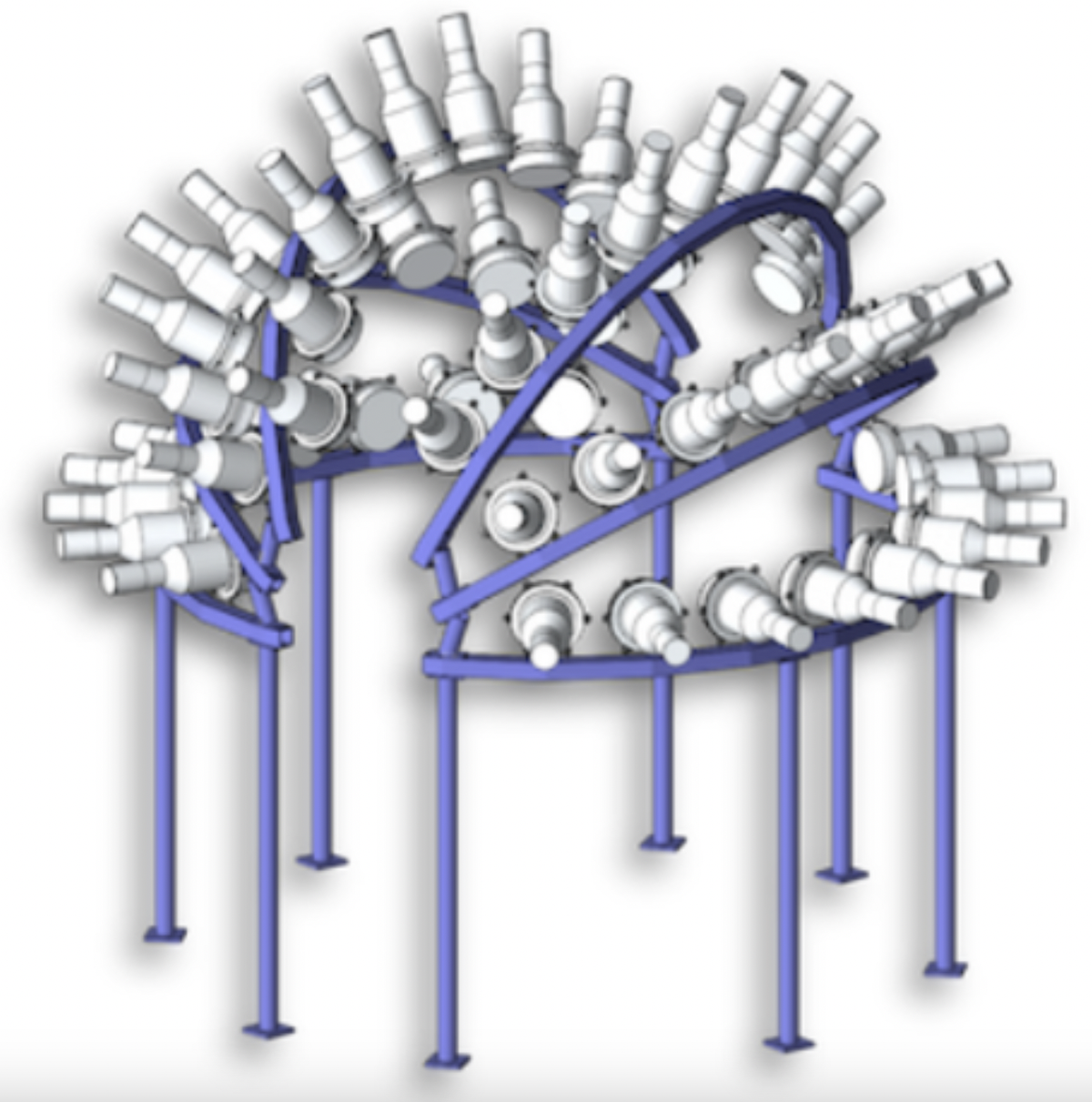
A computer-generated rendering of the liquid scintillator detector system at LANSCE. The Pu-240 sample is located at the centre and neutrons intended to bombard the sample enter from the bottom left side.
| Photo Credit:
U.S. Department of Energy
With this setup, the researchers measured the energies of the neutrons emitted by the sample as well as of other fission products.
Because they were interested in particles of a specific origin (neutron-induced fission), extracting the corresponding PFNS data from the overall data required the researchers to carefully subtract contributions from spontaneous fission, alpha particles, and other sources. After doing so, they reported their analysis for incident neutrons of energies 1-20 MeV.

Updating nuclear data libraries
In addition to deviations between PFNS predicted by models and those observed in the test, the researchers also reported a higher-than-expected rate of second-chance fission of Pu-240: when a nucleus isn’t fissionable but becomes so after losing a neutron. They also reported finding signs of “a smaller contribution from third-chance fission” but added that this “was difficult to observe in the data directly”.
Models that predict the outputs of nuclear reactions are based on data libraries pieced together from various experiments, reactor operation records, simulations, and other sources. For example, applications of the ENDF library prepared by the U.S. National Nuclear Data Centre include research on nuclear reactors, radiation shielding design, calculating radiation dose in nuclear medicine, investigating the trafficking of nuclear materials, and to understand the origins of elements in the universe. Other such libraries are JEFF-3.3, prepared by the OECD’s Nuclear Energy Agency, and JENDL-5.0, by the Japan Atomic Energy Agency.
The PFNS paper concluded that only the JENDL-5.0 library included “both multi-chance fission and pre-equilibrium neutron emission processes” and that the ENDF/B-VIII.0 and JEFF-3.3 libraries “contain multi-chance fission but not pre-equilibrium”. “However,” it continued, “there are also clear differences observed in the [energy levels] relating to the magnitude of second-chance fission in the data, as well as a possible energy shift in the thresholds relating to the pre-equilibrium neutron emission process preceding fission.”