



Almost all animals that fly through the air and many that swim through water have evolved to flap their wings (or fins) at a frequency given by a simple formula, three scientists at Roskilde University in Denmark have found.
The formula relates the flapping frequency at which a winged entity bats its wings to hover in the air (or stay submerged in the water) to the entity’s mass and the size of the wings.
The researchers also found the formula holds for a large variety of life-forms, including insects, birds, bats, penguins, whales, and one robotic bird called an ornithopter — the dragonfly-like aeroplanes in the new Dune films.
What is the formula?
The formula is straightforward: f ∝ √m/A. f here is the flapping frequency, m the mass of the airborne animal, and A the area of the wings (∝ stands for ‘is proportional to’).
When the researchers calculated √m/A number of various animals, birds, and insects and plotted it on the x-axis and their respective frequencies on the y-axis, they found a nearly straight line (see below). The black line is the relationship their model based on the formula predicted — an almost perfect fit.
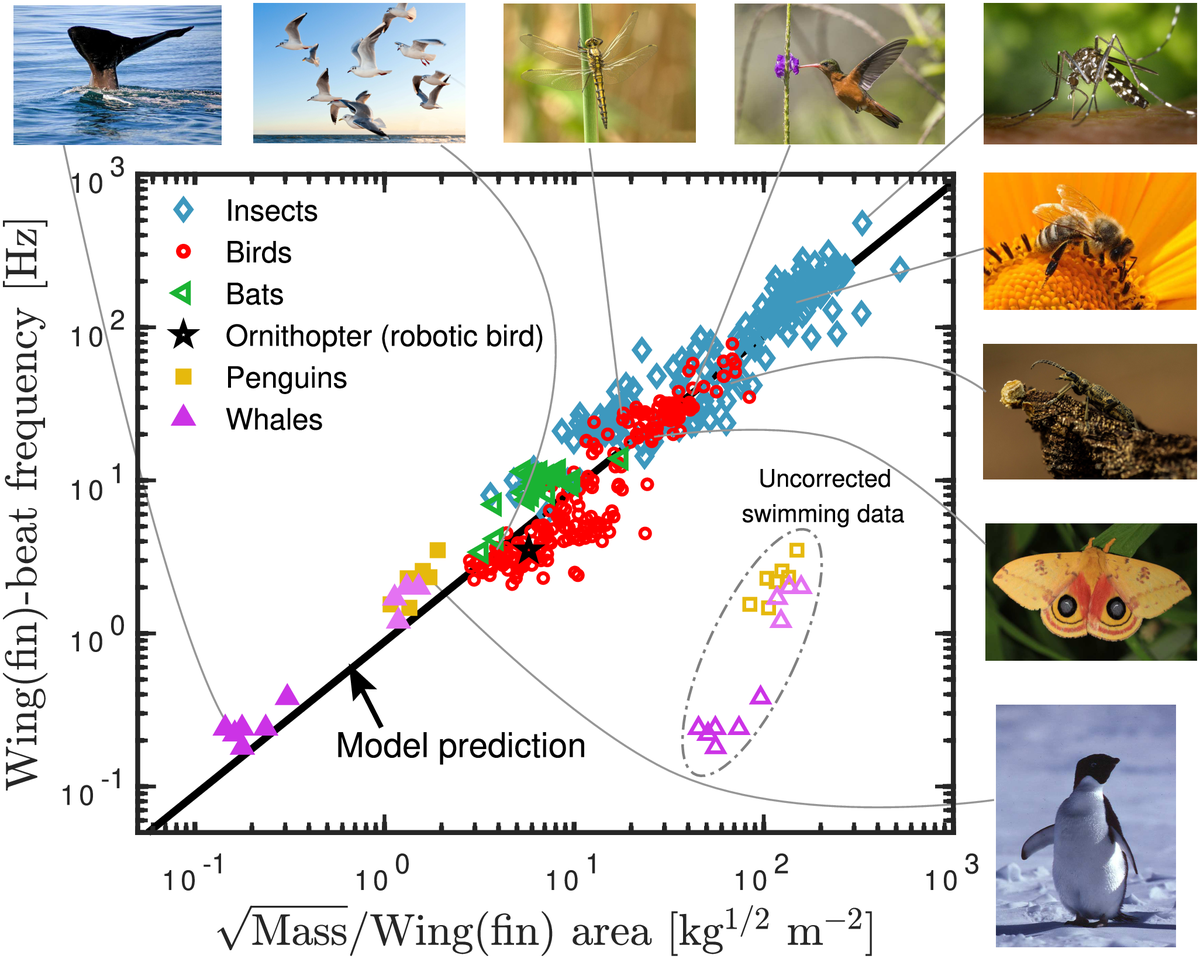
A plot showing the scaling relationship between f and √m/A.
| Photo Credit:
PLoS ONE 19(6): e0303834.
The Roskilde team’s results were published in the journal PLoS One on June 5.
How did they find the formula?
People have attempted before to find some kind of unifying thread through the wing-beating frequencies of animals, birds, and insects that fly. In most of these efforts, scientists arrived at correlations between flapping frequency and mass and between wing area and mass based on measuring these numbers in the wild. The results were relationships like f ∝ m-0.43, which scientists haven’t been able to arrive it using only what they know about physics, without using empirical data.
In its paper, the Roskilde team wrote that its members wanted to attempt the former: derive a theoretical equation and then check if it fit what they find in the wild. As they put it: “can one arrive at a reliable prediction for the wing-beat frequency of a flying animal from physics-based arguments alone, i.e. without appealing to empirical correlations?”
They started at the equation of Newton’s second law for an animal trying to stay airborne by flapping its wings: F = ma. The a here is really g, the downward acceleration due to gravity, and m is the animal’s mass. F is the force the animal has to generate by flapping its wings. From here they worked forward to account for the momentum of the air each wing stroke pushes down, the velocity of air flow around the wings, and the density of the atmosphere.
As they did, they encountered a variety of quantities — especially the shapes of the wings and the angles at which they flap — that didn’t have units, i.e. they were dimensionless. They bundled the numbers representing these entities into a single constant called C; its precise value depends on empirical observations. Thus, they had their equation:
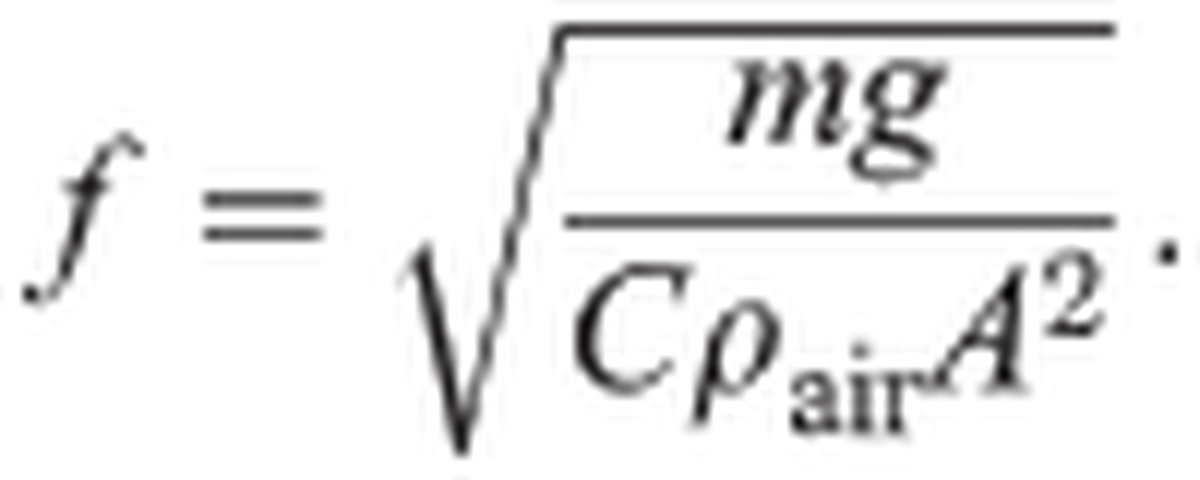
f here is the wingbeat frequency, m the mass of the animal, ⍴air the atmosphere’s density, and A the size of the wing. Et voila.
What does C hold?
Matt Wilkinson, director of studies in natural sciences at the University of Cambridge, flagged that the equation’s proportionality constant, C, could yield more insights, too.
He told Physics World a bird’s flight is most efficient when the wings beat at a bird’s specific resonant frequency, but if the bird is heavier beyond a point, this frequency won’t suffice to hold up its mass, so its flight will be necessarily less than efficient.
Given the equation’s variable components, he added, the size dependence should be hidden away in the constant C. “Unpicking that, despite the enormous differences in wing shape and flight kinematics, is where the real insights will be found,” he told the magazine.
Does the formula apply to fish?
Mathematics is a language to describe the natural universe and the equation depicts what seems to be a universal law telling us why flying birds and insects fly the way they do, what a bird or insect that evolves in the future could look like, and what winged robots need to look like if they expect to become airborne.
The proportionality relationship arises when these adjustables are taken away, leaving f ∝ √m/A.
“Interestingly,” the researchers wrote in their paper, their equation “also gives a recipe for the fin/fluke frequency of swimming animals as positively buoyant diving animals must continuously move water upwards in order to stay submerged. This, of course, holds only for animals with no means of adjusting buoyancy, which excludes fish with a swim bladder. Calculating fin/fluke frequency from [the equation] requires two modifications, replacing the density of air by the density of water and animal mass by the buoyancy-corrected mass.”

Where does the formula apply?
The researchers tested their equation with data about birds, insects, etc. presented in older published studies, where they found “176 different insect data points (including bees, moths, dragonflies, beetles, and mosquitoes), 212 different bird data points (ranging from hummingbirds to swans), and 25 bat data points”.
The equation has a regime in which its left-hand side equals its right-hand side, which presumes certain physical conditions. For example, you’ll remember reading about the Reynolds number (Re) in high school: at a low value of Re, the flow of a fluid will be streamlined; if the value is high, the flow is said to have become turbulent. The value of Re depends on the fluid’s density, speed, viscosity, and a length scale. At high Re, the fluid’s density matters more than its viscosity for an animal trying to ‘fly’ through it — and this is the case for the insects, birds, bats, etc. whose flapping frequencies the equation captures.
The authors wrote in their paper that it will need to be modified at low or very low Re, where the fluid viscosity matters more than density. For example, they were able to work out that “for flying animals at very small Reynolds numbers, f ∝ m/A replaces the above.”
They were also able to determine that as long as the density of animals didn’t vary by an order of magnitude (i.e. a factor of 10) or more, the equation couldn’t be simplified further.