







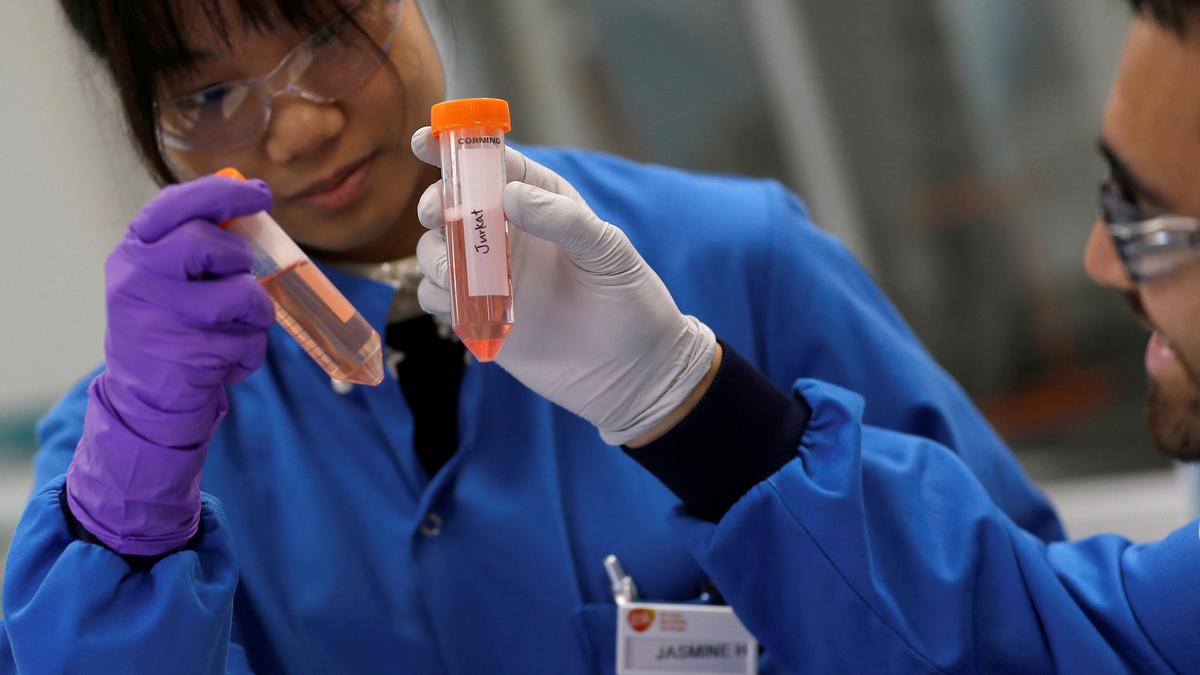
Scientists with test tubes containing stem cells at the GlaxoSmithKline research centre in Stevenage, Britain.
Looking back 10 years to before my father passed away after his diagnosis of brain cancer, what I remember the most is the intricate web of challenges we confronted during his illness. The World Health Organization (WHO) reports that approximately 33,000 new incidences of brain cancer happen each year in India alone, while Global Cancer Observatory 2020 estimates brain cancer as the 19th most common type of cancer. Behind these alarming numbers, lie many stories of pain and unrest. Every family deals with the pain and uncertainty of taking care of loved ones, who may never get better.
Move forward by 10 years. Inadvertently drawn to cancer research by the profound personal experience, I now find myself associated with it – and what I have learned fills me with hope. There have been amazing breakthroughs made in oncology research worldwide, the kind that will mitigate some of the challenges I experienced first hand. Based on my experience in working in this field, I will try to explain how this critical field has evolved over the last decade. The current standard of care for diagnosing cancer often requires invasive and risky procedures such as surgeries to extract tissue samples for analysis. Believe it or not, the risks for patients from these procedures range from short-term paralysis to death. Can we make it easier for the patients and their families, at least as far as diagnosis goes? The answer is a resounding yes. And, the answer lies in our genes.
We have all read about genes, DNA, and RNA as part of our basic high-school science. Technically, they are the fundamental building blocks of life, shaping our traits and our health. In the context of this discussion, science today links people’s genes to their susceptibility to diseases like cancer. Let me give you a simple example. Imagine that you have a recipe for a sweet dish written down, and you want to make a bowl of it. However, when you’re writing out the recipe, you accidentally change one of the ingredients. Instead of listing “sugar,” you write “salt”. This small change alters the taste and texture of the dish, making it turn out very differently than you intended. Similarly, in our bodies, our DNA is like the recipe for making and maintaining us. If there’s a mistake in the DNA code, called a mutation, it can change how our cells behave. Just like the wrong ingredient can change how our recipe turns out, a DNA mutation can change how our cells grow and function, sometimes leading to cancer.

Therefore, what we must primarily understand is what are the mutations in the genes causing cancer. Research suggests that there are close to 3,000 such cancer-causing genes. With each gene containing thousands of DNA codes, and each code potentially holding vital information about cancer development, the sheer volume of data analysis for a human can become quite overwhelming. And seemingly impossible.
But, enter Next-Generation Sequencing (NGS). Cutting-edge technology that is potentially transforming our ability to decipher the genetic code with speed and precision. To provide context, the Human Genome Project officially began in 1990 and was completed in 2003, taking about 13 years to finish, at a cost of about $3 billion. Today’s technology lets us accomplish the same process in possibly less than a week, and costs a little under $1,000!
Getting back to cancer diagnostics, thanks to advancements in NGS, we have the concept of a liquid biopsy, a revolutionary technique that offers a less invasive alternative to surgery. To explain the concept, think of a detective investigating a case. To piece together the crime scene, the detective collects different types of evidence: fingerprints on a doorknob, footprints, and fibre left behind on the carpet. Similarly, in a liquid biopsy, clinicians act as detectives. Instead of invasive procedures like surgery, they collect a small sample of patient’s blood, which is like the evidence at a crime scene. Within this blood sample, they look for genetic patterns that indicate the presence of cancer cells. These genetic biomarkers are like the fingerprints and footprints found at a crime scene, providing crucial clues about the patient’s health. It provides answers to questions: Is there a malignancy? And if so, what precisely is the type of malignancy?

Of course, this process is easier said than done. Producing such real-time results with precision requires the support of rigorous data analysis. The genetic data from several tumour and blood samples needs to be assimilated by artificial intelligence systems based on machine learning algorithms, combined with big data analytics platforms. No wonder chip makers and sequencing technology firms are making significant investments to expand their presence in the NGS domain. These technology tools enable researchers not only to process large amounts of information faster, but also to detect patterns that previously would have gone unnoticed by the human eye or mind alone.
As we navigate the ever-evolving landscape of oncology, it is clear that the future holds immense promise. By combining the power of data at our disposal, with innovative technologies like NGS, we may well be inching closer to unravelling the complexities of this disease. A popular saying suggests that data has become the new oil. As we stand at the forefront of a new era in cancer research, perhaps solving for its cure is also a data problem.
(The author is part of Hyderabad-based Exsegen Genomics, a company focused on pioneering a liquid biopsy diagnostic specifically tailored for brain cancers. vikaspawar@hotmail.com)