








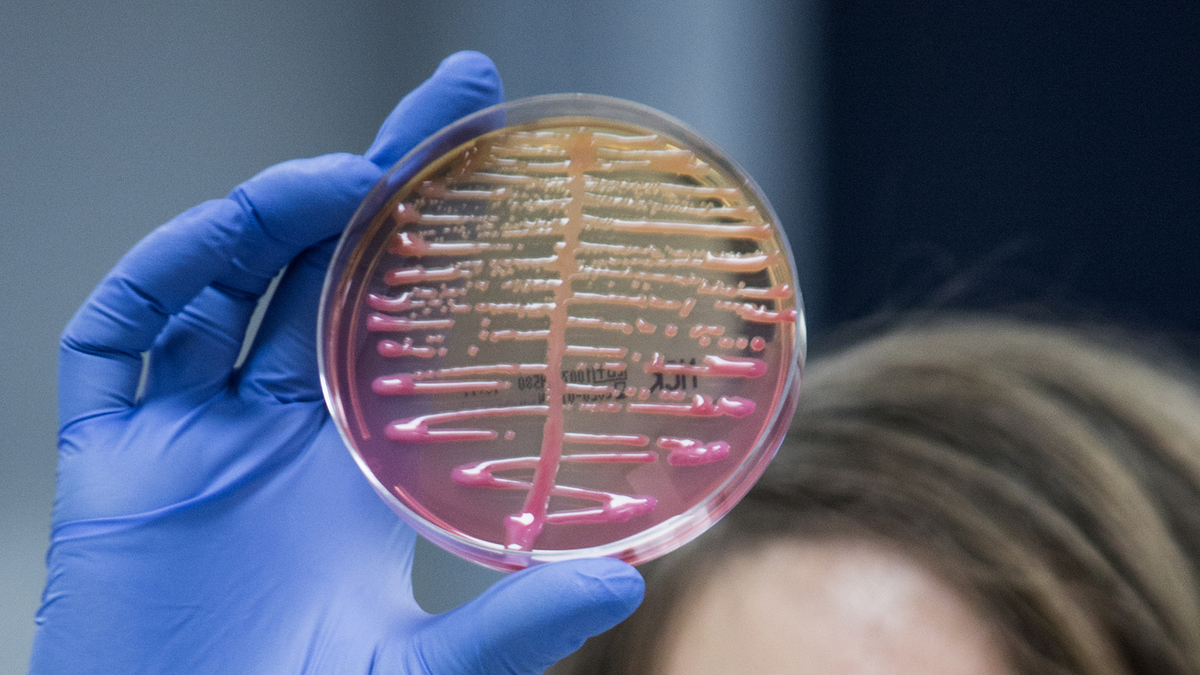
A researcher holds up a plate showing a growth of Klebsiella pneumoniae bacteria from a positive blood culture, December 14, 2019.
| Photo Credit: Chiara Marraccini
Amid the unprecedented challenges presented by the COVID-19 pandemic, a once obscure enzyme found itself in the spotlight: reverse transcriptase. As laboratories worldwide rushed to develop reliable diagnostic tests, techniques using the enzyme became the gold standard to detect the SARS-2 virus, and a cornerstone of molecular diagnostics. This remarkable enzyme didn’t only facilitate rapid and accurate testing; along with another powerful approach — genome-sequencing — it also helped track the virus’s spread, paving the way for surveillance, better public healthcare, and vaccine development.
The discovery of reverse transcriptase is a story unto itself. Researchers in the labs of Howard Temin and David Baltimore independently discovered it and published their findings in back-to-back articles in the journal Nature in 1970. In his paper, Dr. Baltimore suggested that in the vesicular stomatitis virus, a protein called RNA polymerase was involved in reverse-translating RNA to DNA.

A molecular biology revolution
The discovery was transformative. The prevailing belief at the time was that in all living beings, hereditary information flowed only from DNA to RNA and from RNA to protein (a.k.a. the ‘Central Dogma’). The discoveries of Drs. Temin and Baltimore et al. showed information could flow the other way, too, with RNA giving ‘rise’ to DNA. The name “reverse transcriptase” was however coined by the editor of Nature, in an article discussing the significant advance in an accompanying column.
The discovery’s impact was also immediate. The ability of cells to create DNA copies from RNA revolutionised research methods in molecular biology, where researchers could reverse-transcribe messenger RNAs to pieces of DNA, clone that DNA into bacterial vectors, and study the function of the corresponding genes. In diagnostics, clinicians used reverse transcriptase to convert RNA to DNA and thus estimate the amount of viral material in a given sample. This technique quickly found wide application and use in the study of RNA viruses, including hepatitis B and the human immunodeficiency virus (HIV).
Indeed, the discovery of reverse transcriptase had a significant effect on the management and treatment of HIV infections, including Acquired Immunodeficiency Syndrome (AIDS), in the 1980s. A generation of antiviral agents that specifically targeted the reverse transcriptase enzyme helped convert an otherwise deadly disease to one that could be managed, translating to improving the long-term outcomes and survival of people living with AIDS.
Subsequent studies of the reverse transcriptase enzyme since the 1970s led to mechanistic insights into how viruses use this enzyme to replicate, as well.
Retroelements in the human genome
Reverse transcriptases also had a significant role in shaping the human genome.
The human genome is interspersed in many places with sequences, called elements, that appear to have originated from retroviruses. Thus researchers call them retroelements. Evolutionary biologists believe these retroelements to have been transferred horizontally during the course of millions of years of evolution. (Horizontal gene transfer refers to genes ‘jumping’ between organisms rather than from parent to offspring.) And until recently, researchers also considered them to be “junk” elements: they were repeated through the genome and they seemingly did not confer any function to the human organism.
However, recent evidence has suggested that these retroelements could really have had a profound impact on human biology and evolution, and that they play important roles in a variety of physiological processes.
In a recent paper in the journal Nature Communications, researchers extensively studied the expression of genes in different parts of the human brain from post-mortem brain samples. They reported that the expression of more than a thousand human endogenous retroviruses — a major class of retroelements in the human genome — could be associated with a risk of neuropsychiatric diseases in humans.
Retroelements in the human genome and bacterial reverse transcriptases have a common evolutionary history as well as share functional mechanisms. Bacterial reverse transcriptases — believed to be the precursors of their eukaryotic counterparts — exhibit analogous mechanisms.
The discovery of reverse transcriptase activity across the different domains of life underscores the enzyme’s fundamental role in both prokaryotic and eukaryotic systems as well as a remarkable evolutionary continuity and functional versatility.
Writing genes using reverse transcriptase
Researchers widely believed that bacterial reverse transcriptases were the precursors of their eukaryotic counterparts. They discovered the first reverse transcriptase in bacteria in 1989, with papers published back to back in the journals Science and Cell. In bacteria, as in the case of humans, retroelements are categorised as belonging to three broad groups: the Group II introns, the retrons, and the diversity generating retroelements.
In a preprint paper uploaded to the bioRxiv preprint server on May 8, researchers at Columbia University in New York, led by Stephen Tang and Samuel Sternberg, suggested that when the bacteria Klebsiella pneumoniae is infected by bacteriophages — viruses that infect bacteria — they use a non-coding RNA with specific motifs (or structures) that could bind to reverse transcriptase and instruct cells to create DNA. This DNA copy has multiple copies of a gene that can create a specific protein.
The researchers dubbed this protein ‘Neo’ for “never-ending open-reading frame”. It could place the bacterial cell in a state of suspended animation, blocking its replication, and thus stalling the replication of the invading bacteriophage as well. Thus, the infection is stopped in its tracks.
Recent discoveries — including the role of reverse transcriptase in bacterial defence against bacteriophages — hint at the potential of innovative applications in biotechnology and medicine, especially in the context of emerging antimicrobial resistance, the ability of disease-causing microbes to resist the effects of substances designed to incapacitate or kill them. Further exploring reverse transcriptases could also reveal novel mechanisms of genetic evolution and viral resistance, potentially leading to new therapeutic strategies and biotechnological tools.
The authors are senior consultants at Vishwanath Cancer Care Foundation and adjunct professors at IIT Kanpur and Dr. D.Y. Patil Medical College, Hospital & Research Centre, Pune.