




Skip to content
  • Facebook
  • X
  • Linkedin
  • WhatsApp
  • Associate Journalism
  • About Us
  • Privacy Policy
  • 033-46046046
  • editor@artifex.news
Artifex.News

Artifex.News

Stay Connected. Stay Informed.

  • Breaking News
  • World
  • Nation
  • Sports
  • Business
  • Science
  • Entertainment
  • Lifestyle
  • Toggle search form
  • Russia to practice tactical nuclear weapon scenario to deter West World
  • Russia launches barrage of 99 drones and missiles on Ukraine’s energy system, officials say World
  • Rupee settles on flat note, higher by 2 paise at 83.50 against U.S. dollar Business
  • “If MS Dhoni Hadn’t Gotten Out…”: Ex India Star On Thala’s Bitter Likely Swansong Sports
  • IPL 2024, RCB vs PBKS: Virat Kohli’s exceptional fifty carries Bengaluru to four-wicket victory over Punjab Kings Sports
  • Teen Rapes 4-Year-Old-Girl In UP, Arrested: Cops Nation
  • East Bengal vs Mohun Bagan Super Giants Live Streaming ISL Live Telecast: Where To Watch Kolkata Derby Live? Sports
  • India Signs 10-Year Contract To Operate Iran’s Key Chabahar Port World

Humble fern from New Caledonia boasts world’s largest genome

Posted on June 1, 2024 By admin


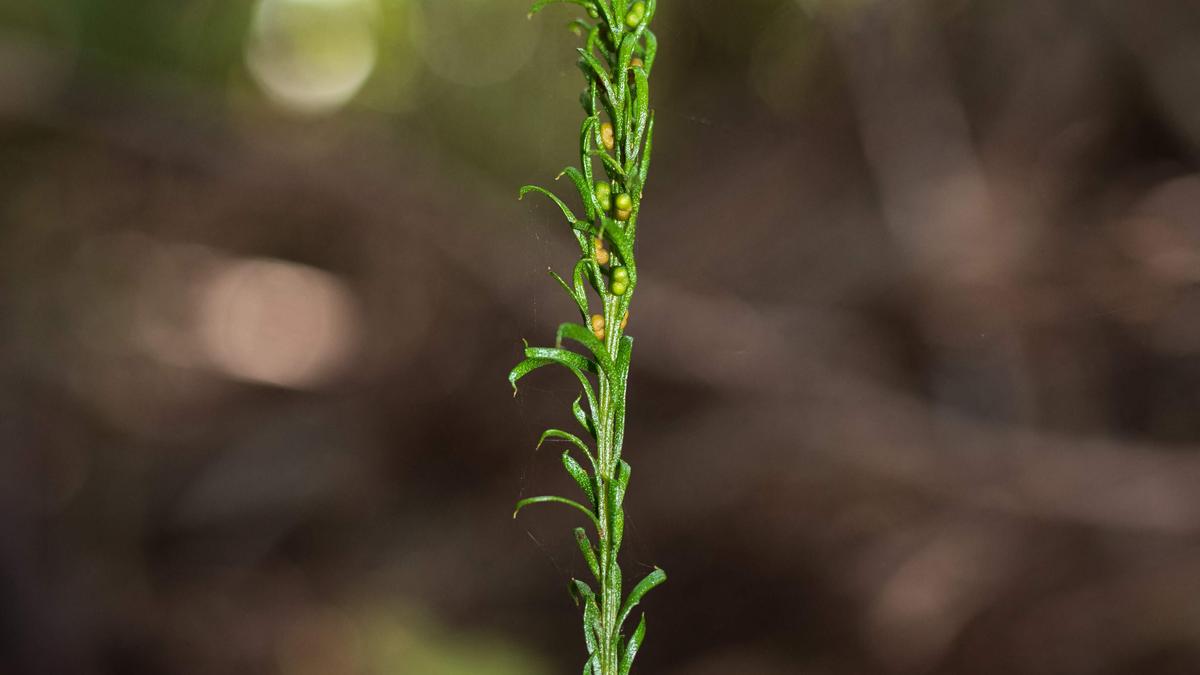
This handout picture obtained on May 30, 2024 from the Institut Botanic de Barcelona (CSIC) shows a fern in New Caledonia.
| Photo Credit: AFP

New research shows that a fork fern species, called Tmesipteris oblanceolata, has a genome — all the genetic information of an organism — that is 7% larger than that of the previous record-holder, the Japanese flowering plant Paris japonica, and more than 50 times the size of the human genome.

The metric for genome size was the number of base pairs, the fundamental units of DNA, in an organism’s cellular nuclei. If stretched out like from a ball of yarn, the length of the DNA in each cell of this fern would extend nearly 350 feet (106 meters), taller than New York’s Statue of Liberty, the clock tower for London’s Big Ben or India’s Taj Mahal. The human genome would extend a mere 6-1/2 feet (2 meters).

The fern grows primarily on the ground or atop fallen tree trunks in New Caledonia, about 750 miles (1,200 km) east of Australia, and on neighboring islands such as Vanuatu.

“We can tell you that this species is not very showy. It is a small plant, typically 10-15 centimeters (4-6 inches) in height, which could easily go unnoticed to anyone who’s not specifically looking for it,” said evolutionary biologist Jaume Pellicer of the Botanical Institute of Barcelona (IBB), co-lead author of the study published on Friday in the journal iScience.

The specimens used in the study were collected last year on New Caledonia’s Grande Terre Island. Its leaf-like structures are not true leaves, but rather flattened stems. It belongs to a fern family whose evolutionary lineage split from other ferns around 350 million years ago, approximately 120 million years before dinosaurs appeared.

A large genome is not considered beneficial.

“We think that Tmesipteris oblanceolata has such a large genome not for any evolutionary advantage but simply because, for a reason that we do not know yet, it has failed over time to efficiently remove non-functional or redundant DNA sequences,” Pellicer said.

DNA, which carries an organism’s genetic information, is comprised of two linked strands that wind around each other in a shape called a double helix that looks like a twisted ladder. Base pairs make up the ladder’s rungs.

Multiple consequences

Genome size has multiple consequences. For instance, larger genomes require more resources for DNA replication, repair and transcription — a process a cell uses to make the proteins an organism needs to function.

“This increased demand can strain the plant’s energy and nutrient resources, which could otherwise be used for growth, reproduction and stress responses,” said IBB evolutionary biologist and study co-lead author Oriane Hidalgo.

Bigger genomes necessitate bigger cells to house them and take longer to replicate the DNA, slowing down cellular division underpinning growth. This could reduce the ability of a plant species to compete for light, water and nutrients, making it ecologically more restricted, Hidalgo said.

Scientists have wondered why some organisms have large genomes and others do not.

“This is indeed a puzzling question. But what is clear is that there is no relationship between genome size and organism complexity,” said plant geneticist and study co-author Ilia Leitch of the Royal Botanic Gardens Kew in London.

There also is no relationship between an organism’s physical size and its genome size. The little fern’s genome is about 6,000% bigger than that of a blue whale, Earth’s largest animal, and about 4,650% bigger than that of an African elephant, the largest land animal. It also is about 1,500% larger than that of the giant redwood, the tallest plant.

Africa’s marbled lung fish has the biggest-known animal genome. The fern’s is nearly 25% larger.

Scientists have gauged the genome size of about 20,000 organisms possessing clearly defined nuclei, with big genomes the exception rather than the rule.

“Genome size is an important biodiversity character as it has been shown to play a role in influencing how, where and when a plant is able to grow and compete, and respond to environmental challenges such as climate change and pollution,” Leitch said.




Source link

Science Tags:fork fern, genome, genome largest, Tmesipteris oblanceolata fern

Post navigation

Previous Post: England All-Rounder Chris Woakes Taking Time Out from Cricket After Father’s Death
Next Post: Custom Officials Open Toy Lunch Box, Find Drugs Worth Over Rs 1 Crore

Related Posts

  • Sci-Five: The Hindu Science Quiz: On Bioluminescence Science
  • Climate change could become the main driver of biodiversity decline by mid-century: report Science
  • Solar Electric Vehicle Championship from March 27-31 in Manipal Science
  • A strange intermittent radio signal from space has astronomers puzzled Science
  • India’s private space sector | History, start-up boom, policy liberalisation & ISRO’s role explained Science
  • ‘Multi-omics’ is changing how India spots and treats TB, cancers Science

More Related Articles

Pollen in pee: fossilised urine from a small African mammal helps us understand past environments Science
Solar Electric Vehicle Championship from March 27-31 in Manipal Science
Deep-learning helps classification of tumours during surgery Science
New light-based tool could cut cost of spotting viral infections Science
How genetics is revealing skin colour biology is more than skin-deep Science
Chandrayaan-3 | ISRO one step away from landing on Moon as Lander Module completes second deboost operation   Science
SiteLock

Archives

  • July 2024
  • June 2024
  • May 2024
  • April 2024
  • March 2024
  • February 2024
  • January 2024
  • December 2023
  • November 2023
  • October 2023
  • September 2023
  • August 2023
  • July 2023
  • June 2023
  • May 2023
  • April 2023
  • March 2023
  • February 2023
  • January 2023
  • December 2022
  • November 2022
  • October 2022
  • September 2022
  • August 2022
  • July 2022
  • June 2022
  • May 2022

Categories

  • Business
  • Nation
  • Science
  • Sports
  • World

Recent Posts

  • Spain Introduces ‘Porn Passport’ To Watch Adult Content Online. Here’s Why
  • “I’m Preparing The Hardik Pandya Role”: Young IPL Star Opens Up On Team India Opportunity
  • Chardham Yatra On Hold Amid Rain Alert, Pilgrims Urged Not To Start From Rishikesh
  • Bronny James, LeBron James’ Son, Loses First Los Angeles Lakers Match
  • Carlos Alcaraz And Jannik Sinner Aim For Wimbledon Quarter-Finals

Recent Comments

  1. GkJwRWEAbS on UP Teacher Who Asked Students To Slap Muslim Classmate
  2. xreDavBVnbGqQA on UP Teacher Who Asked Students To Slap Muslim Classmate
  3. aANVRzfUdmyb on UP Teacher Who Asked Students To Slap Muslim Classmate
  4. YQCyszVBmIP on UP Teacher Who Asked Students To Slap Muslim Classmate
  5. aiXothgwe on UP Teacher Who Asked Students To Slap Muslim Classmate
  • Australia vs India live score over Super Eight – Match 11 T20 11 15 updates Sports
  • Twenty20 World Cup: India to play semifinal in Guyana if they reach last-four stage Sports
  • Dhaka shopping mall fire | Three arrested in connection with deadly fire that killed at least 46 World
  • Ajit Pawar Diagnosed With Dengue, Advised Rest Nation
  • India maintains basmati rice floor price as grain-export curbs continue Business
  • U.S. lawmakers to introduce legislation to formalise Indian Ocean strategy World
  • AFC Asks Ousted AIFF Legal Head To Submit Evidence Of Corruption Charges Against Kalyan Chaubey Sports
  • Not To Worry, Says DK Shivakumar After Bengaluru’s Rameshwaram Cafe Blast Nation

Editor-in-Chief:
Mohammad Ariff,
MSW, MAJMC, BSW, DTL, CTS, CNM, CCR, CAL, RSL, ASOC.
editor@artifex.news

Associate Editors:
1. Zenellis R. Tuba,
zenelis@artifex.news
2. Haris Daniyel
daniyel@artifex.news

Photograher:
Rohan Das
rohan@artifex.news

Artifex.News offers Online Paid Internships to college students from India and Abroad. Interns will get a PRESS CARD and other online offers.
Send your CV (Subjectline: Paid Internship) to internship@artifex.news

Links:
Associate Journalism
About Us
Privacy Policy

News Links:
Breaking News
World
Nation
Sports
Business
Entertainment
Lifestyle

Registered Office:
72/A, Elliot Road, Kolkata - 700016
Tel: 033-22277777, 033-22172217
Email: office@artifex.news

Editorial Office / News Desk:
No. 13, Mezzanine Floor, Esplanade Metro Rail Station,
12 J. L. Nehru Road, Kolkata - 700069.
(Entry from Gate No. 5)
Tel: 033-46011099, 033-46046046
Email: editor@artifex.news

Copyright © 2023 Artifex.News Newsportal designed by Artifex Infotech.