





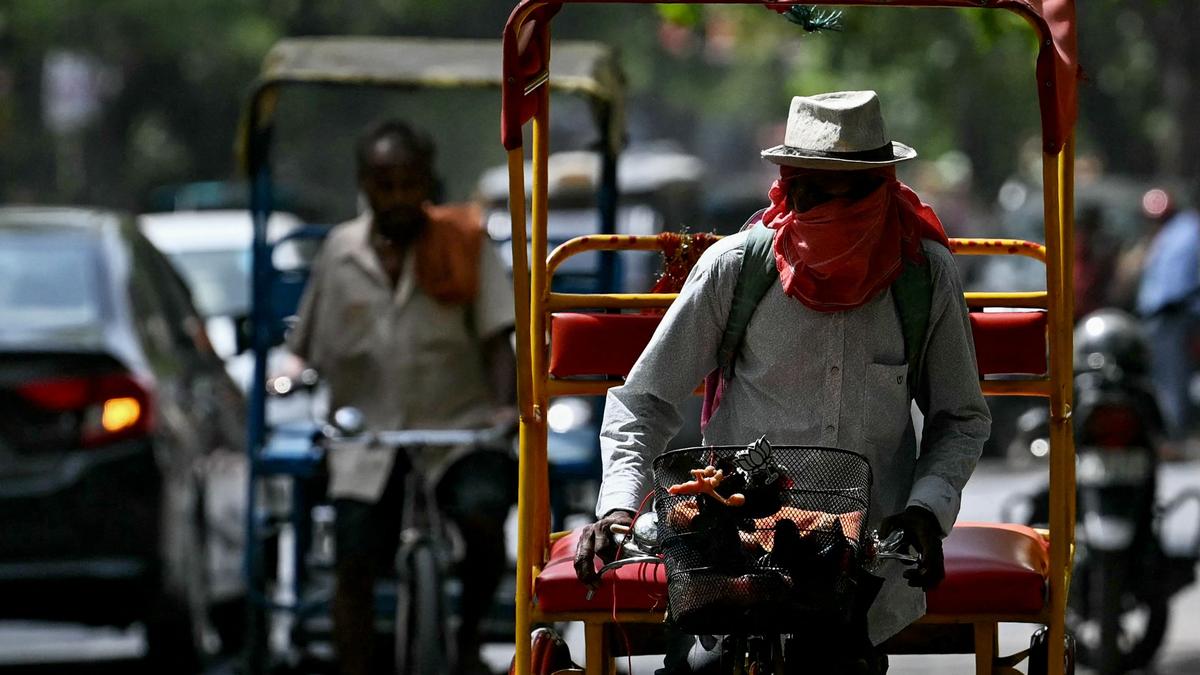
Recently, for two consecutive days, Delhi reported daytime temperature above 50 degree C, the highest ever recorded in the city. There is a reason why cities are experiencing higher temperatures than non-urban and rural areas. The ongoing climate change and rapid urbanisation are now defining the Anthropocene, with the cities experiencing both thereby making the urban population vulnerable to the compounding impact. India’s urban landscape (especially population) is projected to double by 2050, adding more than 450 million residents. This rise outnumbers the present total population of the United States and the European Union, signaling a huge historical shift. Given the breakneck urbanisation, our cities must be prepared for future challenges.
The altered thermodynamic, aerodynamic properties of the cities tend to trap more heat, making cities warmer than their rural and suburban counterparts, a phenomenon well-known as the urban heat island (UHI) effect. In addition, climate change is causing a significant increase in record-breaking temperatures and frequent prolonged heat waves. Therefore, the overall warming in any city tends to be complex with both urbanisation and global warming playing a pivotal role. This significantly alters the resultant micro-climate of the cities with influence on heat, rainfall distribution and even air pollution dispersion with implication to public health. As a result, the pace and course of urbanisation must be carefully planned using strong scientific information.
In a study published recently, we seek to separate the warming caused by local scale urbanisation and regional scale climate change in the context of 141 major cities in India and quantify their relative contributions. This kind of segregation is scientifically quite complex. One strategy is to determine the contributions of various factors to warming over time. These factors include information on concrete structures, roads, industries, parks, water bodies, residential activities, air conditioning, vehicular activities, and so on. Such detailed analysis requires enormous time, effort and investment, even for just one city and has to be incorporated into models or combined with extremely high-resolution satellite images for further analysis. A much simpler approach was followed using high-resolution night-time land surface temperature from MODIS, a sensor aboard Aqua satellite in NASA’s A-train constellation. Under the assumption that the observed changes in warming (2003 to 2020) over the rural areas are driven primarily by regional climate change, the warming over the urban built-up areas for each city was compared to its rural counterpart at every one sq. km area. Thus, after the removal of regional warming signatures from the urban areas, the signal related to urbanisation was estimated for 141 major and minor cities providing first-time information on global warming-free urbanisation signatures.
Overall, the rate of warming in cities is nearly twice that of the rest of the country, with local-scale urbanisation alone causing additional warming of about 60%. While all cities showed an increase in night-time land surface temperature, with an average increase of 0.53 degree C per decade, a large divide among cities was seen. The tier-II cities in the eastern part of the country have stronger urbanisation-driven warming, surprisingly not seen even for the larger metros and mega cities. This may be indicating a window of opportunity as smaller highly urbanising cities could be managed well by proper urban planning than large megacities that have limited land and other resources that could be altered at this point in time.
Mitigation efforts
India is aggressively acting to reduce emissions and shift to non-fossil fuel based energy sources as clearly stated in the updated nationally determined contribution (NDC) working towards climate justice. State level heat action plans and implementation of early warning and forecasting systems for heatwaves show India’s commitment towards saving lives by reducing heat related mortality. Considering escalated risks for cities with a large heat exposure, tailored city specific action plans are needed for sustainable urban growth.
Based on the predominant contribution to warming (urbanisation or climate change), the study emphasises that urban heat management must follow a differential approach for each city. Information on the dominant contributor will help urban planners and policymakers to better allocate limited resources. Cities with a large urbanisation contribution may benefit from local scale interventions —use of sustainable materials like cool roofs and cool/permeable pavements, green infrastructures, creation of maintenance of lakes and parks, urban forests, and comprehensive emission reduction strategies. While other cities may require more regional scale efforts — national or regional level emission reduction, large-scale afforestation/plantation, rejuvenation of surrounding water bodies — for effective warming mitigation with both having implications for extreme urban rainfall, floods, air pollution etc.
(V. Vinoj is Associate Professor, School of Earth, Ocean and Climate Sciences, IIT Bhubaneswar, and S.S. Sethi is PhD scholar in the School of Earth, Ocean and Climate Sciences, IIT Bhubaneswar)