





A new study conducted by scientists from the Indian Institute of Technology Bombay (IIT Bombay), Mumbai published in NPJ Systems Biology and Applications, has shed light on the process of speciation, meaning the formation of new species, in the absence of geographic barriers. Traditionally, it is believed that speciation largely occurs when populations of a species are isolated from each other by geographical barriers such as mountains or bodies of water. This is called allopatric speciation. However, the new IIT Bombay research suggests that speciation can happen even when populations live in the same area without geographical barriers. This mode of speciation is called sympatric speciation.
Professor Supreet Saini, from Department of Chemical Engineering and DBT/Wellcome Trust (India Alliance) Fellow at IIT Bombay and the lead researcher of this study said, “While there is ecological evidence in favour of sympatric hypothesis, there is no experimental evidence. And without a laboratory model to study sympatric speciation, it becomes difficult to understand it as a process. The motivation behind our work is to understand how the environment and the underlying genetics can lead to sympatric speciation and design biologically insightful experiments.”
The researchers used a genetic-based model to investigate the factors that contribute to speciation when populations live in the same geographic area. This theoretical study focused on a population of birds using simulated data and specifically looked at how three aspects that encourage speciation, namely, disruptive selection, sexual selection, and genetic architecture play a role in driving and maintaining sympatric speciation.
Disruptive speciation
“In sympatric speciation, the “divide” in the population can be created due to non-uniform resources present in the environment, and geography has no role to play here. This is called ecological disruptive selection,” co-author Pavithra Venkataraman, PhD student and a Prime Minister’s Research Fellow at IIT Bombay explained. In other words, disruptive selection is a process by which individuals with extreme traits have a higher fitness than those with intermediate traits.
Ms. Venkataraman added, “Disruptive selection is necessary for speciation to occur in sympatry because it favours heritable differences in the population and ensures that the offsprings produced by the mating of individuals belonging to two different groups do not survive. These two factors are extremely important for maintaining biodiversity in sympatry.”
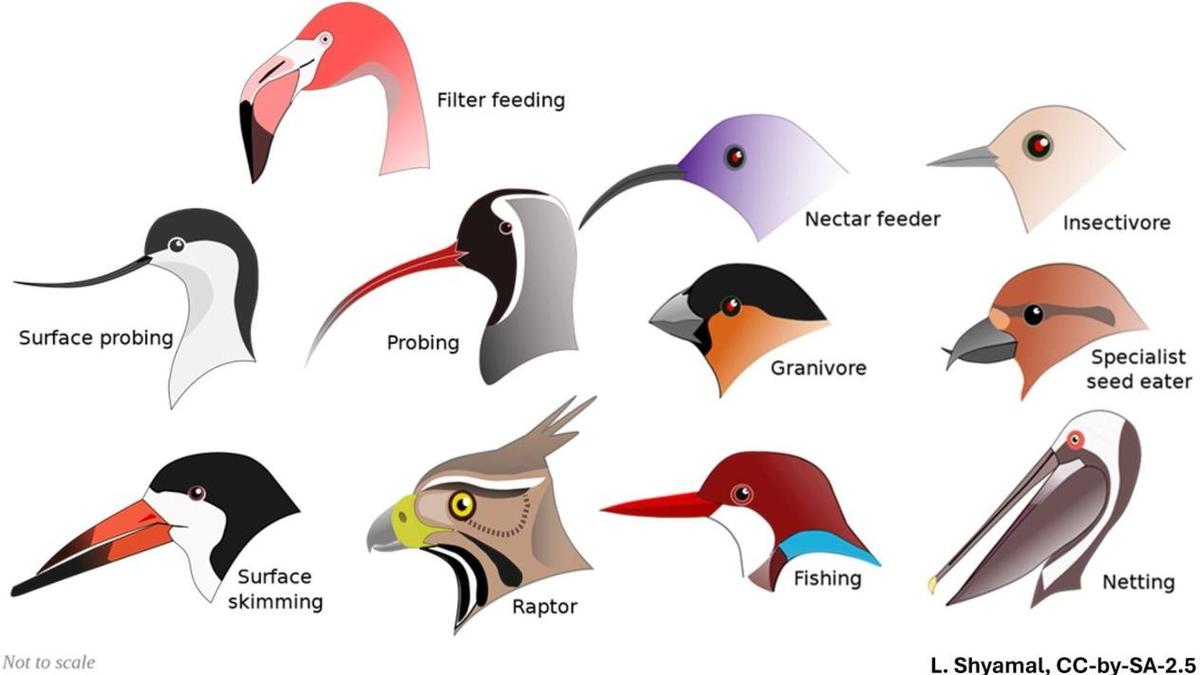
In this study, the researchers focused on a physical trait of the birds – the beak size. The birds in the population had to adapt their beak size to best utilise two types of food resources, such as nuts and flower nectar. Birds with small beaks will be better at utilising resource nuts, while those with longer beaks will be more efficient at utilising flower nectar as their resource.
Role of sexual selection
Sexual selection, on the other hand, is a type of natural selection driven by competition for mates. It can lead to the evolution of elaborate traits that are attractive to potential mates. In this study, the researchers looked at how female mating preference, based on a male’s intensity of the trait (unique character), could play a role in speciation.
“Sexual selection has been thought to be one of the main, or often, the sole driver of sympatric speciation. Essentially, it was thought that some members of the populations could evolve a ‘bias’ towards a trait like feather colour, and a difference in this bias could lead to sympatric speciation. For example, consider a bird population where there are two types of feathers – blue and red. If a bias evolves among the blue birds to only mate with their kind, sympatric speciation would occur because the red birds don’t mix their genes with the blue ones,” Ms. Venkataraman explained.
In other words, this could lead to populations with distinct blue and red traits.
“The drawback of this hypothesis is that there is no basis for such a bias to evolve unless there is a fitness benefit. In other words, why does a blue bird mate only with a blue one, reducing its mate pool is not clear,” Ms. Venkataraman said.
The researchers then incorporated the ability of the bird to utilise resources in the environment into their model. Surprisingly, the researchers found that sexual selection based on special traits did not contribute to speciation in sympatry. Instead, they found that the preference for mates based on a relevant trait that helps in utilising the environmental resources better, (this case, beak size), was the driving force behind speciation. The study also acknowledges the possibility of lower fitness of the offsprings due to sexual selection.
Genetic architecture has a key role
Furthermore, the researchers discovered that genetic architecture, or how genes control the trait under selection, was a crucial factor in determining the likelihood of sympatric speciation. If the genetic architecture allowed changes in beak size, then a new species could develop even with a weak role of disruptive selection.
On the limitations of the study, Professor Saini said, “In our model, we assume that birds from the two groups mate without any bias and that this bias does not change with time. This may not be true in natural populations, where a bias based on the beak size is expected to evolve. It is also possible for the birds of the two groups to evolve with distinct markers that help them distinguish their “kind” from the other.”
Nevertheless, this study provides valuable insights into the conditions and mechanisms that can lead to sympatric speciation. It challenges the traditional view that speciation can only occur in geographical isolation and highlights the importance of genetic architecture and ecological selection in driving the formation of new species, said Mr. Saini.
“A large part of our research effort is to take lessons from theory and to design experiments for understanding how reproductive barriers evolve between members of the population in sympatry. Towards this, we work with yeast to demonstrate and establish a laboratory model to study speciation in sympatry,” Mr. Saini added while indicating the path ahead.
By unravelling the mysteries of speciation, scientists are gaining a deeper understanding of the incredible diversity of life on our planet and the processes that generate it. By demonstrating how sympatric speciation can occur, even with relatively low levels of disruptive selection, the researchers have provided a framework for future experimental studies on biodiversity. This knowledge could open up new avenues for research and help scientists better understand the mechanisms behind the biodiversity on Earth. With the imminent threat of climate change, perhaps this can also shed light on the impacts of climate change on biodiversity at large, Mr. Saini said.