




Skip to content
  • Facebook
  • X
  • Linkedin
  • WhatsApp
  • Associate Journalism
  • About Us
  • Privacy Policy
  • 033-46046046
  • editor@artifex.news
Artifex.News

Artifex.News

Stay Connected. Stay Informed.

  • Breaking News
  • World
  • Nation
  • Sports
  • Business
  • Science
  • Entertainment
  • Lifestyle
  • Toggle search form
  • Pep Guardiola Casts Doubt Over Long-Term Man City Future Sports
  • Ashwin replaces Bumrah at the top of ICC Test rankings Sports
  • India’s sunflower oil, soy oil imports up as palm oil imports fall Business
  • United States vs South Africa HIghlights,T20 World Cup 2024: SA Start Super 8 With 18-Run Over USA Sports
  • US Woman, 18, Arrested For Calling 911 To Avoid Going On Date With Man She Met Online World
  • South Africa vs Australia, 3rd T20I, Live Streaming: When And Where To Watch Live Telecast? Sports
  • CBI Files Case Over Alleged Minority Scholarship “Scam” Nation
  • World reported twice as many cholera cases in 2022 as in 2021: WHO | Data World

Starless and forever alone: more ‘rogue’ planets discovered

Posted on May 29, 2024 By admin


This NASA handout illustration released on May 28, 2024 shows an ice-encrusted, Earth-mass rogue planet drifting through space alone. The Euclid space telescope has discovered seven more rogue planets, shining a light on these dark and lonely worlds, which float freely through the universe untethered to any star. Without being bound to a star — like the Earth is to the Sun — there are no days or years on these planets, which languish in perpetual night.
| Photo Credit: AFP

The Euclid space telescope has discovered seven more rogue planets, shining a light on the dark and lonely worlds floating freely through the universe untethered to any star.

Without being bound to a star, as the Earth is to the Sun, there are no days or years on these planets, which languish in perpetual night.

Yet scientists believe there is a chance they could be able to host life — and estimate there may be trillions dotted throughout the Milky Way.

Last week the European Space Agency released the Euclid telescope’s first scientific results since the mission launched in July.

Among the discoveries were seven new free-floating planets, gas giants at least four times the mass of Jupiter.

They were spotted in the Orion Nebula, the nearest star-forming region to Earth, roughly 1,500 light years away.

Euclid also confirmed the existence of dozens of other previously detected rogue planets.

Spanish astronomer Eduardo Martin, the lead author of a pre-print study published on arXiv.org Friday, said this was likely just the “tip of the iceberg”.

Because they do not reflect the light of a star, spotting rogue planets is like “finding a needle in a haystack”, Martin told AFP.

Younger planets, such as those discovered by Euclid, are hotter, making them a little easier to see.

Awe and mystery

Some research has suggested there are around 20 rogue planets for every star, which could put their number in the trillions in our home galaxy alone.

Given there are thought to be hundreds of billions of galaxies across the universe, the potential number of free-floating worlds becomes difficult to fathom.
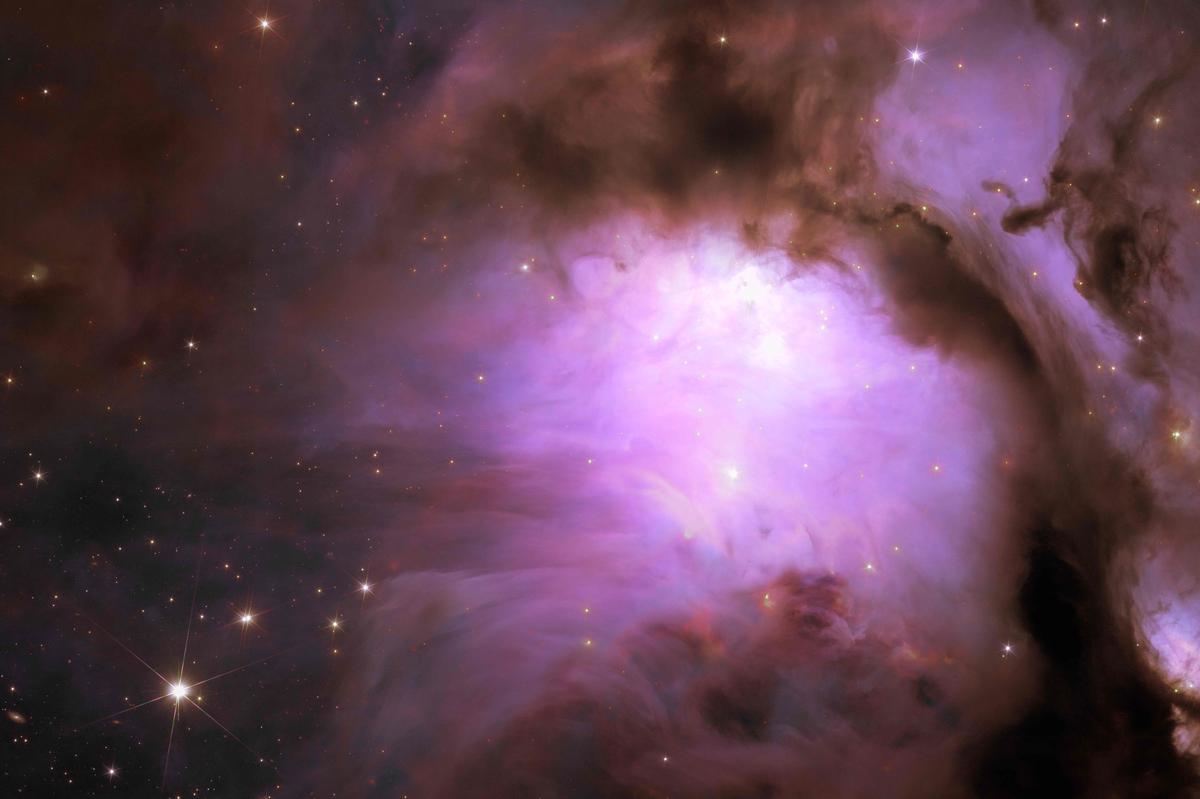
This handout image obtained on May 23, 2024 courtesy of NASA/ESA/CSA shows space telescope Euclid’s new image of star-forming region Messier 78, a vibrant nursery of star formation enveloped in a shroud of interstellar dust. The European Space Agency (ESA) unveiled on May 23, 2024 a first batch of scientific images of the cosmos taken by the Euclid space telescope, which will observe two billion galaxies over six years in an attempt to unravel the mystery of elusive dark matter.

This handout image obtained on May 23, 2024 courtesy of NASA/ESA/CSA shows space telescope Euclid’s new image of star-forming region Messier 78, a vibrant nursery of star formation enveloped in a shroud of interstellar dust. The European Space Agency (ESA) unveiled on May 23, 2024 a first batch of scientific images of the cosmos taken by the Euclid space telescope, which will observe two billion galaxies over six years in an attempt to unravel the mystery of elusive dark matter.
| Photo Credit:
AFP

When NASA’s Roman space telescope launches in 2027 it is expected find many more rogue planets, possibly offering clarity about how many could be out there.

Gavin Coleman, an astronomer at the Queen Mary University of London who was not involved in the Euclid research, said these strange worlds often evoked “feelings of awe and mystery”.

“We’ve all grown up with the Sun in the sky, and so to think of a planet just drifting throughout space with no star on their horizon is fascinating,” he told AFP.

But not all rogue planets wander alone. Four of the more than 20 confirmed by Euclid are believed to be binaries — two planets orbiting each other in a single system.

Could they host life?

If rogue planets are habitable, they could be a key target in humanity’s search for extraterrestrial life.

“Some of our closest neighbours are likely rogue planets,” Martin said.

Lacking heat from a nearby star, free-floating planets are believed to be cold, with frozen surfaces.

That means any life-supporting energy would have to come from inside the planet.

Most of Neptune’s energy comes from within, Coleman pointed out.

And geothermal vents allow animals to survive on Earth that have never seen the Sun’s rays.

But even under the best conditions, this extreme isolation would likely be able to support only bacterial and microbial life, Coleman said.

Advantage of being alone

Rogue planets could be thought of as traversing a lonely path through the cosmos.

But “being around a star has its downsides”, said study co-author Christopher Conselice, professor of extragalactic astronomy at the UK’s University of Manchester.

One particular downside comes to mind.

Once the Sun becomes a red giant — in an estimated 7.6 billion years — it will greatly expand, swallowing the Earth.

Rogue planets do not have to worry about eventually being destroyed by a star. “These things will last forever,” Conselice told AFP.

“If you don’t mind the cold temperatures you could survive on these planets for eternity.”

The Euclid study also offered clues to how rogue planets are created, Conselice said.

Some could be formed in the outer part of a solar system before getting detached from their star and floating away.

But the study indicates that many rogue planets may be created as a “natural byproduct” of the star-formation process, he said.

This suggests a “really close connection between stars and planets and how they form”, he said.

“There’s no firm answers yet,” he added.



Source link

Science

Post navigation

Previous Post: US Man, 19, Survives 400-Foot Fall From Steel Bridge
Next Post: 2 Killed After Fortuner In Convoy Of Brij Bhushan Singh’s Son Hits Bike

Related Posts

  • Why are scientists looking for the Higgs boson’s closest friend? Science
  • Study reveals how Titanosaurs, earth’s biggest land animals, survived so long Science
  • Tonga volcano could cause unusual weather for rest of decade: study Science
  • Galactic tides: Pushing and pulling the heavens Science
  • Other than the red pigment, what material was used in the red paint by people of Peru’s Sicán culture? Science
  • Synthetic human embryos let scientists sidestep ethical hurdles Science

More Related Articles

Health Ministry withdraws fiat mandating doctors prescribe only generic drugs Science
World Ocean Day 2024: Understand the Indian Ocean and you’ll understand much about earth Science
New book throws light on the people who helped build India’s first rockets Science
The Science Quiz | The quiet awesomeness of tungsten Science
PM Modi “directs” ISRO to land man on moon by 2040 Science
The Hindu Daily Quiz, October 16, 2023 | On World Food Day Science
SiteLock

Archives

  • July 2024
  • June 2024
  • May 2024
  • April 2024
  • March 2024
  • February 2024
  • January 2024
  • December 2023
  • November 2023
  • October 2023
  • September 2023
  • August 2023
  • July 2023
  • June 2023
  • May 2023
  • April 2023
  • March 2023
  • February 2023
  • January 2023
  • December 2022
  • November 2022
  • October 2022
  • September 2022
  • August 2022
  • July 2022
  • June 2022
  • May 2022

Categories

  • Business
  • Nation
  • Science
  • Sports
  • World

Recent Posts

  • JSW Energy plans ₹15,000 crore capex in FY25
  • Milan Airport To Be Renamed Silvio Berlusconi Airport
  • Shashi Tharoor’s UK-Themed Dig At BJP
  • Portugal vs France Live Streaming Euro 2024 Quarter Final Live Telecast: When And Where To Watch
  • Rachel Reeves: Britain’s first woman finance chief

Recent Comments

  1. GkJwRWEAbS on UP Teacher Who Asked Students To Slap Muslim Classmate
  2. xreDavBVnbGqQA on UP Teacher Who Asked Students To Slap Muslim Classmate
  3. aANVRzfUdmyb on UP Teacher Who Asked Students To Slap Muslim Classmate
  4. YQCyszVBmIP on UP Teacher Who Asked Students To Slap Muslim Classmate
  5. aiXothgwe on UP Teacher Who Asked Students To Slap Muslim Classmate
  • Project Director Of Aditya-L1 On Its Successful Launch Nation
  • Legendary Nepal Mountaineer Kami Rita Sherpa Climbs Mount Everest For Record 29th Time World
  • Supreme Court Quashes BJP Candidate’s Challenge To Nomination Cancellation Nation
  • Oscars of Diplomacy: High-level UNGA week starts with focus on SDGs, climate action World
  • Budget 2023 | Real money gaming industry welcomes TDS clarification Business
  • 31-Year-Old Woman Dies After Being Chased By A Bear In Slovakia World
  • PM Modi Unveils Development Projects Worth Rs 21,400 Crore In Bihar Nation
  • Pakistan to privatise all state-owned firms, except strategic enterprises: PM Sharif Business

Editor-in-Chief:
Mohammad Ariff,
MSW, MAJMC, BSW, DTL, CTS, CNM, CCR, CAL, RSL, ASOC.
editor@artifex.news

Associate Editors:
1. Zenellis R. Tuba,
zenelis@artifex.news
2. Haris Daniyel
daniyel@artifex.news

Photograher:
Rohan Das
rohan@artifex.news

Artifex.News offers Online Paid Internships to college students from India and Abroad. Interns will get a PRESS CARD and other online offers.
Send your CV (Subjectline: Paid Internship) to internship@artifex.news

Links:
Associate Journalism
About Us
Privacy Policy

News Links:
Breaking News
World
Nation
Sports
Business
Entertainment
Lifestyle

Registered Office:
72/A, Elliot Road, Kolkata - 700016
Tel: 033-22277777, 033-22172217
Email: office@artifex.news

Editorial Office / News Desk:
No. 13, Mezzanine Floor, Esplanade Metro Rail Station,
12 J. L. Nehru Road, Kolkata - 700069.
(Entry from Gate No. 5)
Tel: 033-46011099, 033-46046046
Email: editor@artifex.news

Copyright © 2023 Artifex.News Newsportal designed by Artifex Infotech.