




Skip to content
  • Facebook
  • X
  • Linkedin
  • WhatsApp
  • Associate Journalism
  • About Us
  • Privacy Policy
  • 033-46046046
  • editor@artifex.news
Artifex.News

Artifex.News

Stay Connected. Stay Informed.

  • Breaking News
  • World
  • Nation
  • Sports
  • Business
  • Science
  • Entertainment
  • Lifestyle
  • Toggle search form
  • India’s New York Consulate to remain open even on holidays for ‘genuine emergencies’ World
  • Vatican To Hold Press Conference On “Supernatural Phenomena” Today World
  • Keir Starmer, On Course To Become Next UK PM, Wins Home Constituency World
  • PV Sindhu, HS Prannoy Enter Pre-Quarterfinals At Asian Games Sports
  • 2 Bodies Recovered From Water As Search Work Continues World
  • Lamine Yamal Makes History As Spain Sink France To Reach Euro 2024 Final Sports
  • In China, rocket accidentally lifts off during test and crashes Science
  • After Ronaldo, David Beckham Too Ends Asian Games Campaign For India Without Medal Sports

Chinese fossil reveals evolution of skin in feathered dinosaurs

Posted on May 24, 2024 By admin


The skeleton of a Psittacosaurus dinosaur is displayed during the Collector Exhibition at the Grand Palais Museum in Paris September 10, 2009.
| Photo Credit: Reuters

A new fossil of the Cretaceous Period dinosaur Psittacosaurus, a dog-sized herbivore with a parrot-like beak, that was donated to a Chinese university came with a surprise – one revealed only after scientists viewed it under ultraviolet light.

It retained large patches of beautifully preserved skin, down to its cellular structure, providing new insight into skin evolution in feathered dinosaurs. The fossil points to “zoned development” in the skin of these dinosaurs, researchers said, with Psittacosaurus and probably other feathered dinosaurs possessing scaly, reptile-like skin on body regions without feathers, with soft, bird-like skin on areas with feathers.

“Initially we didn’t really have much hope of finding any soft tissues because, to the naked eye, our specimen appears to preserve only the bones. We didn’t give up, though, because we knew that during fossilization soft tissues can be replaced by minerals, which may blend in with the sediments,” said Zixiao Yang, a postdoctoral researcher in paleontology at University College Cork in Ireland and lead author of the study published on Tuesday in the journal Nature Communications.
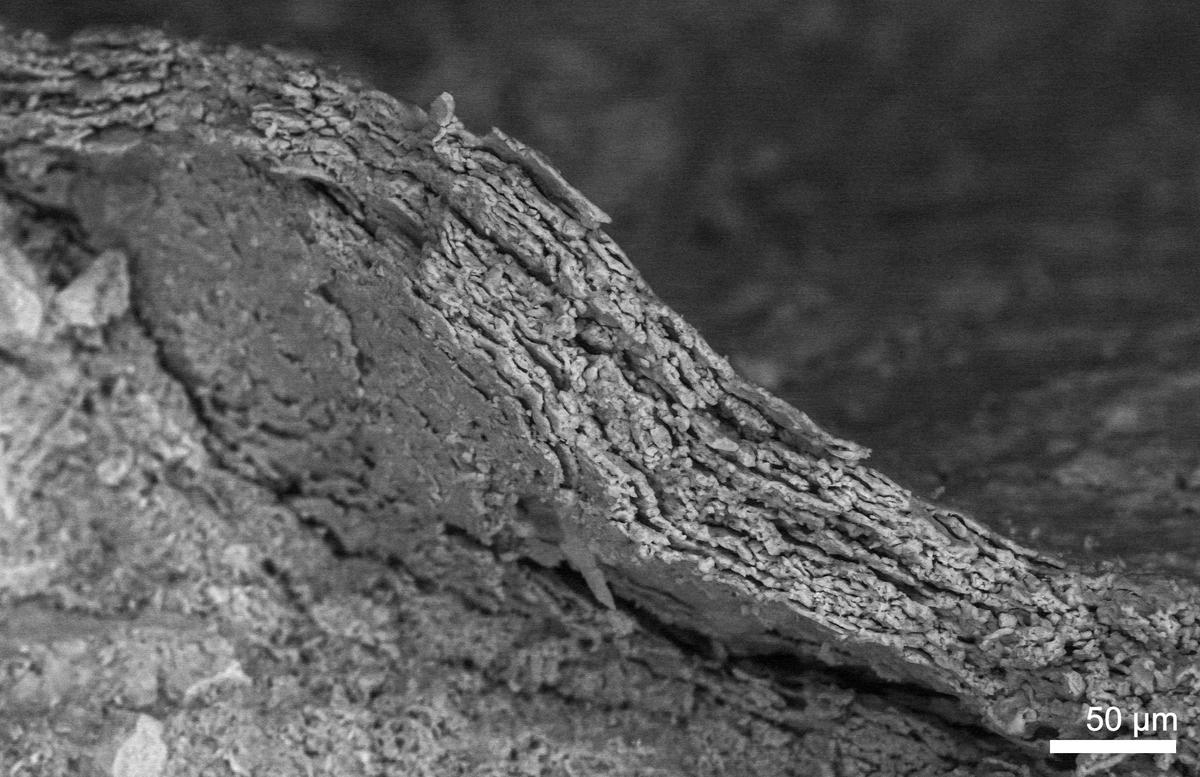
Fossilized skin of the dog-sized Cretaceous Period dinosaur Psittacosaurus from China is shown under an electron microscope, revealing mineralized cell layers, in this undated handout image.

Fossilized skin of the dog-sized Cretaceous Period dinosaur Psittacosaurus from China is shown under an electron microscope, revealing mineralized cell layers, in this undated handout image.
| Photo Credit:
Reuters

“When I turned on the UV light, I could feel my heart almost skip a beat. Large patches of scaly skin, covering the chest and belly, were glowing in a striking golden-yellow color under the UV. The fossil skin looked really exquisite, covered by tiny, rounded scales of about one millimeter wide,” Yang said.

Fossils of any soft tissues are rare. Skin fossils of this quality are rarer still.

Unearthed in northeastern China, the nearly complete fossil, dating to roughly 130 million years ago, is of a juvenile Psittacosaurus (pronounced SIT-ak-oh-sawr-us), about 2-1/4 feet (66 cm) long and approximately 3 years old when it died. It was donated in 2021 to Nanjing University from a private collection.

Psittacosaurus is an early member of the horned dinosaur lineage, called ceratopsians, that later produced large beasts like Triceratops. Psittacosaurus itself lacked horns. Its name means “parrot lizard” based on its protruding beak, adapted for eating plants.
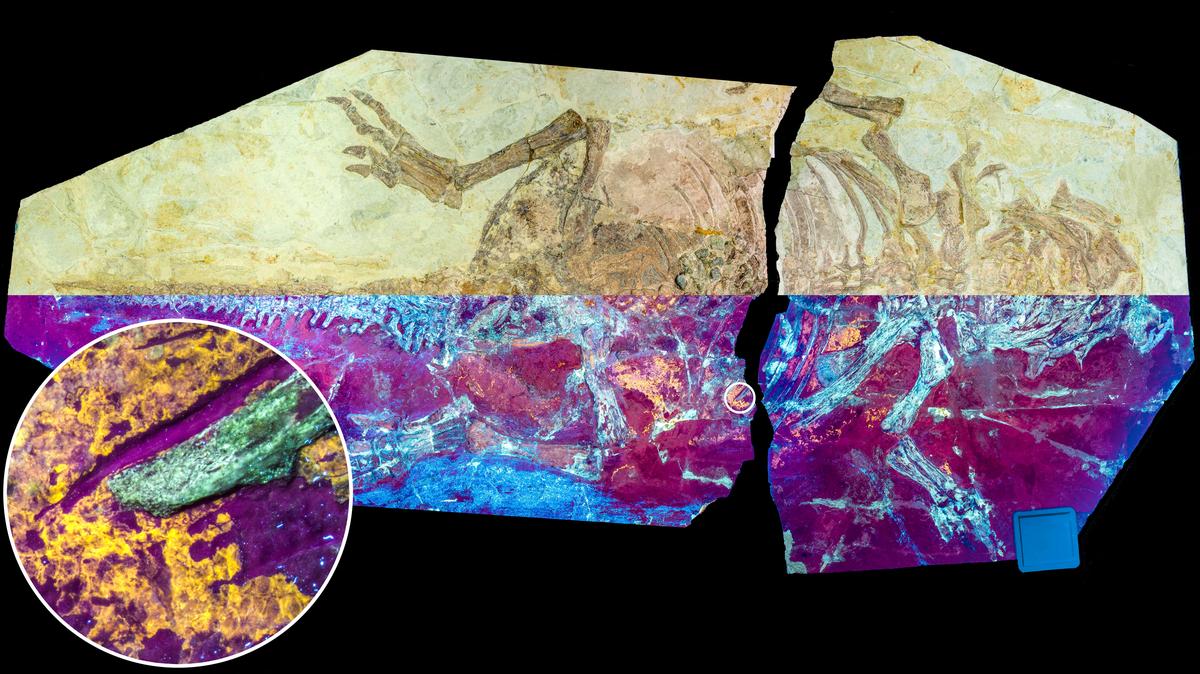
A handout image, formed by combining different images, shows a dog-sized fossil of the Cretaceous Period dinosaur Psittacosaurus from China, the upper half of the image is displayed in natural light, and the lower half in UV light, revealing the orange-yellow fluorescence of fossilised skin, in this undated handout image.

A handout image, formed by combining different images, shows a dog-sized fossil of the Cretaceous Period dinosaur Psittacosaurus from China, the upper half of the image is displayed in natural light, and the lower half in UV light, revealing the orange-yellow fluorescence of fossilised skin, in this undated handout image.
| Photo Credit:
Reuters

Many dinosaurs had feathers. In fact, birds evolved from small feathered dinosaurs. The first rudimentary feathers are thought to have evolved from reptilian scales nearly 250 million years ago in animals ancestral to dinosaurs and the flying reptiles called pterosaurs.

Psittacosaurus had simple, bristle-like feathers atop its tail. The rest of its body was covered by scaly skin. The fossil did not have skin from the dinosaur’s feathered regions, but the researchers think these areas had bird-like skin.

“This discovery adds nuance to our understanding of feather evolution. The acquisition of modern, bird-like skin happened only locally on the body. Tough, reptile-style skin remained essential in body regions not protected by feathers,” said University College Cork paleontology professor and study co-author Maria McNamara.

The skin of birds exhibits multiple adaptations for feathers.

Birds have a dermal network of microscopic muscles that encircles each feather and acts like a hydraulic system, including muscles that pull feathers in different directions. There also is a network of smooth muscles under the skin that keeps feathers separated, as well as deposits of fatty tissue anchored to the base of the skin that create an even skin surface and feather orientation. In addition, feathers are connected by a system of sensory nerve fibers.
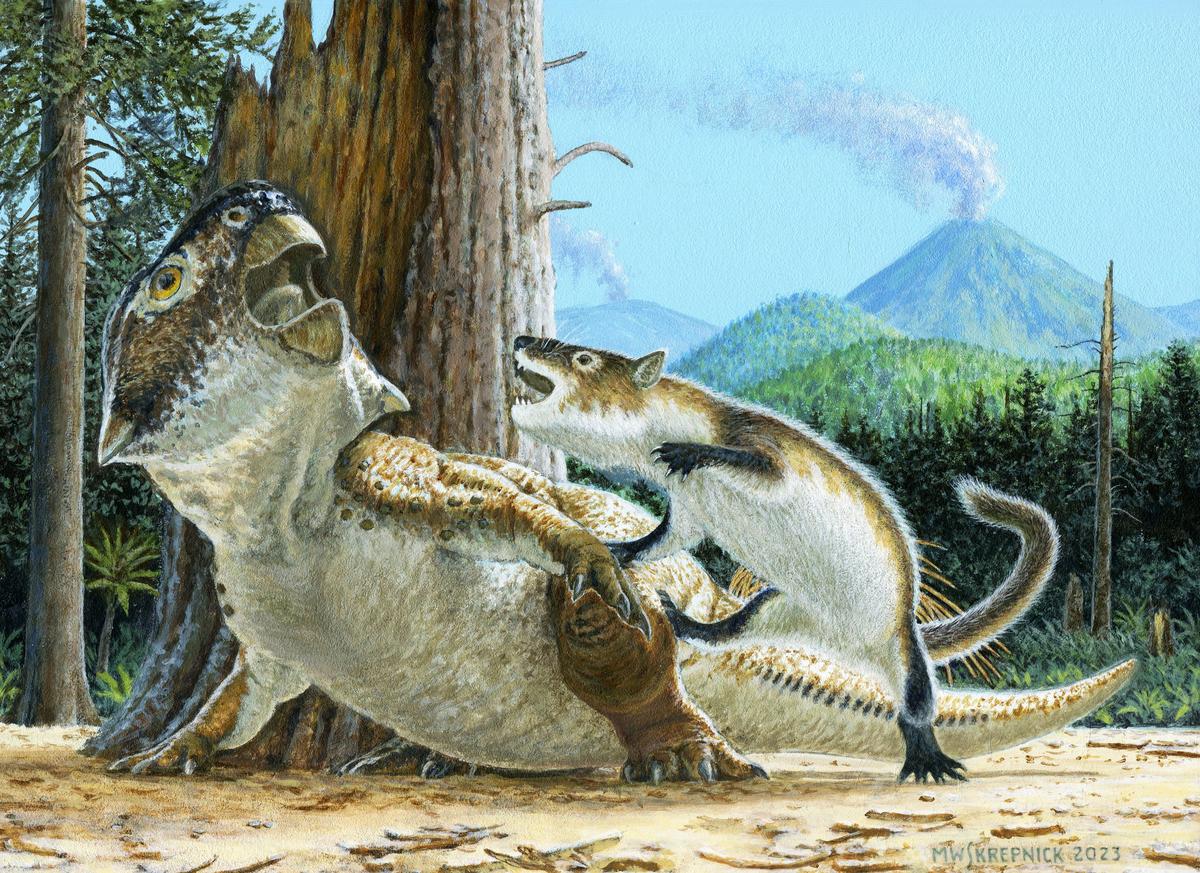
This illustration shows the Cretaceous carnivorous mammal Repenomamus robustus attacking the plant-eating dinosaur Psittacosaurus lujiatunensis moments before a volcanic debris flow buries them both about 125 million years ago in China.

This illustration shows the Cretaceous carnivorous mammal Repenomamus robustus attacking the plant-eating dinosaur Psittacosaurus lujiatunensis moments before a volcanic debris flow buries them both about 125 million years ago in China.
| Photo Credit:
Reuters

“Until now, we haven’t known whether the skin of dinosaurs and their relatives evolved these skin adaptations first and feathers later, or whether they evolved at the same time, and in which parts of the body,” McNamara said.

The Psittacosaurus fossil “strongly suggests that evolution of feathers – and the new skin adaptations – happened at the same time,” McNamara said.

The dinosaur’s scaly skin closely resembled the skin of today’s reptiles.

“They are similar in many aspects, including the shape, size, arrangement and composition of skin cells, and the way the skin produces color patterns,” Yang said.




Source link

Science Tags:dinosaurs fossils, dinosaurs news, Feathered dinosaurs, Psittacosaurus, science news

Post navigation

Previous Post: “In An Election, Hands Off!” Supreme Court Adjourns Voter Turnout Data Plea
Next Post: CCTV Shows Moment Of Explosion In Thane Factory Where 8 Died

Related Posts

  • Rare blue supermoon brightens the night sky this week in the closest full moon of the year Science
  • Goa scientists find 50,000-year-old magnetic fossils in Bay of Bengal Science
  • What is nucleosynthesis? – The Hindu Science
  • Other than the red pigment, what material was used in the red paint by people of Peru’s Sicán culture? Science
  • NASA touts space research in anti-cancer fight Science
  • Watch | Indians are buying land on the moon… but can one ‘own’ lunar land? Science

More Related Articles

‘Today, mathematics is not only necessary in daily life but pervasive’ Science
Kufos succeeds in captive breeding of threatened Indian ornamental fish Science
Concurrent heatwaves, sea level rises pose a threat to coastlines Science
What is it? IceCube: The big, chill neutrino-spotter Science
Gene therapy offers hope for patients with hearing loss Science
ISRO conducts first Earth-bound manoeuvre of Aditya-L1  Science
SiteLock

Archives

  • July 2024
  • June 2024
  • May 2024
  • April 2024
  • March 2024
  • February 2024
  • January 2024
  • December 2023
  • November 2023
  • October 2023
  • September 2023
  • August 2023
  • July 2023
  • June 2023
  • May 2023
  • April 2023
  • March 2023
  • February 2023
  • January 2023
  • December 2022
  • November 2022
  • October 2022
  • September 2022
  • August 2022
  • July 2022
  • June 2022
  • May 2022

Categories

  • Business
  • Nation
  • Science
  • Sports
  • World

Recent Posts

  • U.S. and South Korea sign joint nuclear deterrence guidelines in face of North Korean threats
  • India to clock GDP growth of 7% in FY25: NITI Aayog member Arvind Virmani
  • Rupee trades flat at 83.53 against U.S. dollar in early trade
  • 6 Indians Missing In Nepal After Landslide Pushes Their Bus Into River
  • India abstains on UNGA resolution against Russian offensive in Ukraine

Recent Comments

  1. ywdVpqHiNZCtUDcl on UP Teacher Who Asked Students To Slap Muslim Classmate
  2. bRstIalYyjkCUJqm on UP Teacher Who Asked Students To Slap Muslim Classmate
  3. GkJwRWEAbS on UP Teacher Who Asked Students To Slap Muslim Classmate
  4. xreDavBVnbGqQA on UP Teacher Who Asked Students To Slap Muslim Classmate
  5. aANVRzfUdmyb on UP Teacher Who Asked Students To Slap Muslim Classmate
  • 2 Dead, 7 Missing After Boat Capsizes In Bihar’s Saryu River Nation
  • Gabon military officers seize power days after presidential election World
  • Premier League | Manchester United thumped 4-0 by Crystal Palace Sports
  • Last Date To Exchange Rs 2,000 Note Is September 30, Clarifies RBI Nation
  • Man Arrested After He Jumps Into 9/11 Memorial Pool In New York World
  • PM Narendra Modi To Witness Tri-Services’ Firepower Bharat Shakti Near Pakistan Border In Rajasthan Pokhran Today Nation
  • Gautam Gambhir’s Bold Babar Azam Prediction For World Cup Is Warning For All Other Teams Sports
  • Three killed, including suspected gunman, in Minneapolis shooting, police say World

Editor-in-Chief:
Mohammad Ariff,
MSW, MAJMC, BSW, DTL, CTS, CNM, CCR, CAL, RSL, ASOC.
editor@artifex.news

Associate Editors:
1. Zenellis R. Tuba,
zenelis@artifex.news
2. Haris Daniyel
daniyel@artifex.news

Photograher:
Rohan Das
rohan@artifex.news

Artifex.News offers Online Paid Internships to college students from India and Abroad. Interns will get a PRESS CARD and other online offers.
Send your CV (Subjectline: Paid Internship) to internship@artifex.news

Links:
Associate Journalism
About Us
Privacy Policy

News Links:
Breaking News
World
Nation
Sports
Business
Entertainment
Lifestyle

Registered Office:
72/A, Elliot Road, Kolkata - 700016
Tel: 033-22277777, 033-22172217
Email: office@artifex.news

Editorial Office / News Desk:
No. 13, Mezzanine Floor, Esplanade Metro Rail Station,
12 J. L. Nehru Road, Kolkata - 700069.
(Entry from Gate No. 5)
Tel: 033-46011099, 033-46046046
Email: editor@artifex.news

Copyright © 2023 Artifex.News Newsportal designed by Artifex Infotech.