



We know that all matter is composed of atoms, and atoms are made of protons and neutrons inside the nucleus and electrons outside. But unlike electrons, protons and neutrons are composite particles because they are further made up of quarks.
Quarks can’t exist in isolation. They can only be found in groups of two or three, if not more. Such clumps of quarks are called hadrons. Protons and neutrons are common examples. Physicists have mostly studied quarks based on the behaviour of hadrons, and are also interested in how quarks clump together.
When quarks clump
Two recent findings revealed new insights on this count. One, published on February 20, reported that three-quark clumps are more likely to form than two-quark clumps when a particular type of quark is more densely surrounded by some other particles. According to the international team of researchers that conducted this study, the finding rejects “conventional particle-physics models in which the consolidation of quarks is independent of the particle environment”.
Another study, published on March 15, reported observing clumps composed entirely of the heavier quarks. Protons and neutrons are clumps of lighter quarks and are thus more long-lived. Heavy-quark clumps are very short-lived and harder to study, requiring more sophisticated tools and computing power. Yet understanding them is important to complete our understanding of all quarks, and by extension how these elusive particles affect what we know about nuclear fusion and the fate of stars.
In fact, in the particular and unusual case of quark stars, understanding quarks could have a more direct impact.
The tension of every star
A star is a globe of matter that has found a way to strike a balance between two forces. The force of gravity — arising from the star’s mass — encourages the star to collapse under its own weight and implode. The nuclear force, expressed in the explosive energy released by fusion reactions at its core, pushes the star to blow up and outwards. In a star, the two forces are equally matched and it shines in the sky.
But once a star runs out of material to fuse, nuclear fusion weakens and gravity starts to gain the upper hand. Eventually, the star will ‘die’ and implode. Its fate in its afterlife depends on how large and massive it was when it lived, as a result forming a white dwarf, a neutron star or a black hole.
Scientists have estimated that if the Sun were 20-times more massive, it may collapse into a black hole when it dies. If it were only eight-times heavier, it could become a neutron star. But could there be stars that are too heavy to form a neutron star yet not too heavy to form a black hole, and thus form a quark star?
Enter ‘quark matter’
In neutron stars, the strength with which the core collapses will fuse all protons and electrons inside into neutrons, thus its name. Physicists understand neutron stars well — on paper. The problem is they can’t run any direct experiments on them in any laboratory on the earth. They also don’t know either the masses or the radii of most neutron stars in the universe. So astrophysicists are very interested in studying them.
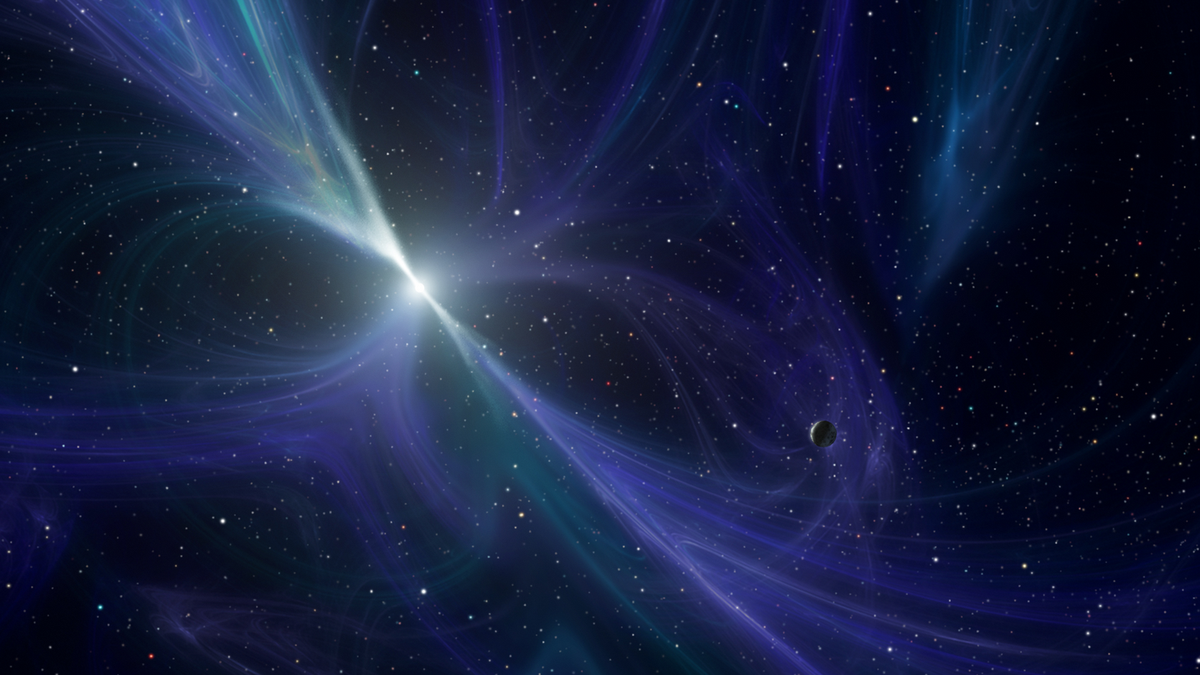
The matter inside neutron stars is extremely dense. For example, two Suns’ worth of mass is packed into a sphere only 25 km wide. This creates an immense pressure that could be forcing the neutrons into a new state of matter.
An old open problem in physics asks whether this state could be quark matter — when there are no longer any neutrons, only quarks.
In December 2023, researchers from the University of Helsinki reported in the journal Nature Communications that the insides of most massive neutron stars have an 80-90% chance of being made of quark matter.
The research team combined astrophysical observations with theoretical ab initio (from scratch) calculations to develop a model that they ran using a supercomputer, and arrived at this result. However, these astrophysical observations were small in number, meaning the result is not so reliable. Astrophysicists need more observational data to understand quark matter and how exactly it forms.
The need for quarks
A popular way of calculating the bulk properties of any material is to use an equation of state — an equation that, when solved with data about some of a material’s physical properties, reveals the values of other properties. For neutron stars, this is the Tolman-Oppenheimer-Volkoff equation: it is very complex but it assigns a probability to the presence of quarks within neutron stars.
Physics has a rich tradition of giving quirky names to things physicists find. For example, quarks come in six ‘flavours’ — three are called charm and strange; quarks themselves have a property called colour charge; and so on. The name ‘quark’ itself is courtesy physicist Murray Gell-Mann, who named these particles after a line in James Joyce’s 1939 masterpiece, Finnegan’s Wake.
Protons are positively charged and therefore have a magnetic moment (a turning force exerted by a magnetic field) associated with them. But neutrons have a magnetic moment, too, yet they are neutrally charged. So physicists in the 1960s figured neutrons must be made of smaller particles that gave rise to the magnetic moment but whose electric charges cancel themselves out. Gell-Mann called them quarks and their existence was confirmed in the 1970s.
Setting quarks free
There are six types of quarks: up, down, top, bottom, strange, and charm. Each quark can have one of three types of colour charge. Then there are also antiquarks, their antimatter versions. A quark-antiquark clump is called a meson (they don’t annihilate each other because they are of different types, e.g. up + anti-down). Three-quark clumps are called baryons and they form the normal matter surrounding us.
Quarks are further held together by another set of particles called gluons. Because nuclear forces are very strong, quarks are always tightly bound to each other and are not free, even in the vacuum of empty space.
The nuclear force that holds quarks together is explained by a theory called quantum chromodynamics. It predicts that at sufficiently high (by all means extreme) energies, nuclear matter can become ‘deconfined’ to create a new phase of matter in which quarks don’t have to exist in clumps.
Physicists have been able to obtain evidence of deconfinement by smashing lead ions against each other at very high energies in machines like the Large Hadron Collider. In these experiments, a state of matter called a quark-gluon plasma exists for a brief moment; the ‘plasma’ means the quarks are independent. According to the Big Bang theory, the universe was filled with this plasma before the particles clumped and formed the first blobs of matter.
This clumping process may release energy or modify its surroundings in a way that astrophysicists can look for, and eventually discover a quark star. Until then, the possibility will live on as one of the many open problems of physics.
Qudsia Gani is an assistant professor in the Department of Physics, Government Degree College Pattan, Baramulla.