


The story so far: Hong Kong’s new security law has drawn widespread criticism from several Western countries, the United Nations and human rights groups, which contend that the “rushed” legislation will further threaten freedom and empower the government to suppress dissent in the financial hub.
Hong Kong lawmakers fast-tracked the “Safeguarding National Security Bill,” unanimously passing it on March 19, within a fortnight of it first being tabled in the Legislative Council on March 8. The new rules, referred to as ‘Article 23’, revise existing regulations and penalties, and add five new categories of offences — treason, insurrection, espionage and theft of state secrets, sabotaging national security, and external interference — some of which carry penalties of imprisonment, even up to life.
The Hong Kong government has said that the home-grown security law, which became effective from March 23, would “plug the gaps” of a similar security legislation imposed by Beijing in 2020 in response to massive pro-democracy protests that rocked Hong Kong in 2019.
Also read | Hong Kong’s plan for new national security law triggers civil liberty fears
Why does Hong Kong have a new security law?
When the British, who had taken control of Hong Kong in the 19th century, handed over the territory to China in 1997, Beijing vowed to respect and preserve the region’s autonomy for 50 years as part of an agreed-upon policy, which came to be known as the “one country, two systems” principle. The Sino-British Joint Declaration of 1984 reflected the basic principles of the “one country, two systems” model and dictated the terms under which Hong Kong was to be returned to China.
The declaration and Hong Kong’s Basic Law, the city’s constitutional document that Beijing enacted in accord with the declaration, enshrined the city’s “capitalist system and way of life” and granted it “a high degree of autonomy” until 2047, says the Council on Foreign Relations (CFR). On July 1, 1997, Hong Kong became a Special Administrative Region of China and the Basic Law came into effect. The Basic Law guaranteed the rule of law and basic freedom of speech, and was formally adopted by China’s National People’s Congress in 1990.
However, escalating tensions between the pro-Beijing ruling elite and pro-democracy civil society in recent years resulted in a series of massive protests against China’s alleged attempts to erode Hong Kong’s autonomy.
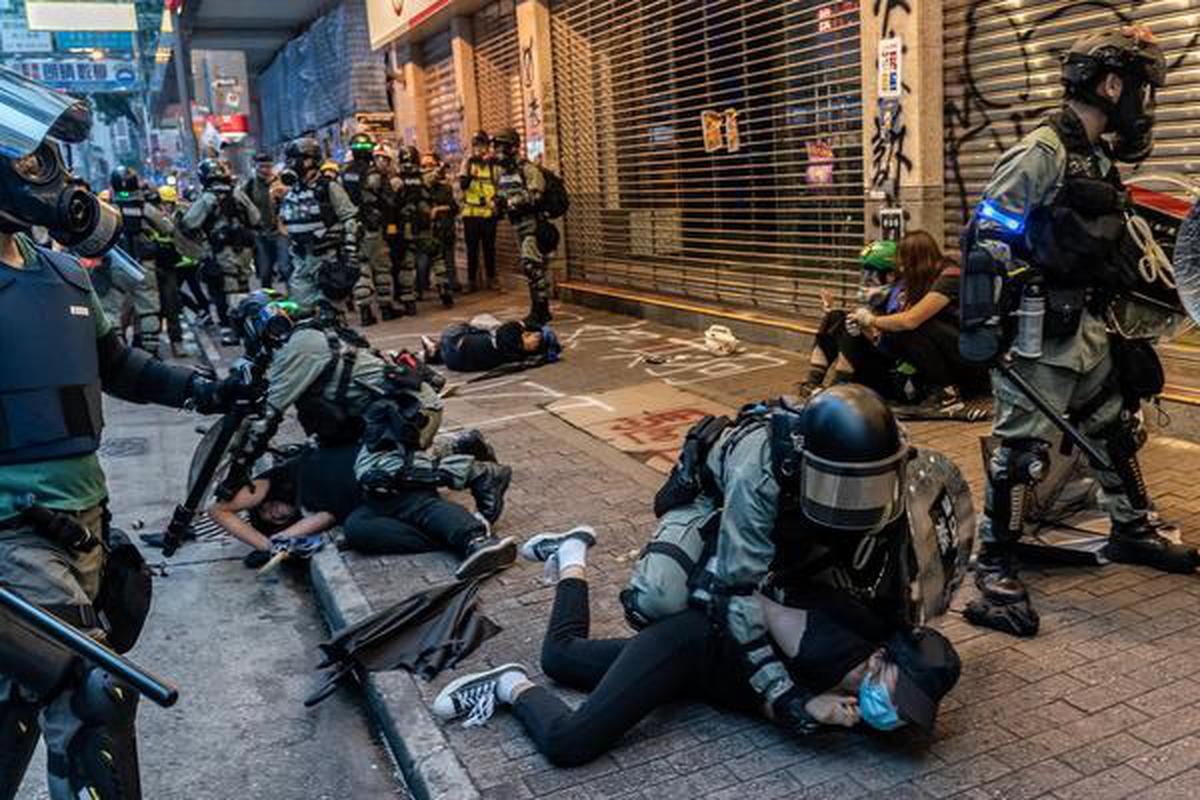
The 2019 anti-government demonstrations against a legislation that allowed extraditions of accused for trials in mainland China saw thousands of Hong Kongers taking to the streets, protesting against the increasing interference of Beijing and calling for more autonomy.This was followed by a police crackdown on protestors. The Bill was withdrawn, but police brutality against protestors continued until the outbreak of COVID-19, garnering international attention.
Pro-democracy protesters being arrested by police during a clash in Wan Chai district on October 6, 2019 in Hong Kong, China.
| Photo Credit:
Getty Images
In 2020, Beijing bypassed the local legislature and imposed a sweeping national security law on Hong Kong. The law criminalised subversion, secession, terrorism and collusion with foreign forces to intervene in the city’s affairs. It was widely seen as part of Beijing’s clampdown on dissent in response to the 2019 protests, as demonstrators were targeted and media outlets were shuttered. The authorities have since arrested nearly 300 people, mostly pro-democracy activists, lawmakers, and journalists, charging over 170, while many others have been silenced or forced into self-exile.
The Hong Kong government, which hailed the security law as restoring peace, came out with its version of the Beijing legislation earlier this year, arguing that a home-grown national security law was a “constitutional responsibility” under Article 23 of the Basic Law.
According to reports, Hong Kong officials felt that they needed to fill legal gaps, particularly to deal with “soft resistance” after the 2019 protests, since the Beijing-imposed law dealt with only some offences. Hong Kong’s pro-Beijing leader John Lee said the “long-overdue” legislation was necessary to keep Hong Kong safe against “potential sabotage” and “undercurrents that try to create troubles,” — particularly ideas of ‘Hong Kong’s independence.’
Also Read | The tale of Hong Kong, a city torn between two systems
What is Hong Kong’s Article 23?
Article 23 of the Basic Law mandates that the Hong Kong government must independently enact laws to prohibit national security offences. In 2003, a Bill related to Article 23 was first proposed, but the Hong Kong government was forced to withdraw the draft after nearly half a million people took to the streets in protest, fearing it would undermine civil liberties.
Nearly two decades later, in January this year, the local government began public consultation on a new local security law. The legislation aimed to target “an extremely small minority of people who endanger national security,” according to the government.
The Bill was introduced in the city’s Opposition-free legislature on March 8 for examination following a month-long public consultation. It was unanimously approved by lawmakers on March 19. The Hong Kong government claimed that its public consultation showed 99% support for the proposals.
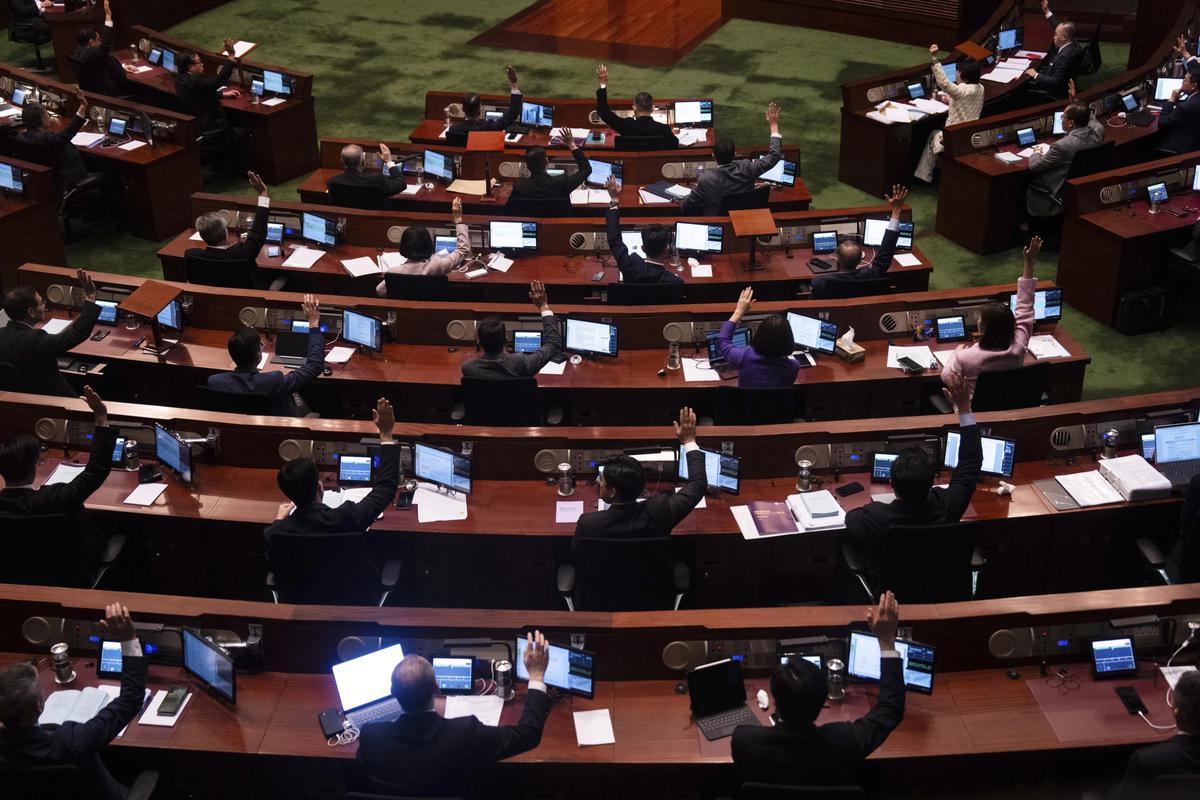
Lawmakers raise their hands to vote after the second reading of the Basic Law Article 23 legislation at the Legislative Council in Hong Kong, March 19, 2024.
| Photo Credit:
AP
What are the new offences and penalties under the new law?
The legislation expands upon the 2020 Beijing-imposed security law, encompassing offences related to theft of state secrets, treason, insurrection, national security, and external influence. It includes prison sentences of up to life for treason, insurrection, sabotage by colluding with external forces to damage public infrastructure and inciting members of the Chinese military to mutiny. Further, it imposes 20 years of imprisonment for espionage and 10 years for the unlawful disclosure of state secrets and sedition. The law grants police the authority to detain suspects for up to 16 days without charge and includes a provision for closed-door trials,BBC has reported.
1. Treason: A person accused of committing treason faces up to 14 years in jail for partnering with an external armed force that is at war with China, to endanger the sovereignty, unity or territorial integrity of the nation, or threaten or use force; publicly manifesting intentions to commit treason; or failing to report to authorities about another person they know who is committing treason.
2. Sedition: A person who “does an act or utters a word” with seditious intentions, or colludes with an external force with such intention faces up to 10 years in jail. The jail sentence for inciting armed forces personnel to mutiny is life imprisonment. Under the law, a law enforcement official has the power to remove or obliterate publications that have seditious intentions.
3. Theft of secrets: If convicted of espionage, a person could face 20 years of imprisonment. Unlawful acquisition, possession and disclosure of state secrets is punishable with a person facing up to 10 years in jail. As per the law, a state secret can be related to any major policy decisions, defence, diplomatic affairs, technological developments and the relationship between the China and Hong Kong governments.
4. Endangering national security: A person accused of damaging public infrastructure with the intent to endanger national security faces 20 years in jail, and life imprisonment if the act is done in collusion with an external force. A person unlawfully using a computer or electronic system to endanger national security also faces 20 years in jail.
5. External interference: The law looks to prevent foreign organisations from operating in the city by imposing tougher penalties on people convicted of working with such bodies to interfere in or influence government policy, the Legislative Council, courts, or elections. A person faces up to 14 years for such “external interferences.”
What is the cause of concern for lawmakers and human rights groups worldwide?
Lawmakers, politicians, international rights groups and pro-democracy activists from around the world have expressed “grave concerns” over the legislation. They have described the law as a “large nail in the coffin of human rights and the rule of law.”
A group of 88 international parliamentarians and public figures have issued a joint statement condemning the passage of the Bill under Article 23, calling on governments to unite against the “flagrant breach” of the Basic Law, the Sino-British Joint Declaration, and international human rights law.
“New legislation under Article 23 will bring a further devastating blow to the city’s autonomy, rule of law, rights and fundamental freedoms, beyond the impact of the National Security Law imposed by Beijing in 2020… The legislation undermines due process and fair trial rights and violates Hong Kong’s obligations under international human rights law, jeopardising Hong Kong’s role as an open international city,” the statement says. Signatories include leaders from the U.S., the U.K., Canada, South Korea and Malaysia.
Separately, the United Nations has described the law as “a regressive step for the protection of human rights in Hong Kong,” warning that it could erode fundamental freedoms. The U.K. has also cautioned against the law’s “far-reaching implications,” noting that its broad definitions of national security and external interference will make it harder for those living, working, and doing business in Hong Kong. The U.S. State Department has also expressed concerns about the vagueness of the law’s language.
The EU says the legislation could “significantly affect” its work in the city and impact Hong Kong’s “long-term attractiveness as an international business hub.”
Amnesty International’s China director Sarah Brooks said the law takes repression to the “next level.” “This legislation imports mainland Chinese legal concepts of ‘national security’ and ‘state secrets’ directly into Hong Kong law in a way that is deeply disturbing for the city’s future,” Ms. Brooks said in a statement.
What is China’s defence?
A defiant China has hit back at the international community for interfering in its internal affairs. Beijing maintains that the law “fully safeguards” the rights and freedoms of Hong Kong residents and will protect “core national interests,” allowing Hong Kong to focus on economic development.
Chinese Foreign Ministry spokesperson Lin Jian has emphasised Beijing’s firm opposition to the “smearing and slandering” of the legislation by some countries, stating that the new law balances the protection of national security, safeguarding rights and freedom, and promoting economic development. The spokesperson warned that any attacks or attempts to discredit the new law are “doomed to fail.”
China has also hit back strongly at the U.K. for “blatantly trampling” on international law and basic norms, accusing it of displaying a “deep-rooted colonial mentality and teacher-like behaviour.”
Meanwhile, the spokesperson for the Commissioner’s Office of China’s Foreign Ministry in Hong Kong asserts that the legislation will not interfere with normal commercial activity, markets, or the free flow of information.