
Skip to content
  • Facebook
  • X
  • Linkedin
  • WhatsApp
  • Associate Journalism
  • About Us
  • Privacy Policy
  • 033-46046046
  • editor@artifex.news
Artifex.News

Artifex.News

Stay Connected. Stay Informed.

  • Breaking News
  • World
  • Nation
  • Sports
  • Business
  • Science
  • Entertainment
  • Lifestyle
  • Toggle search form
  • Exide Energy to double lithium cell production in Karnataka Business
  • Germany recalls Russia envoy over cyberattack World
  • India vs Bangladesh live score over Super Eight – Match 7 T20 11 15 updates Sports
  • Injured Pak pacers Rauf, Naseem doubtful for remainder of Asia Cup; Dahani, Zaman added as back-ups Sports
  • IPL 2024 Points Table: Royal Challengers Bengaluru Register First Victory. The Leaders Are… Sports
  • What are the regulations with respect to rice prices? | Explained Business
  • At President’s G20 Dinner, Ancient Musical Instruments To Delight Guests World
  • Data Point | Fly Me to the Moon: A Glimpse into India’s Space Achievements Science

Kerala takes a pioneering step to curb antimicrobial resistance

Posted on February 24, 2024 By admin


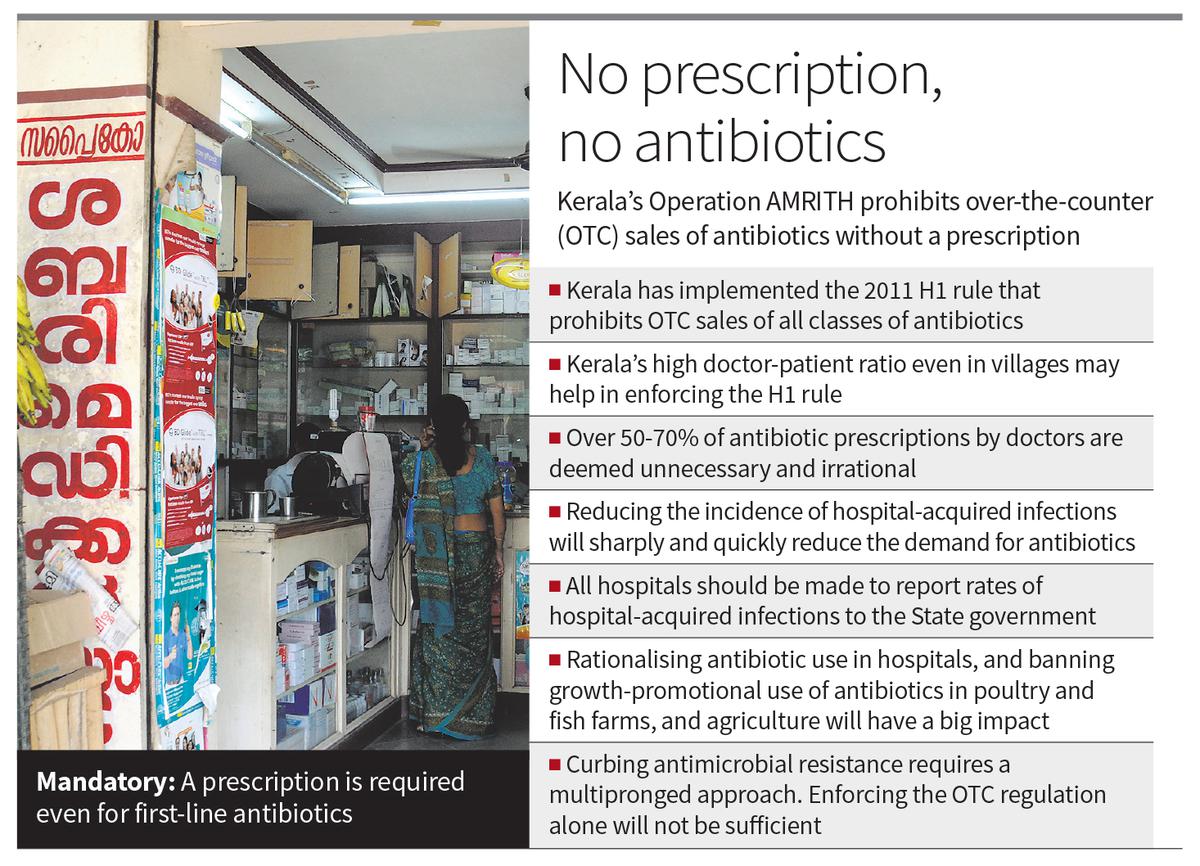
In 2011, the Indian government introduced the H1 rule to prohibit the over-the-counter (OTC) sales of antibiotics without a prescription, responding to the growing concern over antimicrobial resistance (AMR). However, due to the healthcare system’s heterogeneity across the country, the implementation of this rule faced significant challenges. In 2013, following the Chennai Declaration document and initiative by medical societies in India, the Indian government modified the rule to limit the OTC restriction to second- and third-line antibiotics, allowing the sale of first-line antibiotics without a prescription. This modification was aimed to ensure that life-saving antibiotics remained accessible to the public, especially in remote areas of the country where doctors might not be readily available. Despite a decade passing since the rule’s announcement, no State government had adopted it until Kerala recently initiated Operation AMRITH (Antimicrobial Resistance Intervention for Total Health). This programme enforces the original H1 rule, mandating a doctor’s prescription for acquiring any class of antibiotics.

Kerala’s high doctor-patient ratio, even in villages, facilitates the enforcement of this rule. Also, the high literacy rate in the State is poised to contribute significantly to the efficient implementation of the rule. An informed populace is more likely to understand the importance of regulations like these and adhere to them, facilitating smoother execution and compliance. While it is highly commendable that Kerala is implementing the H1 rule to rein in AMR, it is unlikely to have a significant impact on drug-resistant infections in the immediate future. The effects of this initiative may take several years, if not a decade, to manifest. However, it will foster a culture of respecting antibiotics and encourage further actions to combat AMR.

It is critical to acknowledge that over 50-70% of antibiotic prescriptions by doctors are deemed unnecessary and irrational. One of the main reasons for unnecessary antibiotic usage is the unavailability of laboratory facilities to make a correct diagnosis of bacterial infections. Even if they are available, these tests are more expensive than a course of antibiotics. Enhancing laboratory facilities for accurate infection diagnosis, especially with affordable rapid diagnostic tests to determine the necessity of antibiotics, is therefore vital. The other main reason for unnecessary antibiotic prescriptions by doctors is the pressure from patients to receive antibiotics; patients wrongly believe that a course of antibiotics is a quick remedy for a fever episode of any cause. Educating patients about the limitations of antibiotics and discouraging them from pressuring doctors for unnecessary prescriptions is vital.

While it is commendable that the OTC regulation without a prescription has been put into place, what is even more important is that Kerala demand hospitals to disclose the incidence of hospital-acquired infections. Antimicrobial resistance is a socioeconomic problem, and combating it requires measures to improve public health infrastructure, sanitation facilities, and governance in order to decrease the transmission of infections and, therefore, the dependence on antibiotics. The influence of these factors on antimicrobial resistance rates is typically greater than that of the total volume of antibiotics used.

In order to reduce the spread of these infections, healthcare facilities must follow the correct standards for infection prevention. There must be a system where all hospitals report rates of hospital-acquired infections to the State government. Ideally, the data should be made public. Currently, all NABH hospitals collect this data every month and take measures to reduce hospital-acquired infections. But it is crucial that all hospitals follow suit and share the data with the State. There will be greater and immediate long-term benefits of lowering AMR-related fatalities if measures to reduce hospital-acquired infections are successfully implemented.

Other essential measures, including rationalising antibiotic use in hospitals, banning the growth-promotional use of antibiotics in poultry farms, fish farms, and agriculture based on the already existing rules, are of paramount importance. Additionally, Kerala will do well if it supports and promotes the development of new antibiotics, diagnostics, and vaccines by entrepreneurs. Karnataka and Maharashtra-based startups have achieved remarkable progress in this domain. Startups based on novel service delivery models may help us make better use of our human resources when it comes to antibiotic stewardship and infection prevention.

While enforcing the OTC regulation is a welcome step, curbing antimicrobial resistance requires a multipronged approach, including reformations to physicians’ prescribing practices and mandating that hospitals report healthcare-associated infection rates. Strictly enforcing the OTC regulation without addressing the other issues, which are major drivers of antimicrobial resistance, may not help the cause. Enforcing the H1 rule is a relatively easy goal. The real challenge will be tackling the major drivers of AMR.

(Abdul Ghafur is coordinator, Chennai Declaration on AMR, and consultant in infectious diseases, Apollo Hospitals, Chennai)



Source link

Science Tags:Antimicrobial resistanc, antimicrobial resistance, H1 rule, Kerala, Over-the-counter sales of antibiotics

Post navigation

Previous Post: Navalny’s widow says Putin blocking body handover
Next Post: “Briefly Crossed My Mind”: Joe Root Wanted To Repeat “Stupidest Shot In English Test History”. Here’s Why He Didn’t

Related Posts

  • New crew for the space station launches with 4 astronauts from 4 countries Science
  • Sci-Five | The Hindu Science Quiz: On the third eyelid Science
  • Female right whales may never breed after run-ins with fishing gear Science
  • New method to generate virus-like particles, to help with developing antibodies against Nipah Science
  • Russia’s Luna-25 spacecraft suffers technical glitch, space agency says Science
  • Ultradian rhythms: The cycles of life Science

More Related Articles

ISRO Chairman seeks more investment from industry in space sector Science
What was the tussle over Covaxin IPR? | Explained Science
This worm develops food habits and its offspring ‘inherit’ them Science
Echolocation: What goes around comes around Science
Deep tech investments in India doubling every three years, crossed $1 billion between 2021-23: Report Science
Rising temperatures are leading to torrential rains in the Himalayas Science
SiteLock

Archives

  • July 2024
  • June 2024
  • May 2024
  • April 2024
  • March 2024
  • February 2024
  • January 2024
  • December 2023
  • November 2023
  • October 2023
  • September 2023
  • August 2023
  • July 2023
  • June 2023
  • May 2023
  • April 2023
  • March 2023
  • February 2023
  • January 2023
  • December 2022
  • November 2022
  • October 2022
  • September 2022
  • August 2022
  • July 2022
  • June 2022
  • May 2022

Categories

  • Business
  • Nation
  • Science
  • Sports
  • World

Recent Posts

  • River Seine To Have Flying Taxi Landing Pad At Paris Olympics
  • Hathras Stampede, Bhole Baba: Hathras Organisers “Failed To Make Adequate Arrangement”: Probe Report
  • Viswanathan Anand’s Rajinikanth Style Welcome As R Ashwin Buys Chess Team
  • Rotten eggs chemical detected on Jupiter-like alien planet
  • Hathras Stampede Tragedy Reaches Supreme Court, Hearing On Friday

Recent Comments

  1. ywdVpqHiNZCtUDcl on UP Teacher Who Asked Students To Slap Muslim Classmate
  2. bRstIalYyjkCUJqm on UP Teacher Who Asked Students To Slap Muslim Classmate
  3. GkJwRWEAbS on UP Teacher Who Asked Students To Slap Muslim Classmate
  4. xreDavBVnbGqQA on UP Teacher Who Asked Students To Slap Muslim Classmate
  5. aANVRzfUdmyb on UP Teacher Who Asked Students To Slap Muslim Classmate
  • Suspected Gunman Who Killed 2 Swedes In Brussels Shot Dead: Report World
  • Andrew Tate, Brother To Be Extradited To UK Over Sexual Assault Charges World
  • “Can’t See India Winning T20 World Cup Unless…”: Ex-Australia Captain’s ‘Virat Kohli’ Warning Sports
  • 19 Assam Products, Traditional Crafts Get GI Tag: Himanta Sarma Nation
  • PV Sindhu One Step Away From Malaysia Masters Title Sports
  • U.S. President Biden offers massive immigration relief to non-citizens ahead of election World
  • UP Conductor Sacked After Stopping Bus For Namaz, Dies By Suicide Nation
  • 5 Facts About Gourav Vallabh Who Quit Congress Today Nation

Editor-in-Chief:
Mohammad Ariff,
MSW, MAJMC, BSW, DTL, CTS, CNM, CCR, CAL, RSL, ASOC.
editor@artifex.news

Associate Editors:
1. Zenellis R. Tuba,
zenelis@artifex.news
2. Haris Daniyel
daniyel@artifex.news

Photograher:
Rohan Das
rohan@artifex.news

Artifex.News offers Online Paid Internships to college students from India and Abroad. Interns will get a PRESS CARD and other online offers.
Send your CV (Subjectline: Paid Internship) to internship@artifex.news

Links:
Associate Journalism
About Us
Privacy Policy

News Links:
Breaking News
World
Nation
Sports
Business
Entertainment
Lifestyle

Registered Office:
72/A, Elliot Road, Kolkata - 700016
Tel: 033-22277777, 033-22172217
Email: office@artifex.news

Editorial Office / News Desk:
No. 13, Mezzanine Floor, Esplanade Metro Rail Station,
12 J. L. Nehru Road, Kolkata - 700069.
(Entry from Gate No. 5)
Tel: 033-46011099, 033-46046046
Email: editor@artifex.news

Copyright © 2023 Artifex.News Newsportal designed by Artifex Infotech.