




For representative purposes.
| Photo Credit: iStockphoto
The story so far: Recently various Opposition-ruled States especially from south India have claimed that they have not been receiving their fair share as per the present scheme of financial devolution. They have raised issues about their less than proportionate share of receipt in tax revenue when compared to their contribution towards tax collection.
What is divisible pool of taxes?
Article 270 of the Constitution provides for the scheme of distribution of net tax proceeds collected by the Union government between the Centre and the States. The taxes that are shared between the Centre and the States include corporation tax, personal income tax, Central GST, the Centre’s share of the Integrated Goods and Services Tax (IGST) etc. This division is based on the recommendation of the Finance Commission (FC) that is constituted every five years as per the terms of Article 280. Apart from the share of taxes, States are also provided grants-in-aid as per the recommendation of the FC. The divisible pool, however, does not include cess and surcharge that are levied by the Centre.
How is the Finance Commission constituted?
The FC is constituted every five years and is a body that is exclusively constituted by the Union Government. It consists of a chairman and four other members who are appointed by the President. The Finance Commission (Miscellaneous Provisions) Act, 1951, has specified the qualifications for chairman and other members of the commission. The Union government has notified the constitution of the 16th Finance Commission under the chairmanship of Dr. Arvind Panagariya for making its recommendations for the period of 2026-31.
What is the basis for allocation?
The share of States from the divisible pool (vertical devolution) stands at 41% as per the recommendation of the 15th FC. The distribution among the States (horizontal devolution) is based on various criteria. Table 1 lists the criteria for horizontal devolution among the States from the 11th to 15th FC.
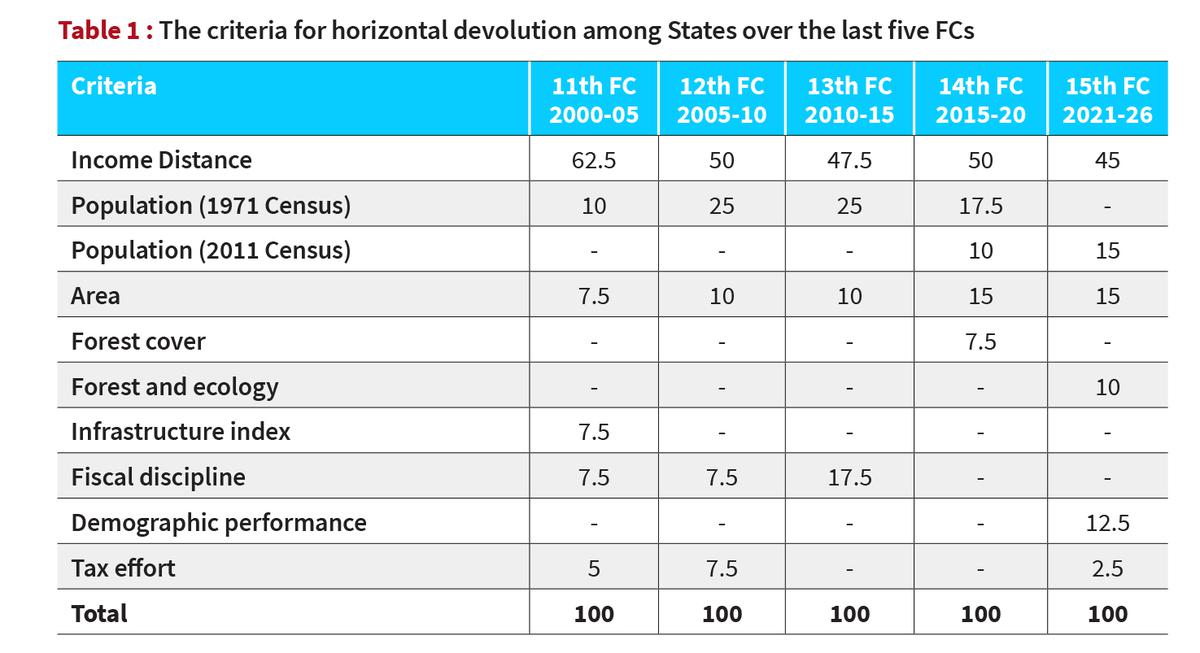
The criteria as per the 15th FC can be briefly explained as follows. ‘Income distance’ is the distance of a State’s income from the State with highest per capita income which is Haryana. States with lower per capita income would be given a higher share to maintain equity among States. ‘Population’ is the population as per the 2011 Census. Till the 14th FC, weightage was given for the population as per the 1971 Census but that has been discontinued in the 15th FC. ‘Forest and ecology’ consider the share of dense forest of each State in the aggregate dense forest of all the States. ‘The demographic performance’ criterion has been introduced to reward efforts made by States in controlling their population. States with a lower fertility ratio will be scored higher on this criterion. ‘Tax effort’ as a criterion has been used to reward States with higher tax collection efficiency.
What are the issues?
The Constitutional scheme has always favoured a strong centre in legislative, administrative and financial relations. However, federalism is a basic feature and it is important that States don’t feel short-changed when it comes to distribution of resources. While there are always political differences between the Union government and Opposition-ruled States that exacerbate the problem, there are genuine issues that need to be considered.
Firstly, cess and surcharge collected by the Union government is estimated at around 23% of its gross tax receipts for 2024-25, which does not form part of the divisible pool and hence not shared with the States. To provide a perspective, the total tax revenue for the year 2022-23 (actual), 2023-24 (revised estimates) and 2024-25 (Budget estimates) of the Union government is ₹30.5, ₹34.4 and ₹38.8 lakh crore respectively. The State’s share was/is ₹9.5, ₹11.0 and ₹12.2 lakh crore respectively, which constitutes around 32% of the total tax receipts of the Centre which is way less than the 41% recommended by the 15th FC. Cess like the GST compensation cess is for the repayment of loans taken to compensate States for the shortfall in tax collection due to GST implementation for the period 2017-22. Some of these amounts are also used for centrally sponsored schemes that benefit the States. However, the States have no control over these components.
Secondly, the amount each State gets back for every rupee they contribute to Central taxes shows steep variation. Chart 1 depicts the same for the year 2021-22.
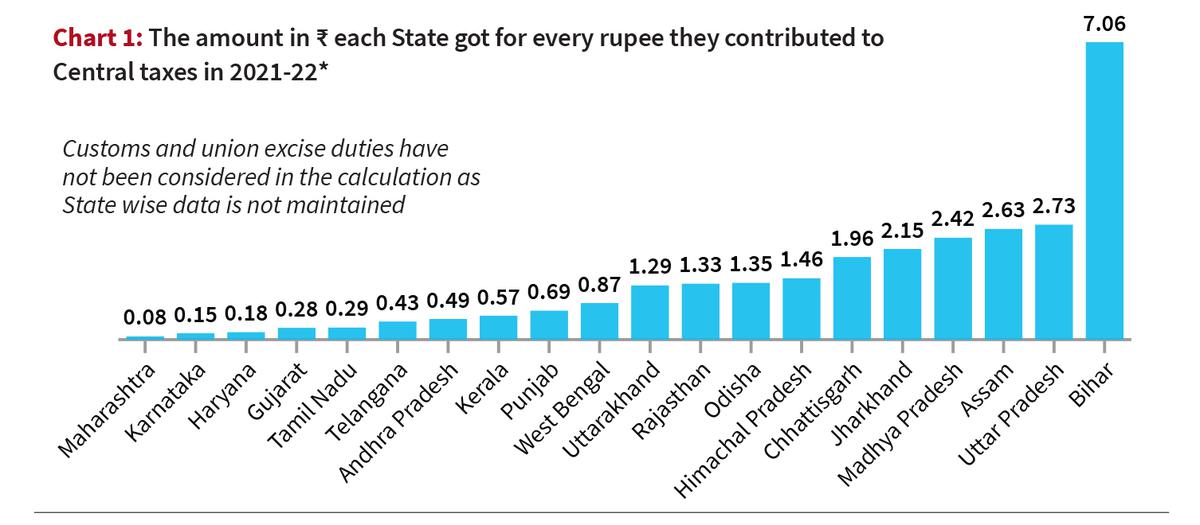
It can be seen that industrially developed States received much less than a rupee for every rupee they contributed as against States like Uttar Pradesh and Bihar. This is partly due to the fact that many corporations are headquartered in these State capitals where they would remit their direct taxes. However, this variation can also be attributed to the difference in GST collection among various States.
Third, the percentage share in the divisible pool of taxes has been reducing for southern States over the last six FCs as can be seen in Chart 2.
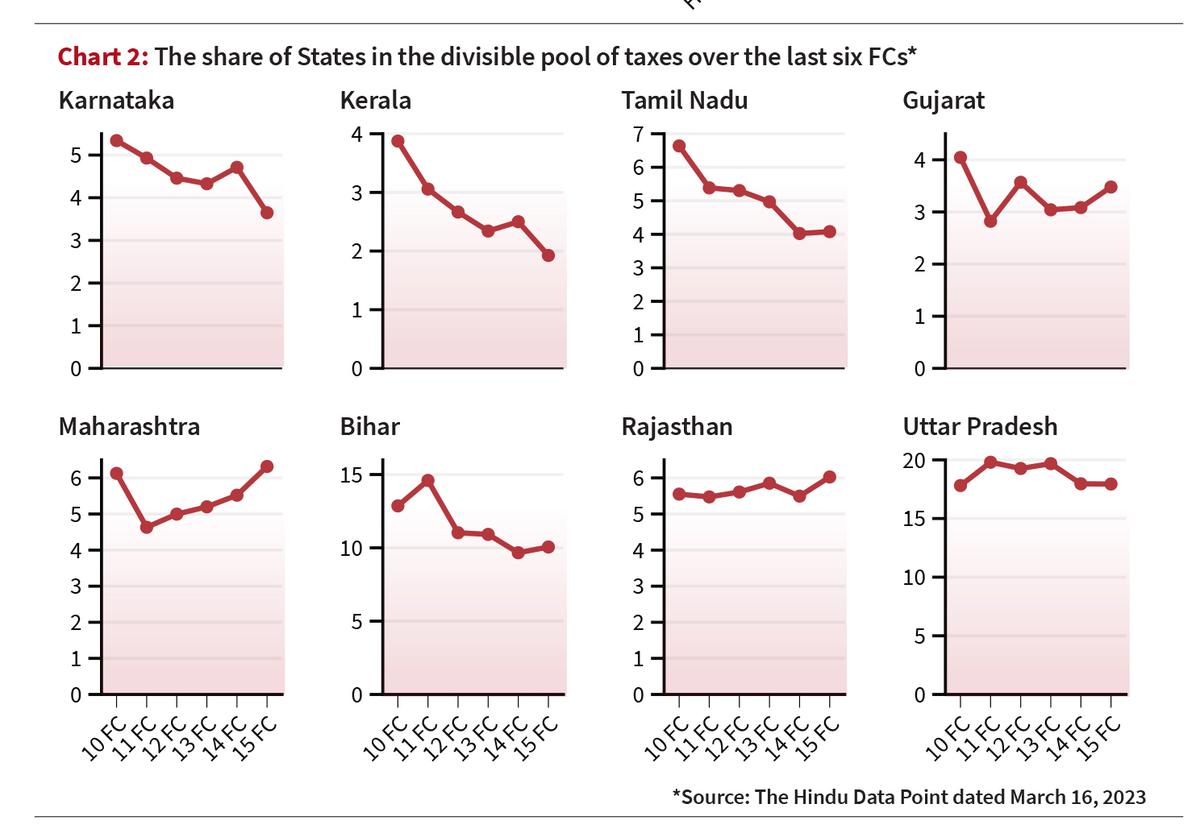
This is attributable to the higher weightage being given for equity (income gap) and needs (population, area and forest) than efficiency (demographic performance and tax effort). Finally, grants-in-aid as per the recommendation of the FC varies among various States. As per the 15th FC, there are revenue deficit, sector-specific and State-specific grants given to various States as well as grants to local bodies that are given based on population and area of States.
What can be the way forward?
It must be noted that States generate around 40% of the revenue and bear around 60% of the expenditure. The FC and its recommendations are meant to assess this imbalance and propose a fair sharing mechanism. It is the responsibility of all States to contribute towards the more equitable development of our country. However, there are three important reforms that may be considered for maintaining the balance between equity and federalism while sharing revenue.
Firstly, the divisible pool can be enlarged by including some portion of cess and surcharge in it. The Centre should also gradually discontinue various cesses and surcharges it imposes by suitably rationalising the tax slabs. Secondly, the weightage for efficiency criteria in horizontal devolution should be increased. GST being a consumption-based destination tax that is equally divided between the Union and the State means that State GST accrual (inclusive of Integrated GST settlement on inter-state sales) should be the same as the Central GST accrual from a State. Hence, relative GST contribution from States can be included as a criterion by providing suitable weightage in future FCs. Finally, similar to the GST council, a more formal arrangement for the participation of States in the constitution and the working of the FC should be considered.
These are measures that need to be implemented by the Centre after discussion with all the States. It is also imperative that the States uphold principles of fiscal federalism by devolving adequate resources to local bodies for vibrant and accountable development.
Rangarajan. R is a former IAS officer and author of ‘Polity Simplified’. He currently trains civil-service aspirants at ‘Officers IAS Academy’. Views expressed are personal.