


Increasingly over the past few decades, many Hindus have insisted on reclaiming three ‘lost temples’ upon which mosques were allegedly built by Mughal emperors – the Babri Masjid (Ram Janmabhoomi), the Shahi Idgah mosque (Krishna Janmabhoomi) and the Gyanvapi mosque (Vishweshwar Temple). With the construction of the Ram Temple at the site where the Babri Masjid stood in Ayodhya, movements in Mathura and Varanasi have regained fervour.

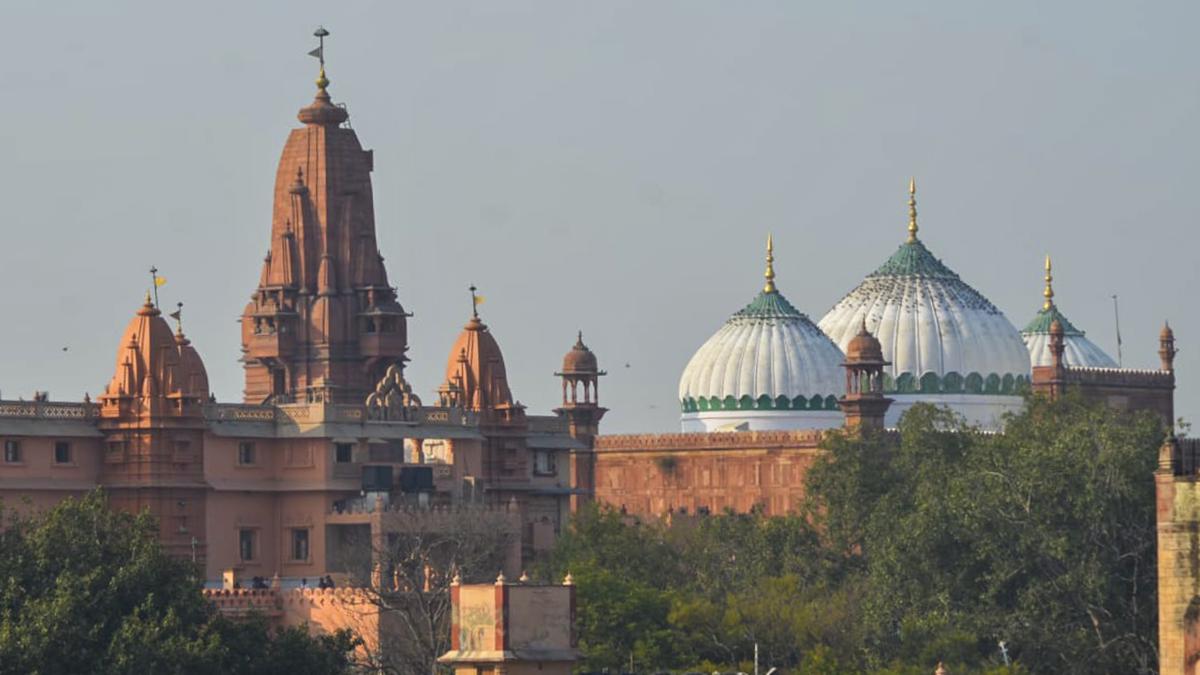
A view of Shri Krishna Janmabhoomi Temple, in Mathura on August 20, 2022
| Photo Credit:
Sandeep Saxena
Unlike the Ram Janmabhoomi movement, where Hindus sought to build a Ram Temple at the site of the demolished Babri Masjid, there already exists a temple complex named the Krishna Janmasthan Temple Complex in Mathura adjacent to the Shahi Idgah mosque. The complex comprises of three temples – the Keshavadeva temple, the Garbha Griha with an underground prison cell to mark the place Lord Krishna was said to be born and the Bhagavata Bhavan dedicated to the ancient Hindu text Srimad Bhagavata.

The Shree Krishna Janmasthan Seva Sangh and Shahi Idgah committee signed an agreement in 1968 granting the temple land to the Trust and the mosque to the Shahi Idgah mosque. This agreement had relinquished the Trust’s legal claim on the mosque. However, a plea to hand over the entire land (housing both the temple and the mosque) has now been filed in court, with historical evidence being cited of a large temple built where the Shahi Idgah mosque stands.
Here’s a look at the history to ‘reclaim’ Lord Krishna’s birthplace in Mathura, with a timeline of the dispute and attempts to address it.
Claims of a Vasudeva temple built in 4th century
American historian A W Entwistle in his book ‘Braj, Center of Krishna Pilgrimage’ suggests that a temple exists at the site of the Shahi Idgah. He claims that the oldest temple dedicated to Vasudeva (Lord Krishna) existed in the fourth century B.C at the Katra site in Mathura built during the reign of Chandragupta-II. Former Mathura museum curator Dr. Vasudeva Sharan Agrawala, while researching sculptures of the Kusana and Gupta period, reportedly found stones at the Katra site bearing an inscription about a ‘great temple built for Vasudeva’. Given its size and style, the stone is thought to be from the seventh or eighth century, bearing inscriptions from the western parts of North India.

Invasion & destruction of Keshavadeva temple (1017-1670)
The destruction of the ‘original’ Keshavadeva temple allegedly occurred in 1017 when Persian Sultan Mahmud of Ghazni invaded India, as per medieval historians Badauni and Ferishta. Mr. Entwistle claims that when the Sultan reached Mathura, he ordered the burning of ‘a temple larger than the others in the middle of the city’ to the ground. However, the temple withstood the fire, though Jain and Buddhist centres around the city did not.
Excavations made by railway contractors at the Katra site in 1889 led to an Archaeological Survey of India (ASI) team discovering that the damaged temple was repaired by one Jajja in 1150, a vassal of Gahadavala King Vijayapala and was in-charge of Mathura. The temple, described as ‘brilliantly white and touching the clouds’, remained till the 15th century when Sultan Sikandar Lodi demolished Hindu, Jain and Buddhist temples in Mathura,according to Mr. Entwistle.
With the fall of the Lodi dynasty in the Battle of Panipat, the Mughals began their expansion across India. Under Emperor Akbar, temples were given land and revenue grants, leading to a resurgence of temple construction. Mr. Entwistle says that a Krishna shrine named the ‘Dera Keshava Rai temple’ was built by Raja Bir Singh Deo Bundela — the ruler of Bundelkhand, during Emperor Akbar’s son Jahangir’s reign in 1618.

Citing the ASI discovery in 1889, Hindus claim that the temple was built in the same spot where the Shahi Idgah mosque currently stands, adding that the Raja had chosen that spot after identifying it as the place where Lord Krishna’s parents Vasudeva and Devaki were kept imprisoned and where the Lord himself was born.
The Dera Keshava Rai Temple continued to exist for several generations as successive Mughal rulers propogated religious co-existence, prior to its demolition by Emperor Aurangazeb in 1670. Aurangazeb had issued a diktat ordering the demolition of all Hindu schools and temple across his empire, which included the Vishwanath temple in Kashi and the Keshavadev temple in Mathura.
Two conflicting versions of the reason for Aurangazeb’s demolition of the Keshavadeva temple have emerged. American historian Audrey Truschke argues in her book ‘Aurangzeb: The Man and the Myth’ that the temple was razed by the Mughal for political reasons rather than religious ones. She claims that it was to punish the Mathura Brahmins in aiding the Maratha king Shivaji Maharaj’s escape in 1666 from Agra, to quell Jat uprisings in Mathura at that time and to oppose Dara Shikoh – his eldest brother and rival to the Mughal throne.

Meanwhile, Indian historian Jadunath Sarkar in his five-volume ‘History of Aurangazib’ says that on April 9, 1669, Aurangazeb issued an order to demolish all schools and temples of Hindus, including the Somnath, Vishwanath and the Dera Keshava Rai temples. He claims that on learning that a stone railing had been erected around the temple by his brother Dara Shikoh, Aurangazeb ordered its removal, destruction of the temple and changing of the city’s name to ‘Islamabad’.
Transfer to British empire, auction & reconstruction
As the Mughal empire declined, the East India Company took over the entire district by 1803. In 1815, wealthy Benaras businessman Raja Patni Mal acquired the 13.77 acre-land which includes the 2.5 acre land housing the Shahi Idgah mosque from the East India company via auction. While Muslims challenged the auction and Raja Patni Mal’s possession of the land, all cases were dismissed, affirming that he and his descendants were rightful owners of the land.
In 1944, his descendants Rai Kishan Das and Rai Anand Das sold the entire land to Congress leader Pandit Madan Mohan Malviya for Rs 13,400, paid by noted industrialist Jugal Kishore Birla who wished to construct a temple at the original Katra site. While Mr. Malviya passed away in 1946, Mr. Birla formed a private trust named the ‘Shri Krishna Janmabhoomi Trust’ in 1951 to fulfill the late Hindu leader’s dream of a temple at Lord Krishna’s birthplace. The land rights were then transferred to the Trust with the condition that the property would not be sold or pledged and the land would be solely used to construct the temple.

Lighting at Krishna Janmasthan Temple on the eve of the consecration ceremony of Ayodhya’s Ram Mandir, in Mathura, Sunday, January 21, 2024
| Photo Credit:
PTI
As construction of the temple began in 1953 in the land adjacent to the mosque, under the leadership of industrialist Jaidayal Dalmia, a new body named the Shri Krishna Janmasthan Sewa Sangh was formed in 1956 under Uttar Pradesh society law to manage the affairs of the temple Trust. A wall was constructed to separate the mosque and the temple. The word ‘Sangh’ was substituted with Sansthan in 1977.

In 1967, the Trust asked hutments and tenants to vacate the premises so that the new temple could be constructed. These tenants, backed by the Shahi Idgah Committee which managed the mosque, challenged the notice issued to them.
As the impasse continued, the Shri Krishna Janmasthan Sewa Sangh and the Shahi Idgah Committee came to an agreement in 1968. The Committee agreed to vacate Muslim tenants living outside the mosque’s walls on the north and south side and hand over the land to the Sangh. Ownership of the land within the northern walls (i.e. the Shahi Idgah mosque complex) was relinquished by the Sangh to the Committee. Moreover, the mosque agreed to not fix any door, window, grill or open a drain towards the temple and vice-versa. The land outside the mosque inside the walls was also handed over to the Committee.
Construction of the Krishna Janmasthan complex was completed in 1982, and presently houses three temples. The Keshavadeva temple, built in the memory of Jadiadevi Dalmia, has the main deity Krishna and is located outside the southern side of the mosque. The Garbha Griha (sanctum sanctorum) has a marble structure with an underground prison cell to mark Krishna’s birthplace and the Bhagvata Bhavan which has five shrines dedicated to deities: Radha-Krishna, Balarama-Subhadra-Jagannath, Ram-Lakshman-Sita, Durga and Shiva. The complex also has a deep steeped water tank, supposed to mark baby Krishna’s first bath.
Litigation battle (1993-2024)
1993: Post demolition of the Babri Masjid in December 1992, a Vrindavan resident named Manohar Lal Sharma filed a case in the Mathura District court challenging the 1968 agreement between the Shri Krishna Janmasthan Sewa Sangh and the Shahi Idgah Committee, claiming that the Sangh did not have the authority to act on behalf of the Shri Krishna Janmabhoomi Trust and that it did not have legal ownership of the 13.77 acre land in question.
2020: Shortly after the 2019 Supreme Court verdict on the Ram Janmabhoomi – Babri Masjid dispute, advocate Ranjana Agnihotri filed a civil suit on behalf of the deity ‘Bhagwan Shri Krishna Virajman’ challenging the 1968 agreement between the Sangh and the Committee, claiming the original Shri Krishna Janmabhoomi Trust, established in 1951 was not party to it and neither was the deity in question.
The suit also claims that the Sangh deceived Hindus as the original ‘birthplace’ of the deity was beneath the mosque and not at the adjacent site built by the Trust. Seeking scrapping of the agreement, the suit seeks that the deity be declared as the owner of the entire land. It further seeks removal of the mosque and handover of the vacant land to the Trust.

A View of the Shahi Idgah Masjid at Mathura in Uttar Pradesh on Saturday, October 15, 2022
| Photo Credit:
R. V. Moorthy
More than a dozen civil suits were filed across various courts in Agra and Mathura pertaining to the Krishna Janmabhoomi dispute. While most of them seek the scrapping of the 1968 agreement, some of them want an archaeological survey of the mosque to ascertain the existence of the original Katra Keshavadeva temple beneath it. Certain parties want the entire land to be handed over to the Shri Krishna Janmabhoomi Trust, and the shifting of the Shahi Idgah mosque to another suitable location.
2022: After hearing several suits pertaining to the land dispute, a Mathura civil court, on December 24, ordered a survey of the Shahi Idgah Masjid, directing court officers to visit the mosque and submit a report with detailed site plans and maps of the site. The order was passed mere days after a Varanasi court admitted pleas of Hindu parties seeking access to the Shringar Devi site in the Gyanvapi mosque to offer prayers.
2023: With a Varanasi court ordering the ASI to conduct a scientific survey of the Gyanvapi mosque premises to ascertain if any Hindu temple had existed beneath the mosque, the Shri Krishna Janmabhoomi Trust, on August 12, filed a suit seeking cancellation of the 1968 agreement between the mosque committee and its own body, the Shri Krishna Janmasthan Sewa Sangh.

A team of the Archaeological Survey of India (ASI) during scientific survey at the Gyanvapi mosque complex, in Varanasi, Tuesday, August 8, 2023.
| Photo Credit:
PTI
The Trust claimed that the Sangh (later known as Sansthan), which was formed for merely managing the temple’s affairs, did not have the authority to decide on the question of ownership of the 13.37-acre land. The Trust also pointed out that the body was later dissolved and hence the agreement finalised by a Mathura civil judge in 1973-74 was ‘not binding’. All eighteen cases regarding the Krishna Janmabhoomi were clubbed by the Allahabad High Court which began hearing pleas soon after.

Another party named the Shri Krishna Janmabhoomi Mukti Nirman Trust moved the Supreme Court, seeking a scientific survey of the mosque. The plea also challenged the validity of the 1991 Places of Worship Act, which protects against changing the ‘character’ of any place of worship as it exists on August 15, 1947. However, the SC refused to entertain the plea, stating that the matter was pending with the Allahabad High Court.
Finally, on December 14, the Allahabad High Court allowed a court-monitored inspection of the Shahi Idgah mosque. The inspection will be done by a court-monitored three-member team of advocate commissioners, said Judge Mayank Kumar Jain, while hearing a bunch of pleas on the land dispute.
The main plea, filed in 2020, claims that there were number of signs in the Shahi Idgah mosque to establish that there was temple at the site. Pointing to a ‘kalash’ (pot) and a pinnacle at top of the structure, a lotus-shaped pillar top at the main gate, and a Sheshnag (snake) etched on the walls, the plea claims that these symbols exemplify Hindu architectural style and are not present on any Islamic structure.
2024: Hearing pleas by the UP Sunni Central Wakf board and the Shahi Idgah mosque challenging the survey, the Supreme Court, on January 16, stayed the Allahabad High Court’s order allowing a court-monitored commission to inspect the Shahi Idgah mosque. The SC has said that the court’s order was passed on an “omnibus, vague” application for inspection of the mosque premises. The stay was further extended till the next hearing in April.
Meanwhile on January 25, the ASI report on the Gyanvapi mosque in Varanasi concluded that the western wall of the mosque is the remaining part of a pre-existing Hindu temple and found sculptures of Hindu deities in the cellar of the mosque. On publishing of the ASI report, a Varanasi court gave access to Hindus to offer prayers at the southern cellar of the mosque. Muslims have approached the High Court challenging this.
The Hindus scored another win when the Allahabad High Court, on August 1, dismissed the plea filed by the Shahi Eidgah mosque committee challenging maintainability of 18 lawsuits initiated by Hindu devotees, citing the Places of Worship Act 1991. The court opined that Act does not define ‘religious character’, paving the way for trial.
Citing a 1920 notification by the Lieutenant Governor, United Province, Agra and Oudh, the court said, “It indicates the existence of a temple of Keshav Dev prior to its demolition. After the demolition, the site was utilised as the mosque of Aurangzeb”.
With a favourable ASI report in the Gyanvapi case, the inauguration of the Ram Temple in Ayodhya, and an impending trial in Mathura, Hindu parties have redoubled their efforts to reclaim ‘Krishna janmabhoomi’.