

Skip to content
  • Facebook
  • X
  • Linkedin
  • WhatsApp
  • Associate Journalism
  • About Us
  • Privacy Policy
  • 033-46046046
  • editor@artifex.news
Artifex.News

Artifex.News

Stay Connected. Stay Informed.

  • Breaking News
  • World
  • Nation
  • Sports
  • Business
  • Science
  • Entertainment
  • Lifestyle
  • Toggle search form
  • Gangs unleash attacks in Haiti’s capital, at least a dozen killed World
  • Meta Charged For Breaching EU Tech Rules Over Pay Or Consent Model World
  • Russia Says US Trying To Destabilise India During Lok Sabha Polls: Report World
  •  Record breaking Q2 growth in India: Apple Business
  • PM Modi Arrives In Bhutan For 2-Day Tour, To Hold Talks With King Nation
  • Nobel Peace Prize will embolden Mohammadi’s fight, husband says World
  • Amended Citizenship Rules May Be Notified By Government Today: Sources Nation
  • Sensex, Nifty pare early gains to end on flat note Business

Ohsumi, Japan’s first successful satellite

Posted on February 10, 2024 By admin


There’s no doubt that wars create a lot of destruction. It’s been the case throughout recorded history. Wars, however, are also often accompanied by advances at break-neck speed. The fields of science and technology are usually beneficiaries as the advances made without budgetary constraints often contribute to military use that are crucial during the war.

There was unprecedented growth in a number of scientific fields during World War II and its immediate aftermath. The same war, however, also ensured that certain countries fell behind. Japan was one of them.

Terms of surrender

The terms of Japan’s surrender after World War II clearly stated that the country was not allowed to have rocket control technology that could be repurposed for military use. With the available budget also much smaller than those at the disposal of the U.S. and former U.S.S.R, Japan had a mountain to climb when its space exploration began in 1955.

Undeterred, Japan began their journey by conducting Pencil rocket experiments. By 1958, Japan began attempting observations of the atmosphere using a Kappa rocket. In 1962, they set themselves a target of launching a 30 kg satellite in the next five years.

Rapid economic growth

It was in that same year that they switched their launch site to Ohsumi Peninsula, Kagoshima Prefecture. As Lambda rockets were better placed to be equipped with a satellite, they started experimenting with them. With the 1960s seeing Japan’s rapid economic growth, every passing year witnessed rocket performance grow as well.

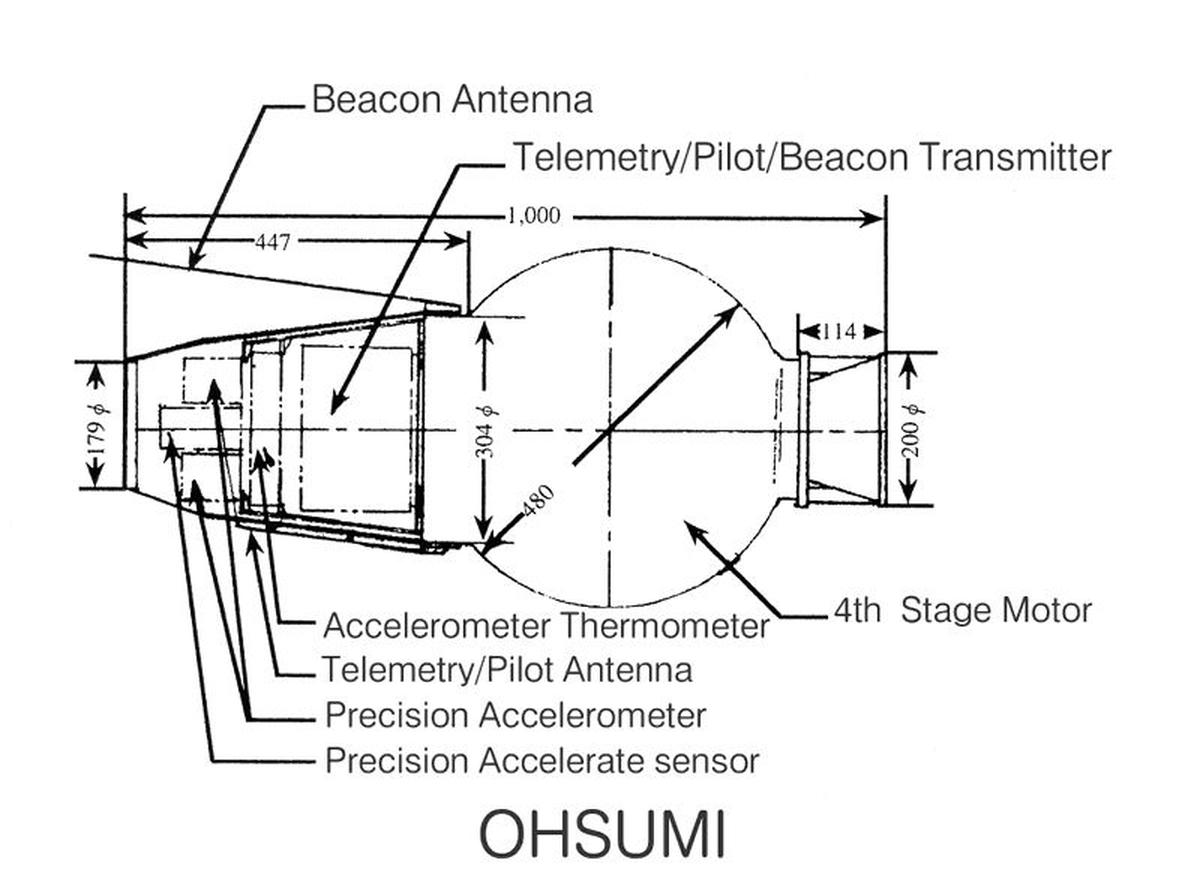
Illustration shows the configuration of the Ohsumi.
| Photo Credit:
JAXA

The first attempt to launch the L(Lambda)-4S rocket with an Ohsumi satellite (named after the peninsula) failed on September 26, 1966 when the fourth stage attitude control failed. As the fourth stage failed to ignite the next time, the second attempt on December 20 also failed.

Repeated failures

The same failure ensured that the third attempt on April 13, 1967 also ended up as a failure. The fourth launch on September 22, 1969 saw the third stage collide with the fourth stage, thereby leading to a fourth stage control system malfunction. The Japanese media had a field day reporting on the repeated failures. With that, the public too started criticising the programme.
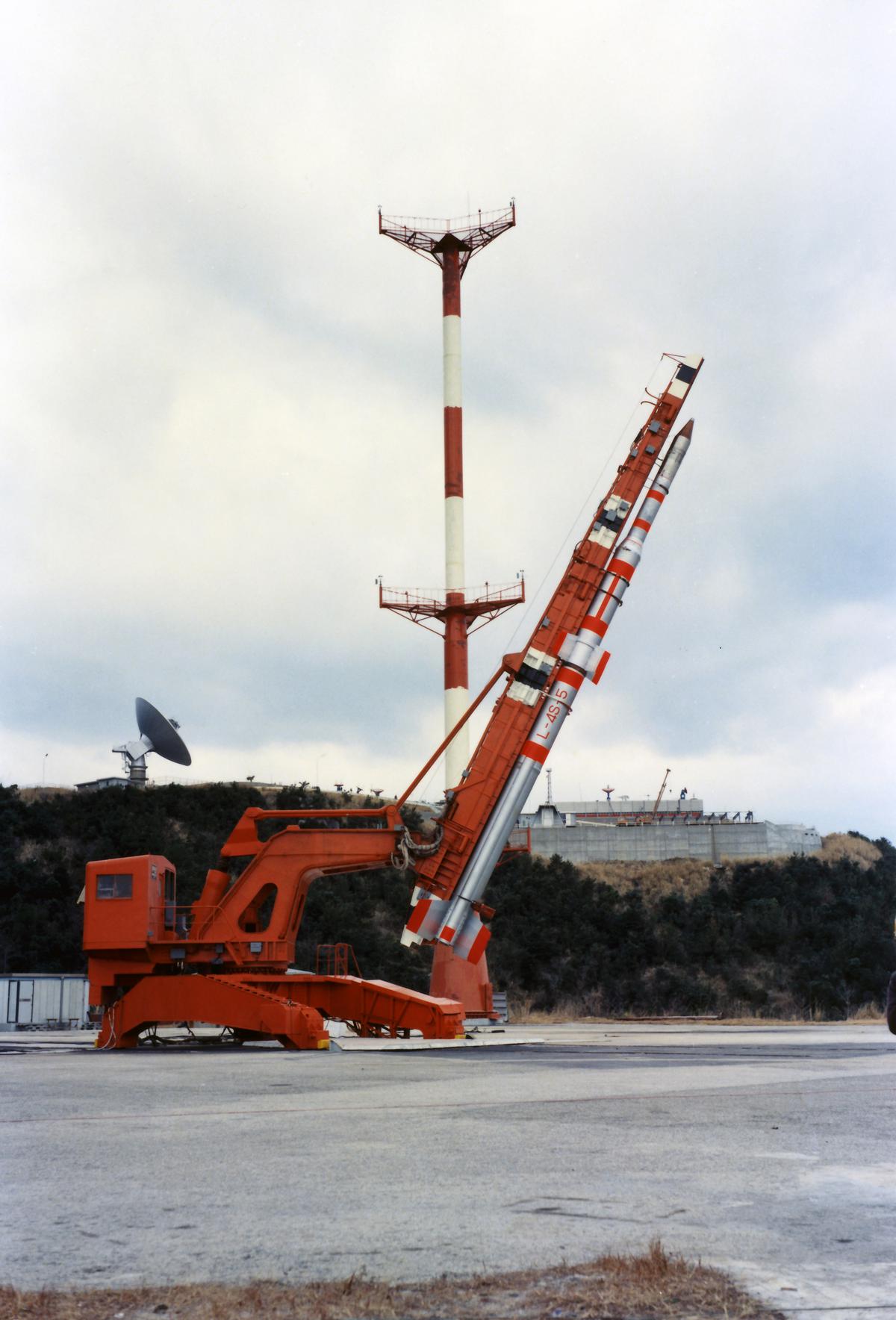
The L-4S-5 loaded on the launcher at Kagoshima Space Center on February 11, 1970.

The L-4S-5 loaded on the launcher at Kagoshima Space Center on February 11, 1970.
| Photo Credit:
JAXA

It was under such circumstances that the fifth launch attempt was made. At 1:25 p.m. on February 11, 1970, L-4S rocket no. 5 was launched. The rocket was launched successfully and an elliptical orbit was achieved.

Despite the successful launch, there was still tension at the launch site. While they had finally surmounted this challenge, the mission could be termed successful only once the Ohsumi satellite returned over Japanese skies after circling the Earth once.

Detecting the signal
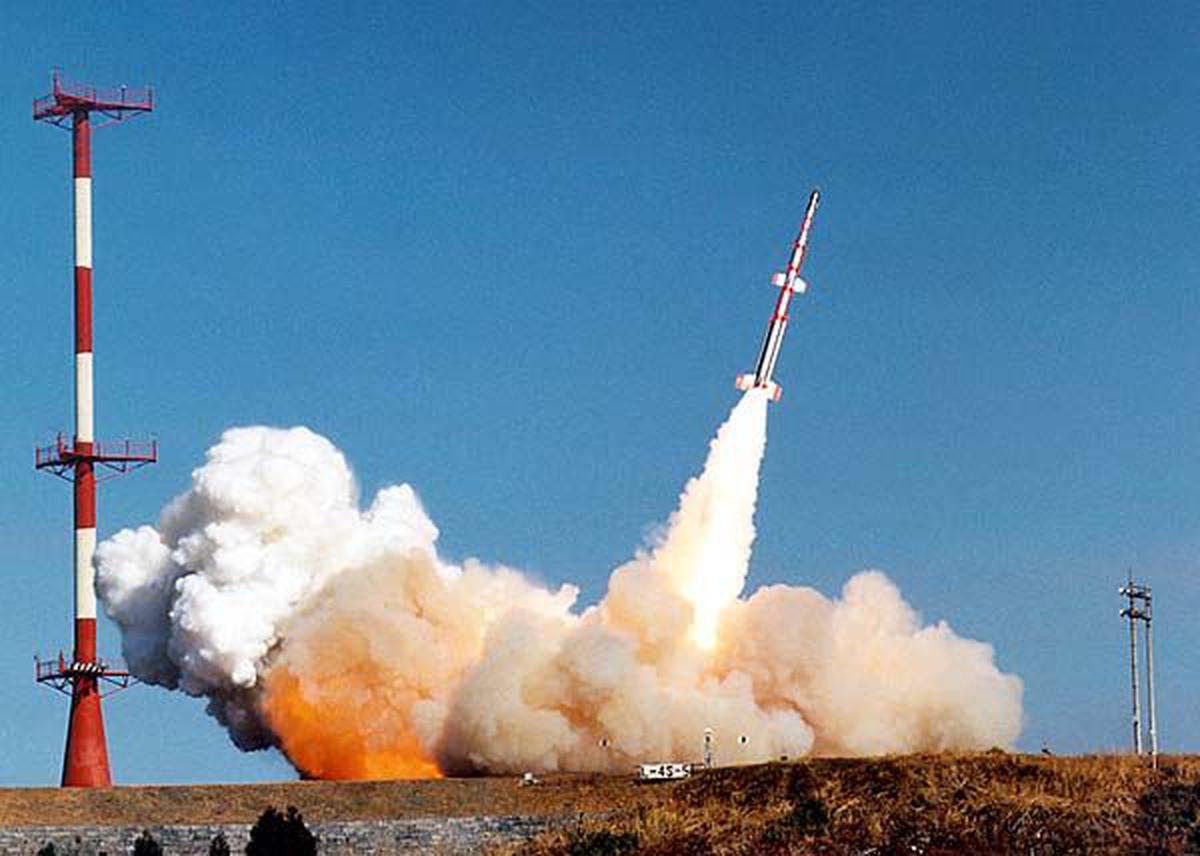
The successful launch on February 11, 1970.

The successful launch on February 11, 1970.
| Photo Credit:
JAXA

NASA was cooperating with them for tracking the satellite. After the successful launch, NASA’s each successive tracking station reported receiving the signal at Guam, Hawaii, Quito (Ecuador), Santiago (Chile), and Johannesburg (South Africa).

At 3:56:10 p.m., nearly 2.5 hours after the launch, Ohsumi’s signal was received at the Kagoshima Space Center (now called the Uchinoura Space Center after the JAXA space agency was set up in 2003), confirming its first revolution around the Earth. With that, Japan became the fourth country to successfully launch its own satellite, after the former U.S.S.R, the U.S., and France.

The radio signal from Ohsumi grew fainter with every revolution and on the next day, February 12, during its sixth revolution, it was hardly noticeable. During the seventh revolution, 14-15 hours after the launch, the signal was interrupted and could no longer be detected.

Re-entry in 2003

Rapid reduction of power capacity owing to encountering higher than expected temperatures is the reason attributed to losing the signal. But since Ohsumi was inserted into a hyperellipse with a 337 km perigee and a 5,151 km apogee, it could live for a long time.

In fact, Ohsumi went around the Earth for decades, re-entering its atmosphere and burning up only at 05:45 on August 2, 2003. The re-entry location was over North Africa, at the border between Egypt and Libya. Ohsumi’s success turned out to be a guiding light for Japan’s space exploration as it helped them master the gravity turn manoeuvre, paving the way for their future.

Source link

Science

Post navigation

Previous Post: Serum’s HPV vaccine non-inferior to Gardasil: study
Next Post: India’s ambitious plans on space station on track, says Chandrayaan-3 project director

Related Posts

  • NASA shifts UFO debate from sensationalism to science | Data Science
  • Sci-Five | The Hindu Science Quiz: On Wetlands Science
  • How a 6.3 magnitude quake caused another of same intensity Science
  • Ahead of Gaganyaan, ISRO CE-20 engine already has a notable legacy Science
  • China’s spacecraft carrying rocks from the far side of the moon leaves the lunar surface Science
  • Inside India’s ‘Deep Ocean Mission’, a challenge harder than going to space Science

More Related Articles

Big Swedish study hints at link between bowel disease, infant diet Science
A star party in the mountains Science
Biologists in slow and steady race to help North America’s largest and rarest tortoise species Science
New breast cancer genes found in women of African ancestry, may improve risk assessment Science
First fossilised snake traces discovered in South Africa Science
Study documents headaches experienced by astronauts in space Science
SiteLock

Archives

  • July 2024
  • June 2024
  • May 2024
  • April 2024
  • March 2024
  • February 2024
  • January 2024
  • December 2023
  • November 2023
  • October 2023
  • September 2023
  • August 2023
  • July 2023
  • June 2023
  • May 2023
  • April 2023
  • March 2023
  • February 2023
  • January 2023
  • December 2022
  • November 2022
  • October 2022
  • September 2022
  • August 2022
  • July 2022
  • June 2022
  • May 2022

Categories

  • Business
  • Nation
  • Science
  • Sports
  • World

Recent Posts

  • U.S. and South Korea sign joint nuclear deterrence guidelines in face of North Korean threats
  • India to clock GDP growth of 7% in FY25: NITI Aayog member Arvind Virmani
  • Rupee trades flat at 83.53 against U.S. dollar in early trade
  • 6 Indians Missing In Nepal After Landslide Pushes Their Bus Into River
  • India abstains on UNGA resolution against Russian offensive in Ukraine

Recent Comments

  1. ywdVpqHiNZCtUDcl on UP Teacher Who Asked Students To Slap Muslim Classmate
  2. bRstIalYyjkCUJqm on UP Teacher Who Asked Students To Slap Muslim Classmate
  3. GkJwRWEAbS on UP Teacher Who Asked Students To Slap Muslim Classmate
  4. xreDavBVnbGqQA on UP Teacher Who Asked Students To Slap Muslim Classmate
  5. aANVRzfUdmyb on UP Teacher Who Asked Students To Slap Muslim Classmate
  • Telangana Police Officer Paritosh Pankaj Injured After Being Hit By Minister’s Convoy Car Nation
  • India-specific model to give accurate gestational age of foetus Science
  • Delhi Cops File 2 FIRs After DU Walls Defaced With Poll Boycott Slogans Nation
  • On Kota Suicides, Rajasthan Minister Mahesh Joshi Lists Causes Of Stress In Students Nation
  • Global Life Expectancy Dropped By 2 Years Due To Covid: WHO World
  • Monsoon Sets In Over Kerala, Likely To Reach Delhi In A Month Nation
  • Sirens sound in Tel Aviv for the first time in months as Hamas says it fired rockets from Gaza World
  • South Korean YouTuber Stabbed By Rival During Live Stream In Front Of Court World

Editor-in-Chief:
Mohammad Ariff,
MSW, MAJMC, BSW, DTL, CTS, CNM, CCR, CAL, RSL, ASOC.
editor@artifex.news

Associate Editors:
1. Zenellis R. Tuba,
zenelis@artifex.news
2. Haris Daniyel
daniyel@artifex.news

Photograher:
Rohan Das
rohan@artifex.news

Artifex.News offers Online Paid Internships to college students from India and Abroad. Interns will get a PRESS CARD and other online offers.
Send your CV (Subjectline: Paid Internship) to internship@artifex.news

Links:
Associate Journalism
About Us
Privacy Policy

News Links:
Breaking News
World
Nation
Sports
Business
Entertainment
Lifestyle

Registered Office:
72/A, Elliot Road, Kolkata - 700016
Tel: 033-22277777, 033-22172217
Email: office@artifex.news

Editorial Office / News Desk:
No. 13, Mezzanine Floor, Esplanade Metro Rail Station,
12 J. L. Nehru Road, Kolkata - 700069.
(Entry from Gate No. 5)
Tel: 033-46011099, 033-46046046
Email: editor@artifex.news

Copyright © 2023 Artifex.News Newsportal designed by Artifex Infotech.