






At Rajiv Sinha’s laboratory in IIT Kanpur lie soil, sand, and rocks drilled out from across thousands of metres under the Karnali, Ganga, and Kosi rivers. Each sample, called a “sedimentary core” is held in a container 7.6 cm wide; together, they create snapshots of the rivers’ ancient history.
Every centimetre of these cores reveals the size and kind of sediment that the rivers were carrying at a point in time. The cores thus show how the composition of these sediments changed over time.
New study
These cores have proved crucial to Prof. Sinha and a team of geologists from the Universities of Edinburgh and Glasgow, who are reconstructing river floods in the Gangetic plain between 23 and 5 million years ago, in the Miocene era.
Based on these studies, the researchers have reported that climate-change-related and seismic events ravaging the planet today could create super-floods that could be catastrophic for people in the Gangetic plain, in a paper published in the journal Communications Earth and Environment on August 23.
The findings signal that we need to urgently update India’s disaster management strategy to account for what Prof. Sinha calls “cascading hazards”: natural disasters that are triggered by other disasters.
Delayed transition
The study began with a peculiar observation.
As rivers flow from their origins in the mountains to the plains, they carry rocks, gravel, and sand. The heavier particles – rocks and gravel – settle down earlier in the river’s trajectory whereas the lighter particles settle later. The part of the river’s path where there is a gradual transition from heavier to lighter particles on the riverbed is called the gravel-sand transition.
With the river Ganga, for example, Prof. Sinha said that larger particles are restricted to the areas around Haridwar and Rishikesh, in Uttarakhand. In normal circumstances, large particles should not be usually found in downstream areas.
But in a 2014 study, Prof. Sinha and colleagues reported that, around 11,000 years ago, in the Holocene era, there was coarse gravel in the Kosi river some 30-40 km downstream of the current gravel-sand transition. His team inferred this from sedimentary cores.
At the Mohand anticline
The team’s investigation of this anomaly – such large particles downstream of the current transition spot – took the team to the Mohand anticline in Uttarakhand, around 45 km southwest of Dehradun.
An anticline is a fold in a sedimentary rock that bulges outwards. Older layers of sediments are found towards the centre and the younger ones are located towards the exterior.
At the Mohand anticline, the team documented all the layers and recorded the size and type of the sediments in each. The researchers estimated when each sediment layer was deposited based on how deep it was. By combining this data with that obtained from the drilled cores, they could compute the rivers’ flow at different times.
An ancient event
That’s how they landed at one potential reason the coarse gravel in the Kosi was so far away from the modern gravel-sand transition: an “extreme monsoon event” leading to a flood that occurs every 200-1,000 years.
This extreme event is expected to have occurred along with a complementary cause called hyperconcentrated flows. Hyperconcentrated flows occur when some event – a trigger, like a landslide or a glacial lake outburst – causes the river to carry more sediments than usual. In such conditions, “high concentrations of sediments are distributed through the water column,” according to the paper.
Hyperconcentrated flows can change the way rivers flow, so they often have devastating consequences.
“A major landslide combined with a heavy monsoon can generate hyperconcentrated flows, which can actually move very large particles further downstream,” Prof. Sinha said. As a result, the river could be clogged, the water level could rise to dangerous levels, and cause a flood.
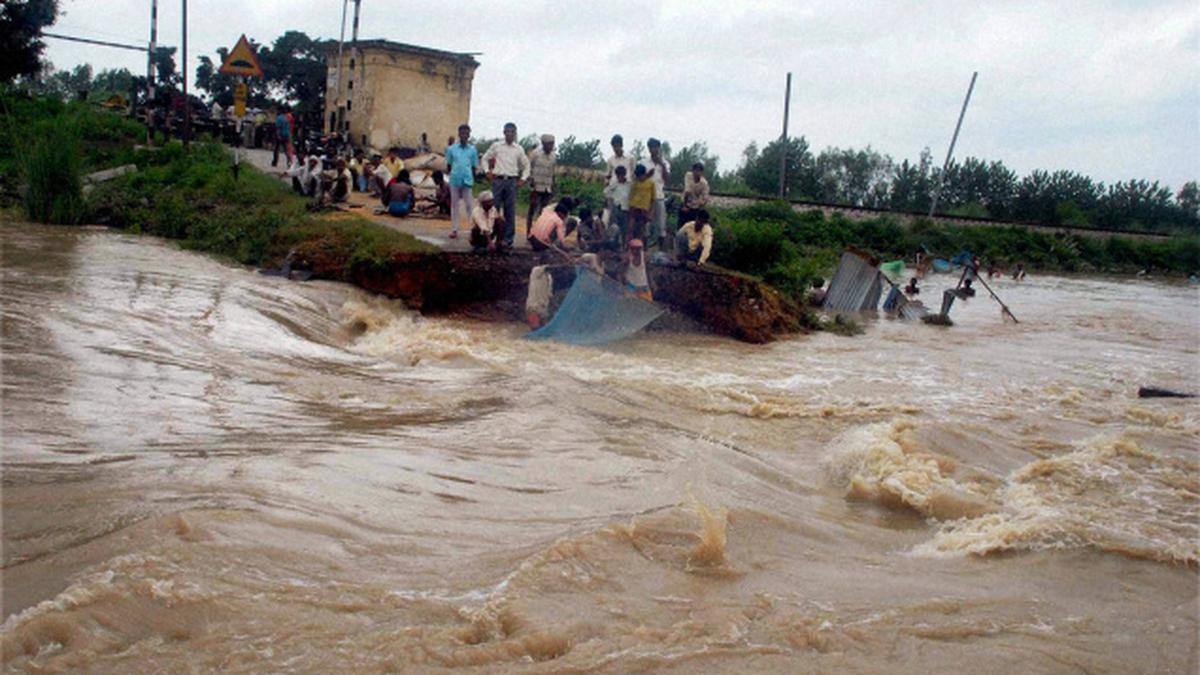
Hyperconcentrated flows can also change the course of the river in a process called avulsion, forcing thousands of people to move. When the Kosi river avulsed in 2008, it deposited around 2 metres of sediment in the surrounding land, inundated and destroyed crops, left the soil infertile, and created conditions conducive to the spread of disease.
Old threat, new risk
In early 2021, a large rock and ice avalanche triggered a disastrous flood in Chamoli district, leaving more than 200 people dead or missing. According to Prof. Sinha, the incident, like several others in Himachal Pradesh and Uttarakhand in 2023, is a reminder of how areas prone to landslides and heavy monsoons are especially vulnerable to hyperconcentrated flows.
The odds of an extreme monsoon event in the same regions are expected to increase due to climate change. According to a 2021 study in western Nepal, the chance could increase by as much as 60%. More extreme rains could also mean more landslides, which in turn could mean hyperconcentrated flows leading floods downstream in the plains.
‘Cascading hazards’
Prof. Sinha and his colleagues wrote in their paper that accounting for hyperconcentrated flows in “future disaster risk management strategies remains an important and major challenge”. This is because, he added, India’s disaster management strategy relies largely on a “compartmentalised” understanding of disasters, where how one disaster leads to the other is not taken into consideration.
“If we keep looking at these hazards in an isolated and compartmentalised way, we will never be able to understand the entire cascading effect of a disaster,” he said. Instead, we need an “integrated disaster management approach” where the relationship between instances of earthquakes, landslides, and floods – along with the individual incidents themselves – is used to frame risk-mitigation plans.
Sayantan Datta (they/them) are a queer-trans freelance science writer, communicator and journalist. They are currently a faculty member at Krea University and tweet at @queersprings.