



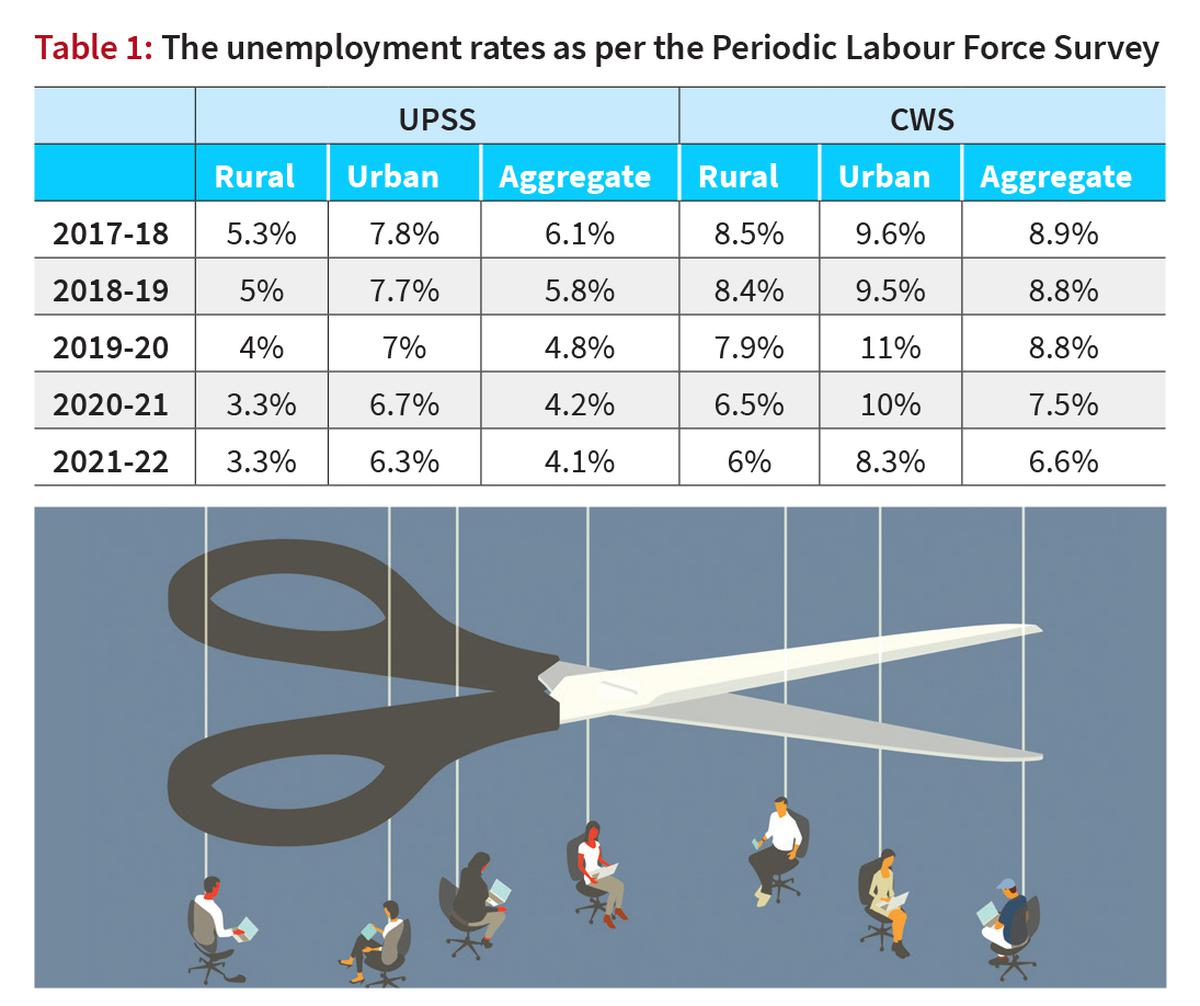
When the Periodic Labour Force Survey (PLFS) was released in 2017, it revealed the unemployment rate of India to be 6.1%, the highest ever recorded in India. The PLFS of 2021-22 showed unemployment reducing to 4.1%, much lower than before, but higher than some developed economies. The U.S unemployment rate fluctuated between 3.5% in July 2022 to 3.7% in July 2023.
However, the economies of the U.S and India are very different. The former is more industrialised, while the latter is characterised by a large informal sector. As such, the methods used to measure unemployment are very different.
Defining unemployment
Unemployment is not synonymous with joblessness. The International Labour Organization (ILO) defines unemployment as being out of a job; being available to take a job; and actively engaged in searching for work. Therefore, an individual who has lost work but does not look for another job is not unemployed.
The labour force is defined as the sum of the employed and the unemployed. Those neither employed nor unemployed — such as students and those engaged in unpaid domestic work — are considered out of the labour force. The unemployment rate is measured as the ratio of the unemployed to the labour force. The unemployment rate could also fall if an economy is not generating enough jobs, or if people decide not to search for work.
In the U.S., the employment-to-population ratio (EPR) in 2019 was 60.8, while the unemployment rate was 3.7%. In 2022, the EPR was 60, but the unemployment rate had fallen to 3.6%. Even though there were fewer jobs (as a proportion of the total population), the unemployment rate was lower because many individuals had exited the labour force.
Measuring unemployment in India
The situation is complicated in a developing economy, because decisions to search for work are constrained by social norms. According to a 2009-10 survey undertaken by the National Sample Survey Organisation (NSSO), 33.3% of rural women and 27.2% of urban women aged 15 and above who were engaged in domestic work reported willingness to work if it were made available within the premises of the household. This represents 18.8% of the rural female population aged 15 and up; the labour force participation rate (LFPR) for rural women that year was 26.5%. These women would not be counted among the unemployed because they are not actively looking for work. A definition of unemployment that focuses on actively searching for a job may underestimate the true picture in a developing economy.
Measuring unemployment in India is difficult due to the informal nature of jobs. Unlike developed economies, individuals do not hold one job year-round. An individual may be unemployed this week, but may have worked as a casual labourer last month, and as a farmer for most of the year. Are they to be counted as unemployed?
The NSSO adopts two major measures for classifying the working status of individuals in India — the Usual Principal and Subsidiary Status (UPSS) and the Current Weekly Status (CWS). An individual’s principal status, whether employed, unemployed or out of the labour force, is based on the activity in which they “…spent relatively long time…” in the previous year. A person who is not a worker, according to the principal status, would still be counted as employed according to the UPSS if they were engaged in some economic activity in a subsidiary role for a period “…not less than 30 days”. Thus, an individual unemployed for five months and working for seven months in the previous year would be considered a worker according to the principal status, while an individual unemployed for nine months but working for three months would be counted as employed as per the UPSS.
The CWS adopts a shorter reference period of a week. An individual is counted as being employed if they have worked for “…at least one hour on at least one day during the seven days preceding the date of survey.” UPSS unemployment rates will always be lower than CWS rates because there is a greater probability that an individual would find work over a year as compared to a week.
The low bar for classifying an individual as employed explains why unemployment rates are lower in rural areas than urban. In agrarian economies, where individuals have access to family farms or some form of casual agrarian work, there is greater probability of finding some kind of work when compared to urban areas. These definitions may ‘underestimate’ unemployment, but they were largely designed to capture the extent of the informal economy.
The Centre for Monitoring Indian Economy classifies individuals based on their activity in the day preceding the interview. They, therefore, estimate a higher unemployment rate, but lower labour force participation rates. This is because in an informal economy, there is a lower chance of an individual having work on any given day as compared to longer periods of a week or a year.
One cannot say which of the above frameworks is “right” or “wrong” for this represents an unavoidable trade-off in a developing economy. Adopt too short a reference period, and one gets higher rates of the unemployed and lower of the employed, and vice versa. This dilemma does not arise in developed nations where work is largely regular over the year.
The lockdown effect
The lockdown announced in March 2020 was a profound disruption to the Indian economy. But this wasn’t reflected in the PLFS unemployment rates, which covers a period between July of one year to June of the next. The lockdown would have been covered in the last quarter of the 2019-20 PLFS, its after-effects seen in the 2020-21 PLFS. However, unemployment rates — measured both by the UPSS and CWS standards — fell in 2019-20 and 2020-21.
Consider an individual with regular employment who loses work in March 2020. According to the UPSS status, this individual would be considered employed, since they spent most of the previous year employed. If those individuals who lost jobs during the lockdown find employment in a time less than six months, they would never be counted as unemployed by the UPSS.
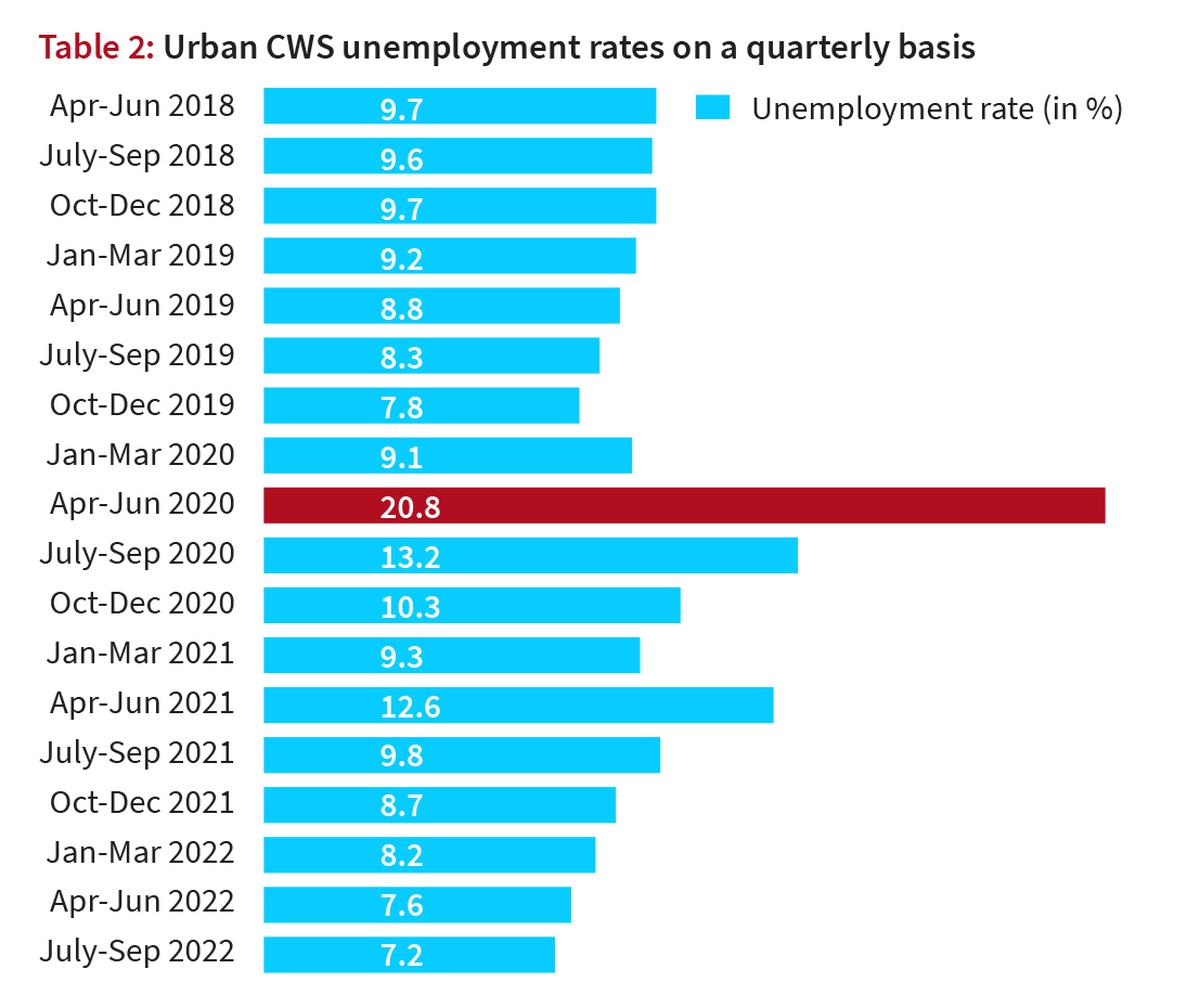
The CWS criterion, with a shorter reference period, would record higher unemployment rates. However, the measures presented in the PLFS report are an aggregation of interviews conducted across the year. If those rendered jobless by the lockdown were able to find employment relatively quickly, the CWS unemployment rate for the lockdown period would show high unemployment, but not so for subsequent periods. When averaging across these different periods, the CWS rate for the entire year would show a lower measure.
This can be seen in Table 2, which shows urban CWS unemployment rates on a quarterly basis. Unemployment spiked during the lockdown quarter, but reduced thereafter. The CWS unemployment over the year would not show such a high rise.
Unemployment is shaping up to be an important factor in the upcoming election. In order to successfully tackle it, it is important to understand how it is defined and measured in a developing economy.
Rahul Menon is Associate Professor, Jindal School of Government and Public Policy, O.P. Jindal Global University