




Say you have a friend who asserts that they can smell water. You are sceptical, yet also curious. To test their claim, you fill up 50 cups out of 100 with water and instruct your blindfolded friend to sniff away.
If your scepticism – the null hypothesis – is justified, the odds of your friend identifying all 50 filled cups are very slim. In fact, they will get it right only about half the time, through simple luck. This would be the “null result” of the test.
Any careful investigation proceeds in this spirit, with a null hypothesis determined by the context. In court, you are innocent until proven guilty. In experiments of fundamental physics, you will often hear that today’s discovery is tomorrow’s null hypothesis.
Even today, thousands of physicists are searching for hitherto undiscovered particles and forces. This is because they want to defy the Standard Model, the best theory physicists have to explain the universe – and today’s null hypothesis. But since the discovery of the Higgs boson in 2012, no conclusive positive results have been reported.
What should we make of that?
Sea change
In the late 19th century, Albert Michelson and Edward Morley conducted an experiment to look for “luminiferous ether” in their laboratory. According to the science of their time, the luminiferous ether was the universal medium through which light waves travelled. As earth moves through the ether, the physicist duo had to show that the speed of light varied according to its direction. But despite meticulous care, they couldn’t show that.
The profound shock of this null result stirred speculation among physicists as to whether the ether existed at all and about the very nature of space and time. This result eventually led to the special theory of relativity, and a new understanding of gravity, light, and the universe.
Like the aftermath of the Michelson-Morley experiment, there is another, more recent paradigm shift underway: in the hunt for the identity of “dark matter”, an invisible substance making up five-sixths of the mass of the cosmos. For many decades until the 1990s, scientists believed dark matter to be too-faint-to-see black holes, dwarf stars, planets, and so forth. They also expected that they could find dark matter in space by looking for its effects on starlight. But when they eventually surveyed the sky, they couldn’t find any dark matter in this form.
The result prompted suspicion – later confirmed by more data – that dark matter is made of a mysterious species of particles that physicists have neverencountered before.
Experimental revolutions
To accurately measure the speed of light, Michelson and Morley developed methods to observe the mingling of light waves. Today, these methods are at the heart of the detection of gravitational waves in experiments like LIGO (whose Indian edition is imminent).
This is to say that null results are not just null results. Finding nothing takes something as well as yields something, both of which can be useful.
Some null results are a failure to find something in one place and keep open the possibility that it could exist elsewhere. For example, searches for dark matter have narrowed the mass range in which the substance can be found by eliminating those ranges in which it hasn’t been.
Other results are the result of starting off asking the ‘wrong’ questions. Sophisticated detectors built in the 1980s to check whether protons decay came up empty-handed – but serendipitously caught neutrinos released by a powerful supernova in 1987, teaching us much about the death throes of heavy stars. Today, these “proton-decay detectors”, still yielding null results, are regularly used as “neutrino telescopes”.
This particular null result is also a happy one. Our own existence implies that protons live for at least 10-million-times the age of the universe. If they decayed any faster, the ensuing radiation produced by our bodies would have given us all cancer.
Balancing acts
Nobody has succeeded in measuring a particle moving faster than 299,792,458 m/s, the speed of light in vacuum. So in 2011, when the OPERA experiment in Italy reported finding neutrinos that seemed to exceed nature’s speed limit, its scientists were up against sound theoretical judgement as well as great empirical weight. An internal probe later found the problem to be a loose fibre optic cable and a malfunctioning clock.
Claiming a discovery in science is tricky business. To be taken seriously, independent scientists must reproduce a result elsewhere. A number of claims on signals of dark matter and new forces currently circulate, but counter-claims by other labs temper excitement with caution.
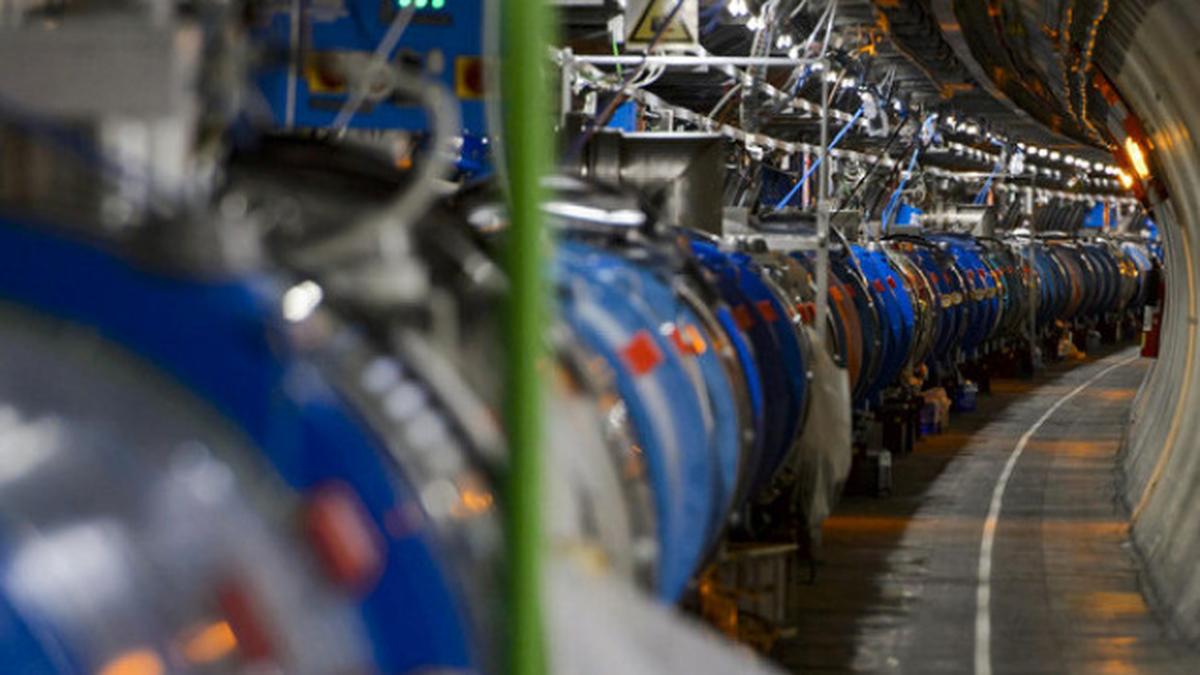
Such conservatism is why, at particle accelerators such as the Large Hadron Collider (LHC) in Europe, two competing collaborations skin the cat of data their own way.
Pushing the envelope
Only massless particles can travel at lightspeed – but this hasn’t stopped physicists from checking whether photons, the particles of light, have mass. These physicists tell us it could weigh up to 10-51 grams! They will no doubt continue checking.
Sometimes results like these are null only until they aren’t – then they become ground-breaking. The LHC churns out hundreds of papers on not finding evidence for new physics, while underground experiments seeking to trap dark matter particles have, for four decades and counting, only produced increasingly severe null results. Yet these are not exercises in futility but in patience.
Experimental progress in fundamental physics has been long stuck at a logjam because nature seems not to care about scientists’ most cherished predictions. But this has had the effect of raising the din of voices clamouring for defunding big science. Yet not finding the expected has driven humans to discover continents, make life-saving vaccines, and prove a convict’s innocence. It is really the lifeblood of scientific enlightenment.
The author is an assistant professor of theoretical physics at the Indian Institute of Science, Bengaluru, who tweets at @PhysicsNirmal.