




Information technology (IT) has become essential to communication, banking, business, health, education, entertainment, and many other walks of our lives. Its prevalence makes us wonder if society can survive without it. IT relies on gadgets that store and process vast amounts of information at humanly impossible speeds.
Gate in computing
A bit is the smallest piece of information storage (it is a portmanteau of binary digit). Often, a large number of bits is required to convey meaningful information. With the advent of modern semiconductor technology, we routinely speak of household computers having a few terabytes (8 trillion bits) of information storage. One terabyte can store 500 hours of high-definition video content.
In a computer, a bit is a physical system with two easily discernible configurations, or states – e.g. high and low voltage. These physical bits are useful to represent and process expressions that involve 0s and 1s: for instance, low voltage can represent 0 and high voltage can represent 1.
A gate is a circuit that changes the states of bits in a predictable way. The speed at which these gates work determines how fast a computer functions.
The quantum gate
Modern computers use semiconductor transistors to build circuits that function as bits. A semiconductor chip hosts more than 100 million transistors on 1 sq. mm. Imagine how small an individual transistor is and how close it is to adjacent transistors. As transistors become smaller, they become more susceptible to quantum effects. This is not desirable as the existing technology will then become unreliable for computational tasks. So there is a limit to how many transistors a computer can have.
Moore’s law, announced in 1965, states that computing power increases tenfold every five years. This law no longer holds as we have already slowed to a two-fold increase every five years. But this doesn’t have to mean we are nearing the end of computing development: the quantum revolution is coming.
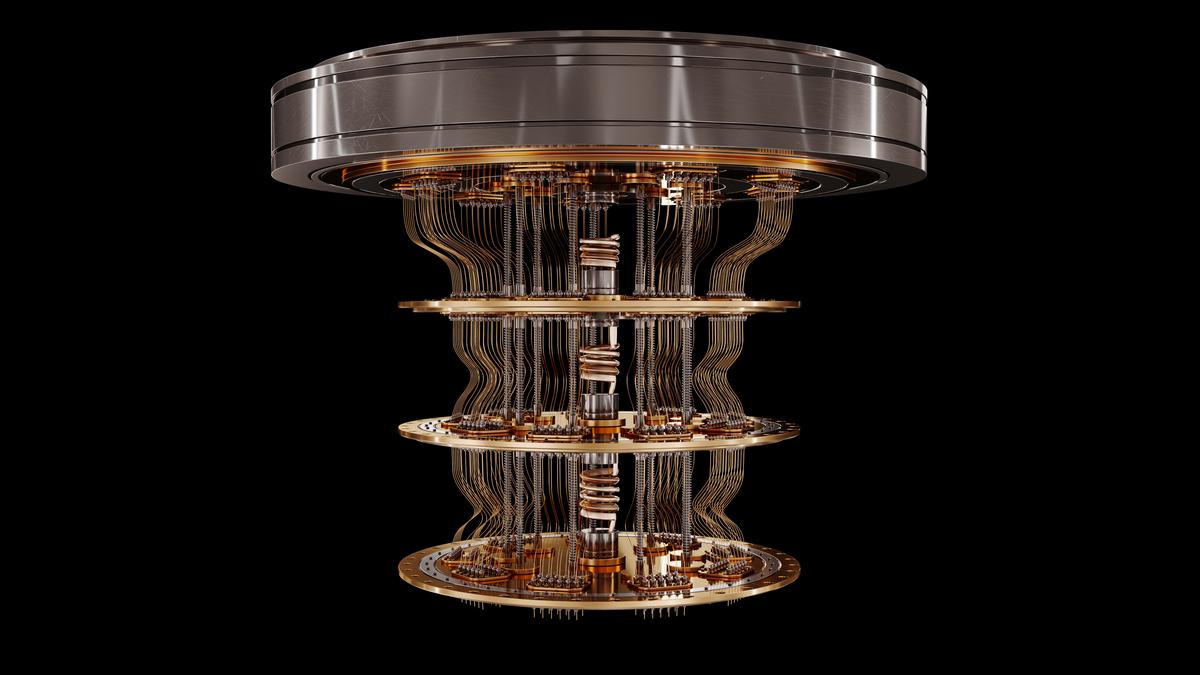
The most basic unit of a quantum computer is a quantum bit, or qubit. Like in a conventional computer, it is a physical object that has two states. For example, the spin of a particle can point along two different directions, so the particle can function as a qubit. Or it can be a superconducting circuit that mimics an atom, and its two states can be a ground state, where it has lower energy, and a higher ‘excited’ state.
A quantum gate is a physical process or circuit that changes the state of a qubit or a collection of qubits.
In the quantum-computing context, if particles or superconducting qubits are the physical qubits, the gate is often an electromagnetic pulse.
Interlude: Superposition
A fundamental limitation of conventional computing architecture is that each bit can exist in only one of the two states, 0 or 1. But according to quantum physics, a qubit can also be in a superposition of its two states at the same time.
Imagine you’re walking in the northeast direction. It is equivalent to moving partly along the north and the rest along the east. Your northeast movement is a superposition of walking along the north and along the east. So by combining different distances along the two directions, you can realise some movement in any direction between the two.
The basis states of the qubit are similar to the north and east directions. A qubit in a superposition has some contributions from each basis state. Different superpositions correspond to different amounts of contributions.
If a qubit is in a superposition, then measuring the qubit will cause it to collapse to one of the two states (i.e. either north or east). However, we can only predict the probability that it will collapse to one state. Quantum computers use this to their advantage.
For example, to perform one calculation that requires 16 different inputs, a classical computer requires a total of four bits and sixteen computations. But with four qubits in superposition, a quantum computer could generate answers corresponding to all 16 inputs in a single computation.
Superposition is one of the main factors responsible for speeding up a quantum computer.
But while superposition provides enormous advantages, it is a fragile effect. It deteriorates when qubits interact with their environment. Identifying ways to sidestep or overcome this fragility is an active area of research today.
What gates do
In quantum computers, quantum gates act on qubits to process information. For example, a quantum NOT gate changes the state of a qubit from 0 to 1 and vice versa. The effect of the NOT gate on a superposition is again a superposition, resulting from the action of the NOT gate on each basis state in the initial superposition.
Notably, this feature is common to all quantum gates: the effect of a quantum gate on a superposition is the superposition of the effects of the quantum gate on the basis states contributing to the initial superposition.
So as the quantum NOT gate inter-converts the states 0 and 1, its action is to swap the contributions of the basis states in the superposition.
The Hadamard gate is a type of gate that acts on a single qubit: it generates a superposition of the basis states.
The controlled-NOT, or CNOT, gate acts on two qubits: a control qubit and a target qubit. The control qubit is unaffected by the CNOT gate. The target qubit flips from 0 to 1 or 1 to 0 if the control qubit state is 1.
CNOT plus a few other gates (that act on single qubits) can perform all possible logical operations on binary information encoded on qubits. That is, they can be combined to form quantum circuits capable of processing information.
Research on reliable quantum computers and suitable quantum algorithms is happening in many institutes, universities, and research labs worldwide. Large-scale, reliable quantum computers will benefit industries ranging from drug design to safe communications.
S. Srinivasan is a professor of physics at Krea University.