


Skip to content
  • Facebook
  • X
  • Linkedin
  • WhatsApp
  • YouTube
  • Associate Journalism
  • About Us
  • Privacy Policy
  • 033-46046046
  • editor@artifex.news
Artifex.News

Artifex.News

Stay Connected. Stay Informed.

  • Breaking News
  • World
  • Nation
  • Sports
  • Business
  • Science
  • Entertainment
  • Lifestyle
  • Toggle search form
  • Bihar Man Seeks Rs 50 Lakh Compensation From Indian Railways Over “Negligence”
    Bihar Man Seeks Rs 50 Lakh Compensation From Indian Railways Over “Negligence” Nation
  • What Is Daylight Saving Time, Why Donald Trump Plans To End It
    What Is Daylight Saving Time, Why Donald Trump Plans To End It World
  • Watch: Pentagon chief wants ‘highest male standard’ for combat roles.
    Watch: Pentagon chief wants ‘highest male standard’ for combat roles. World
  • Adani power plant: Bangladesh seeks full power supply restoration from Adani Gooda plant
    Adani power plant: Bangladesh seeks full power supply restoration from Adani Gooda plant Business
  • Justin Trudeau’s Canada Bans Chinese App WeChat, Russia’s Kaspersky On Government Phones
    Justin Trudeau’s Canada Bans Chinese App WeChat, Russia’s Kaspersky On Government Phones World
  • Access Denied Business
  • Open competition to determine India’s chess representative for Esports World Cup
    Open competition to determine India’s chess representative for Esports World Cup Sports
  • New Study Warns Climate Change Will Make You Poorer
    New Study Warns Climate Change Will Make You Poorer World
The afterglow of an explosive collision between giant planets may have been detected in a far-off star system

The afterglow of an explosive collision between giant planets may have been detected in a far-off star system

Posted on October 13, 2023 By admin


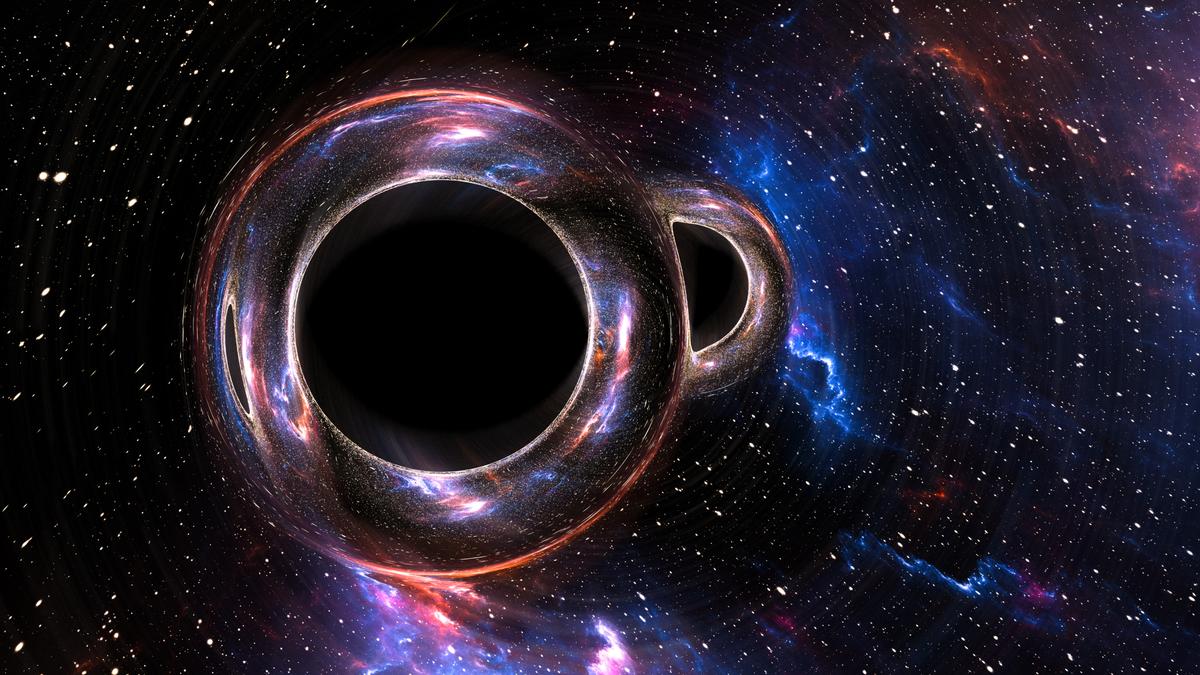
The afterglow of a massive collision between two giant planets may have been detected for the first time. The wreckage of the collision could eventually cool and form an entirely new planet. If the observation is confirmed, it provides an amazing opportunity to watch the birth of a new world in real time and open a window into how planets form.

In December 2021, astronomers watching an otherwise unremarkable sun-like star saw it begin to flicker. For a few months, the visible light (the light we can see with our eyes) from this star continued to change. At times it would almost disappear, before returning to its previous brightness.

The star, which sits roughly 1,800 light years from Earth, was given the identifier ASASSN-21qj, after the ASASN-SN astronomy survey that first observed the star’s dimming.

Seeing stars dim like this is not uncommon. It’s generally attributed to material passing between the star and Earth. ASASSN-21qj may just have been added to a growing list of similar observations had it not been for an amateur astronomer, Arttu Sainio. Sainio pointed out on social media that some two and a half years before the star’s light was seen to fade, the emission of infrared light coming from its location rose by roughly 4%.

Infrared light is most strongly emitted by objects at relatively high temperatures of a few hundred degrees Celsius. This posed the questions: were these two observations related and, if so, what the heck was going on around ASASSN-21qj?

Planetary cataclysm

Publishing our findings in Nature, we propose that both sets of observations could be explained by a cataclysmic collision between two planets. Giant impacts, as such collisions are known, are thought to be common in the final stages of the formation of planets. They dictate the final sizes, compositions, and thermal states of planets and mould the orbits of objects in those planetary systems.

In our solar system, giant impacts are thought to be responsible for the odd tilt of Uranus, the high density of Mercury and the existence of Earth’s Moon. However, until now, we had little direct evidence of giant impacts ongoing in the galaxy.

In order to explain the observations, a collision would have needed to release more energy in the first few hours after impact than would be emitted from the star. Material from the colliding bodies would have been superheated and melted, vaporised or both.

The impact would have formed a hot, glowing mass of material hundreds of times larger than the original planets. The infrared brightening of ASASSN-21qj was observed by Nasa’s WISE space telescope. WISE only looks at the star every 300 days or so, and probably missed the initial flash of light from the impact.

However, the expanded planetary body produced by the impact will take a long time, perhaps millions of years, to cool and shrink to something we might recognise as a new planet. Initially, when this “post-impact body” was at its greatest extent, the light emitted from it could still be as high as several percent of emission from the star. Such a body could have produced the infrared brightening that we saw.

The impact would also have ejected great plumes of debris into a range of different orbits around the star. A fraction of this debris would have been vaporised by the shock of the impact, later condensing to form clouds of tiny ice and rock crystals. Over time, some of this clumpy cloud of material passed between ASASSN-21qj and Earth, blocking out a fraction of the visible light from the star and producing the erratic dimming.

If our interpretation of the events is correct, studying this star system could help us understand a key mechanism of planet formation. Even from the limited set of observations we have so far, we have learned some very interesting things.

Firstly, to emit the amount of energy observed, the post-impact body must have been many hundreds of times the size of Earth. To create a body that large, the planets that collided must each have been several times the mass of Earth – possibly as large as the “ice giant” planets Uranus and Neptune.

Secondly, we estimate the temperature of the post-impact body to be around 700°C. For the temperature to be that low, the colliding bodies could not have been entirely made of rock and metal.

Ice giants

The outer regions of at least one of the planets must have contained elements with low boiling temperatures, such as in water. We therefore think that we have seen a collision between two Neptune-like worlds that are rich in ice.

The delay that was seen between the emission of infrared light and the observation of debris crossing the star suggests that the collision took place quite far away from the star – further away than the Earth is from the Sun. Such a system, in which there are ice giants far from the star, is more similar to our solar system than to many of the tightly-packed planetary systems astronomers often observe around other stars.

The most exciting aspect of this is that we can continue to watch the system evolve for many decades and test our conclusions. Future observations, using telescopes such as Nasa’s JWST, will determine the sizes and compositions of particles in the debris cloud, identify the chemistry of the upper layers of the post-impact body and track how this hot mass of debris cools down. We may even see new moons emerge.

These observations can inform our theories, helping us understand how giant impacts shape planetary systems. So far the only examples we’ve had are the echoes of impacts in our own solar system. We will now be able to watch the birth of a new planet in real time.

Simon Lock, NERC Research Fellow, School of Earth Sciences, University of Bristol; Matthew Kenworthy, Associate professor in Astronomy, Leiden University, and Zoe Leinhardt, Associate Professor, School of Physics, University of Bristol

This article is republished from The Conversation under a Creative Commons license. Read the original article.


Source link

Science Tags:astronomy news, science news, space news

Post navigation

Previous Post: Cricket World Cup 2023: Shardul Thakur Receives Best Fielder Medal vs Afghanistan. Virat Kohli’s Reaction Goes Viral. Watch
Next Post: ‘Call Of Duty’ Maker Activision To Be Bought By Microsoft For $69 Billion

Related Posts

  • Chandrayaan-3 takes another crucial step closer to moon
    Chandrayaan-3 takes another crucial step closer to moon Science
  • Clearest black hole merger signal yet allows probe of Hawking’s law
    Clearest black hole merger signal yet allows probe of Hawking’s law Science
  • How does a speed gun work?
    How does a speed gun work? Science
  • Scientists grow a model of human embryo in the lab
    Scientists grow a model of human embryo in the lab Science
  • What is the legal framework for space missions like the Chandrayaan 3 and Aditya L-1? | Explained
    What is the legal framework for space missions like the Chandrayaan 3 and Aditya L-1? | Explained Science
  • Nepal floods: Engineers in a WhatsApp group are guiding tunnel rescue efforts
    Nepal floods: Engineers in a WhatsApp group are guiding tunnel rescue efforts Science

More Related Articles

Mathematician Ruixiang Zhang to receive 2023 Sastra Ramanujan Prize Mathematician Ruixiang Zhang to receive 2023 Sastra Ramanujan Prize Science
SHAR expo at Andhra Loyola College on August 29 SHAR expo at Andhra Loyola College on August 29 Science
The many benefits of coconut The many benefits of coconut Science
Primates often gave birth to twins 60M years ago: new research Primates often gave birth to twins 60M years ago: new research Science
Can ‘good sounds’ help coral islands recover from bleaching? Can ‘good sounds’ help coral islands recover from bleaching? Science
Sanofi gets approval for alternative inactivated polio vaccine Sanofi gets approval for alternative inactivated polio vaccine Science
SiteLock

Archives

  • October 2026
  • September 2026
  • August 2026
  • July 2026
  • June 2026
  • May 2026
  • April 2026
  • March 2026
  • February 2026
  • January 2026
  • December 2025
  • November 2025
  • October 2025
  • September 2025
  • August 2025
  • July 2025
  • June 2025
  • May 2025
  • April 2025
  • March 2025
  • February 2025
  • January 2025
  • December 2024
  • November 2024
  • October 2024
  • September 2024
  • August 2024
  • July 2024
  • June 2024
  • May 2024
  • April 2024
  • March 2024
  • February 2024
  • January 2024
  • December 2023
  • November 2023
  • October 2023
  • September 2023
  • August 2023
  • July 2023
  • June 2023
  • May 2023
  • April 2023
  • March 2023
  • February 2023
  • January 2023
  • December 2022
  • November 2022
  • October 2022
  • September 2022
  • August 2022
  • July 2022
  • June 2022
  • May 2022

Categories

  • Business
  • Nation
  • Science
  • Sports
  • World

Recent Posts

  • BJP party worker killed in Bengaluru as high-end car rams gas tanker near Devanahalli; three injured
  • Ranji Trophy: Bengal picks up Delhi’s gauntlet to win by nine wickets
  • Stock markets close lower amid elevated crude oil, rising inflation
  • C.Ve. Shanmugam wants AIADMK leadership to consult with functionaries over party’s bypoll loss
  • Activists allege tender for beach pathway for persons with disabilities is incomplete

Recent Comments

  1. RobertTes on UP Teacher Who Asked Students To Slap Muslim Classmate
  2. Manuelret on UP Teacher Who Asked Students To Slap Muslim Classmate
  3. RobertTes on UP Teacher Who Asked Students To Slap Muslim Classmate
  4. RobertTes on UP Teacher Who Asked Students To Slap Muslim Classmate
  5. BrentWes on UP Teacher Who Asked Students To Slap Muslim Classmate
  • Toss was crucial, says Jharkhand skipper Kushagra
    Toss was crucial, says Jharkhand skipper Kushagra Sports
  • Rotavirus vaccine: tortured data analyses raise false safety alarm
    Rotavirus vaccine: tortured data analyses raise false safety alarm Science
  • Access Denied
    Access Denied Nation
  • India vs Australia Live Score Ball by Ball, India vs Australia, 2023 Live Cricket Score Of Today's Match on NDTV Sports
    India vs Australia Live Score Ball by Ball, India vs Australia, 2023 Live Cricket Score Of Today's Match on NDTV Sports Sports
  • Siddaramaiah makes brief visit to Mysuru
    Siddaramaiah makes brief visit to Mysuru Nation
  • Markets extend gains on fag-end buying; SBI, Reliance shine
    Markets extend gains on fag-end buying; SBI, Reliance shine Business
  • National Lok Adalat in Vizag today
    National Lok Adalat in Vizag today Nation
  • Access Denied
    Access Denied Nation

Editor-in-Chief:
Mohammad Ariff,
MSW, MAJMC, BSW, DTL, CTS, CNM, CCR, CAL, RSL, ASOC.
editor@artifex.news

Associate Editors:
1. Zenellis R. Tuba,
zenelis@artifex.news
2. Haris Daniyel
daniyel@artifex.news

Photograher:
Rohan Das
rohan@artifex.news

Associate Journalists
1. Subrata Paul - AN/2020/01
2. Quamruz Zaman - AN/2021/22
3. Ahmed Sha - AN/2021/035
4. Ajay Kumar Shaw - AN/2021/39
5. Tahqiqul Hoda - AN/2021/21

Artifex.News offers Online Paid Internships to college students from India and Abroad. Interns will get a PRESS CARD and other online offers.
Send your CV (Subjectline: Paid Internship) to internship@artifex.news

Links:
Associate Journalism
About Us
Privacy Policy

News Links:
Breaking News
World
Nation
Sports
Business
Entertainment
Lifestyle

Registered Office:
72/A, Elliot Road, Kolkata - 700016
Tel: 033-22277777, 033-22172217
Email: office@artifex.news

Editorial Office / News Desk:
No. 13, Mezzanine Floor, Esplanade Metro Rail Station,
12 J. L. Nehru Road, Kolkata - 700069.
(Entry from Gate No. 5)
Tel: 033-46011099, 033-46046046
Email: editor@artifex.news

Copyright © 2023 Artifex.News Newsportal designed by Artifex Infotech.