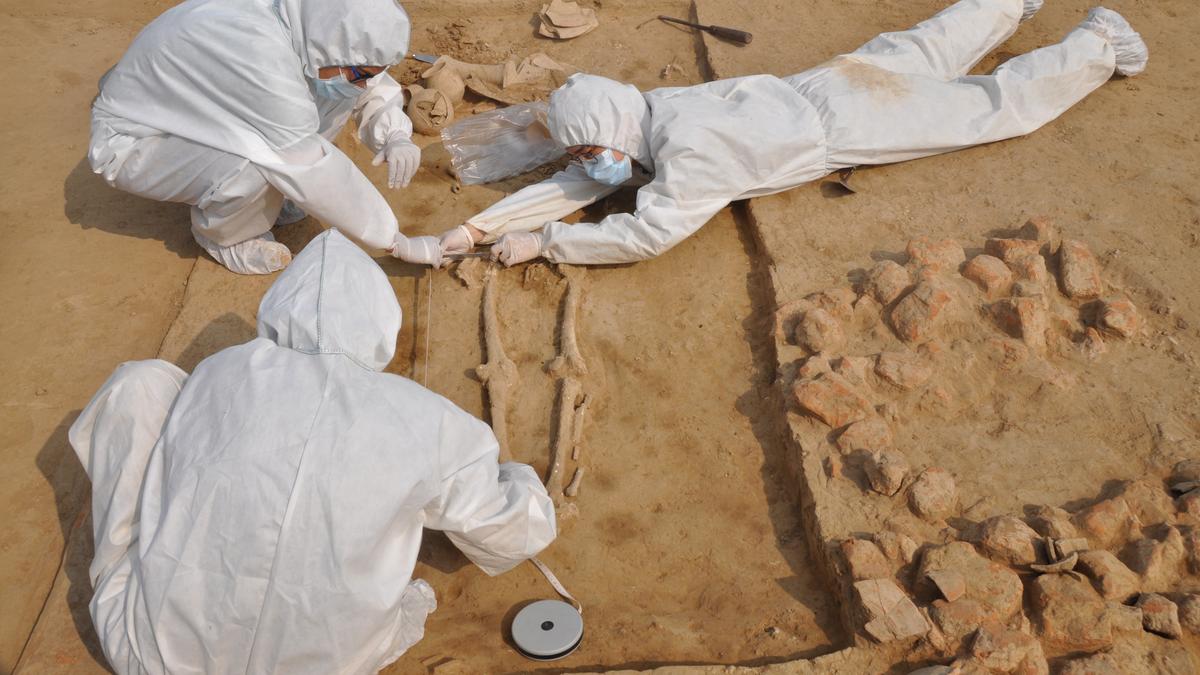






Prehistoric human ceremonial burials, mass grave mounts, and war graves scattered around the world are a treasure trove of ancient genetic material that scientists consider key to unlocking secrets from our past. The ancient DNA (aDNA) at these sites opens windows into population dynamics, including the expansion and replacement of populations using peaceful, natural or violent means, admixture events involving two or more sub-populations, cultural transitions, migrations for hunting, and wealth at individual, local, and global scales.
This said, tracing genetic ancestry in particular across populations still remains a challenging task. This is because populations across geographical regions often tend to be very similar, statistically speaking.
Different sample sizes
For example, studies in the past have documented genetic differences between ancient groups such as the hunter-gatherers, early farmers, and the steppe-pastoralists of the Stone and Bronze Ages. Similarly, numerous studies in recent years have provided insights into the genetic diversity of mediaeval populations across the world. But comparing the genetic ancestry of ancient and medieval populations has been hampered by differences in sample sizes. There are fewer samples bearing aDNA, resulting in lower sequencing quality compared to that of medieval or modern genomes, which come from larger cohorts.
The incorporation of genetic material in the form of gene flows laterally, from an ancient line into a modern one after ancient times, adds an additional layer of complexity.
Traditionally, researchers’ studies of aDNA have involved analysing single nucleotide polymorphisms (SNPs), which are natural genetic variations in the genomes. The method has been extensively used to reconstruct genetic histories and ancestry models using aDNA derived from Indo-European and Native American populations.
In a 2009 study, researchers from the Broad Institute in the US and the CSIR-Centre for Cellular and Molecular Biology, Hyderabad, reconstructed India’s population history as well. They analysed 25 diverse groups and identified two ancient populations in the country that were ancestral to most Indians. Ancestral North Indians were found to be genetically closer to Central Asian, European, and Middle Eastern populations while Ancestral South Indians were a distinct group. The analysis of SNPs is a powerful technique when the task is to understand populations, but it’s restricted by the need for high quality DNA samples and its inability to resolve the histories of groups with closely related ancestors.
Combining various techniques
Alternatively, analytical methods that use haplotypes, or shared segments of DNA, and rare variants instead of only SNPs have been found to be more powerful. Researchers have applied the genealogical tree inference method to modern and ancient genomes to understand their population structure, demographics, locations of ancestors, etc.
This method captures information from haplotype-sharing or identity-by-descent and rare variants simultaneously, includes time-resolved information about genetic ancestry, and provides comprehensive insights into how individuals ‘share’ their ancestors.
For example, in a study published on January 1 in Nature, a collaboration led by the Francis Crick Institute in the UK and including multiple research groups across the UK, Japan, and Sweden developed a new way to infer genome-wide genealogies. The team has called it Twigstats. It uses time-stratified ancestry analysis that boosts the statistical power of existing methods by a magnitude and reduces statistical errors.
A particularly unique aspect of Twigstats is its ability to take into account the coalescence of populations in recent times.
The moving Viking
The authors first tested Twigstats on multiple simulated genetic conditions, including to verify using previously published work, to ascertain its robustness. Then they applied it to the task of reconstructing the genetic history of 1,556 aDNA samples belonging to individuals who lived in northern and central Europe from 500 BC to 1000 AD, spanning the Iron, Roman, and Viking ages on the European continent.
This fresh analysis using Twigstats has determined more precisely than ever individual-level ancestry at a very high resolution. The researchers were even able to revisit the ancestry of population groups in the far-flung western frontiers of the Roman Empire in the first millennium AD. Twigstats models also provided direct evidence and high-resolution maps of the migration of individuals who spoke Germanic languages and had Scandinavian-like ancestry across Europe in the first century AD.
In the region represented by present-day Poland, the analysis of ancient genomes using Twigstats suggested a unique shift in ancestry over historical timelines. For example, the team found signs of a shift away from the corded ware cultures in the middle to late Bronze Age (1500 BC to 1000 BC). For another, in the first to the fifth centuries AD, populations associated with the Wielbark culture peeled away from Bronze Age groups.
In the appropriate historical and anthropological contexts, these insights are significant — and Twigstats should be credited for uncovering them. By analysing a large dataset of ancient genomes, the researchers could reconstruct fine population movements and admixture events that coincided with key cultural transitions, offering new insights into the genetic legacy of groups like the Vikings and the impact of migrations on the genetic makeup of modern Europeans.
The study also uncovered evidence of Scandinavian-like ancestry present in the British and the Baltic regions before the traditional commencement of the Viking Age. This suggests interactions with and migrations from Scandinavia began sooner than researchers believed was the case. The presence of Scandinavian ancestry in Britain was also linked to the Anglo-Saxon migrations, while its presence in the Baltic region indicated early contact with Scandinavian groups.
While Scandinavian ancestry expanded significantly across Europe, the study also revealed gene flows into Scandinavia before the Viking Age. Specifically, the researchers reported evidence of ancestry related to continental Europe and the British Isles in pre-Viking Age Scandinavian individuals. The implication is that the flow of genes was bidirectional. Evidence of the movements of Vikings are recorded in the genetic makeup of the populations of Britain, Ireland, and Iceland.
Cultures and genes
In the historical context, the study seems to confirm the widespread impact of Viking activity as well as highlights the complex and dynamic nature of population movements during the Viking Age.
Taken together, the new study is a good example of how the use of innovative methods for genomic analysis can refine our understanding of the dynamics of early mediaeval populations. By combining genetic data with archaeological and historical evidence, and adding the fact that cultural shifts are often associated with genetic changes as well, researchers can now offer a more nuanced and detailed picture of the complex processes that shaped the cultural histories of our ancestors.
As the researchers wrote in their paper, “our approach can be used for the reconstruction of new high-resolution genetic histories around the world.”
The authors work at Karkinos Healthcare and are adjunct professors at IIT Kanpur and Dr DY Patil Medical College, Hospital and Research Centre. All opinions are personal.
Published – January 07, 2025 05:30 am IST