




The story so far: On October 3, the 2023 Nobel Prize for physics was awarded to Anne L’Huillier, Pierre Agostini, and Ferenc Krausz “for experimental methods that generate attosecond pulses of light for the study of electron dynamics in matter”.
What is an attosecond?
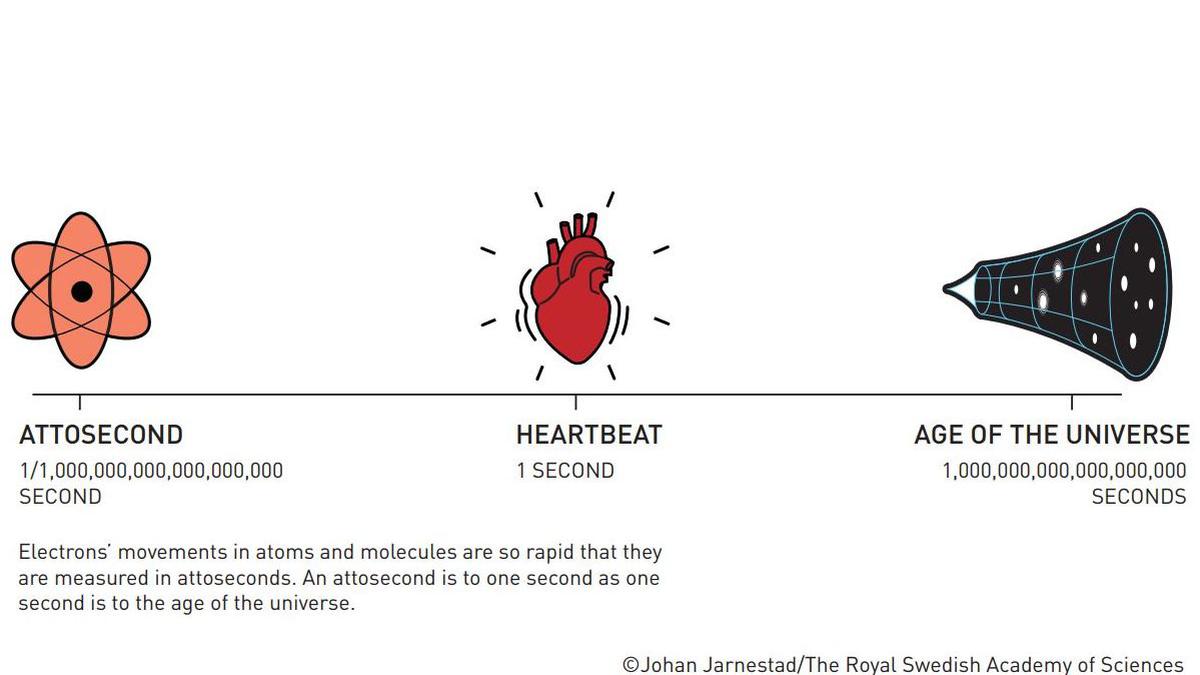
An attosecond is one quintillionth of a second, or 10^-18 seconds. This is the timescale at which the properties of an electron change. So, to truly understand electrons, it should be possible to study them at these timescales. This is what the work of the Nobel laureates made possible.
What is attosecond science?
Attosecond science, including attosecond physics, or attophysics, deals with the production of extremely short light pulses and using them to study superfast processes. A hummingbird’s wings beat 80 times a second, so a single beat would last 1/80th of a second. At its best, the human eye can see up to 60 frames per second, which is not good enough to see a single wingbeat as it happens. Instead, the wings’ motion would appear as a blur.
Editorial | Let there be light: On the 2023 physics Nobel
One solution is to use a digital camera that creates photographs by capturing light coming from a source using a sensor. To capture a single wingbeat, the camera needs to capture only just as much light — which it can do if its aperture is open for exactly 1/80th of a second. An alternative is to keep the aperture open at all times and release a light pulse whose duration is 1/80th of a second towards the wing and capture the reflection. The former is much easier to do with a digital camera, but when you’re studying electrons, the latter is a better option. In attosecond science, the light pulse’s duration is a few hundred attoseconds because the electrons’ ‘wingbeats’ happen that rapidly.
What is the physics of producing an attosecond pulse?
The concepts underlying the production of attosecond pulses come from wave mechanics. In 1988, Anne L’Huillier and her colleagues in Paris passed a beam of infrared light through a noble gas. They found that the gas emitted light whose frequency was a high multiple of the beam’s frequency — for example, if the beam frequency was 10 arbitrary units, the emitted light had frequencies of 50 units, 60 units, 70 units, etc. This phenomenon is called high-harmonic generation, and the emitted waves are said to be overtones of the original. The researchers also found that as they increased the frequency of the original beam, the intensity of the emitted light dropped sharply, then stayed constant for a range, and then dropped again.
By 1994, researchers had worked out why passing the infrared beam through the noble gas was having these effects. A beam of light consists of oscillating electric and magnetic fields. ‘Oscillating’ means that at a given point, the field’s strength alternately increases and decreases. So an electron at this point would be imparted some energy and then have it taken away; when energy is imparted, the electron would come loose from an atom, and when it is taken away, the electron and the atom would recombine, releasing some excess energy. This energy is the light re-emitted by the gas.
The researchers also found a way to describe this process using the equations of quantum mechanics. These equations also explained why the intensity of the re-emitted light plateaued as the beam frequency was increased.
How is an attosecond pulse produced?
When the infrared beam strikes the noble gas atoms, it produces multiple overtones. If the peak of one overtone merges with the peak of another, they undergo constructive interference (like in the double-slit experiment) and produce a larger peak. When the peak of one overtone merges with the trough of another, however, they undergo destructive interference, ‘cancelling’ themselves out.
By combining a large number of overtones in this way, physicists could fine-tune a setup to produce light pulses for a few hundred attoseconds — due to constructive interference — and then stop, due to destructive interference. These pulses are produced only when the beam’s frequency is within the plateau range.
How do we know a pulse lasts for an attosecond?
A major technique to measure the duration of a short light pulse is called RABBIT — and Pierre Agostini and his colleagues at a facility in Paris developed it in 1994. Here, the attosecond pulse and another pulse of a longer duration are shined on atoms of a noble gas. Due to the photoelectric effect, the photons in the two pulses kick out electrons from the atoms. Physicists harvest data about these electrons and the atoms. Information about the pulse’s properties — including its duration — can be mathematically extracted by analysing this data. The principles of producing and then measuring attosecond pulses were finally in place.
It was only in 2001 that Agostini et al., in Paris, and Ferenc Krausz et al. in Vienna were able to produce verified attosecond pulses in a ‘train’: a pulse followed by a gap, followed by a pulse, and so forth. The pulse duration in the former case was 250 as. In the latter, the Krausz group produced a pulse train with a pulse duration of 650 as, and using a filtering technique was also able to isolate a single pulse, a bullet of light.
After these achievements, all three groups, and other physicists, kept refining these techniques so that, by 2017, experts were able to produce a pulse as short as 43 attoseconds.
What are the applications of attophysics?
The devices used to produce attosecond pulses cost crores of rupees, great skill to operate, and are bulky. But miniaturisation has been an important form of technological progress in the last century and, someday, we may have pocket-sized gizmos to study electrons. The important thing is we know how to achieve it. Science has had its own variety of miniaturisation — microbiology, femtochemistry, attophysics — facilitated by devices that could see smaller and smaller things.
Microbiology alerted us to bacteria and femtochemistry allowed us to finely manipulate chemical reactions. In 2010, a team led by Dr. Krausz used attophysics to find that electrons leaving two slightly different energy levels in a neon atom, due to the photoelectric effect, don’t do so simultaneously, as was once thought. Instead, there is a 21-attosecond delay. The photoelectric effect is at the heart of solar power, and by refining our theoretical understanding of it based on studies like this, we could gain big. This motif extends to most parts of physics, chemistry, and biology — everywhere the properties of electrons matter.