Skip to content
  • Facebook
  • X
  • Linkedin
  • WhatsApp
  • YouTube
  • Associate Journalism
  • About Us
  • Privacy Policy
  • 033-46046046
  • editor@artifex.news
Artifex.News

Artifex.News

Stay Connected. Stay Informed.

  • Breaking News
  • World
  • Nation
  • Sports
  • Business
  • Science
  • Entertainment
  • Lifestyle
  • Toggle search form
  • Karur stampede left an indelible scar, says Vijay on first anniversary
    Karur stampede left an indelible scar, says Vijay on first anniversary Nation
  • Access Denied World
  • ISRO satellites closely tracking Cyclone Fengal
    ISRO satellites closely tracking Cyclone Fengal Science
  • Vinesh Phogat Disqualification To Imane Khelif Gender Row: Five Biggest Controversies Of Paris Olympics 2024
    Vinesh Phogat Disqualification To Imane Khelif Gender Row: Five Biggest Controversies Of Paris Olympics 2024 Sports
  • The many firsts of the near-Mir mission
    The many firsts of the near-Mir mission Science
  • Amul denies supplying ghee to TTD in Tirupati laddu row
    Amul denies supplying ghee to TTD in Tirupati laddu row Business
  • AI Can Change Belief In Conspiracy Theories, Study Finds
    AI Can Change Belief In Conspiracy Theories, Study Finds World
  • Trump ‘inclined’ to keep ExxonMobil out of Venezuela after CEO calls it ‘uninvestable’
    Trump ‘inclined’ to keep ExxonMobil out of Venezuela after CEO calls it ‘uninvestable’ World
Scientists gather to decode puzzle of world’s rarest whale

Scientists gather to decode puzzle of world’s rarest whale

Posted on December 2, 2024 By admin


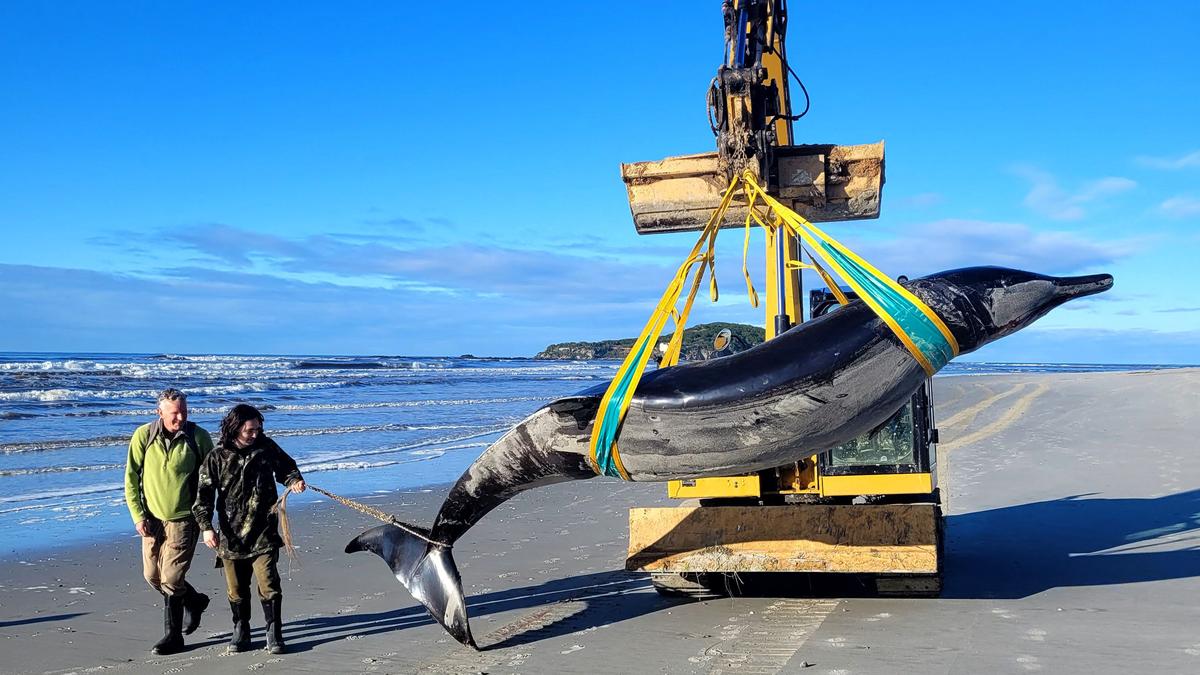
A photo taken on July 5, 2024, by the New Zealand Department of Conservation shows rangers walking beside what appears to be the carcass of a rare spade-toothed whale after it was discovered washed ashore on a beach near Taieri Mouth, New Zealand.
| Photo Credit: AFP

It is the world’s rarest whale, with only seven of its kind ever spotted. Almost nothing is known about the enigmatic species. But on Monday a small group of scientists and cultural experts in New Zealand clustered around a near-perfectly preserved spade-toothed whale hoping to decode decades of mystery.

“I can’t tell you how extraordinary it is,” said a joyful Anton van Helden, senior marine science adviser for New Zealand’s conservation agency, who gave the spade-toothed whale its name to distinguish it from other beaked species. “For me personally, it’s unbelievable.” Van Helden has studied beaked whales for 35 years, but Monday was the first time he has participated in a dissection of the spade-toothed variety. In fact, the careful study of the creature — which washed up dead on a New Zealand beach in July — is the first ever to take place.

None has ever been seen alive at sea.

The list of what scientists don’t know about spade-toothed whales is longer than what they do know. They don’t know where in the ocean the whales live, why they’ve never been spotted in the wild, or what their brains look like. All beaked whales have different stomach systems and researchers don’t know how the spade-toothed kind processes its food. They don’t know how this one died.

Over the next week, researchers studying the 5-metre (16-foot)-long male at an agricultural research centre near the city of Dunedin hope to find out.

“There may be parasites completely new to science that just live in this whale,” said van Helden, who thrilled at the chance of learning how the species produces sound and what it eats. “Who knows what we’ll discover?” Only six other spade-toothed whales have ever been found, but all those discovered intact were buried before DNA testing could verify their identification.

New Zealand is a whale-stranding hotspot, with more than 5,000 episodes recorded since 1840, according to the Department of Conservation. The first spade-toothed whale bones were found in 1872 on New Zealand’s Pitt Island. Another discovery was made at an offshore island in the 1950s, and the bones of a third were found on Chile’s Robinson Crusoe Island in 1986.

DNA sequencing in 2002 proved that all three specimens were of the same species — and that it was distinct from other beaked whales. But researchers studying the mammal couldn’t confirm whether the species was extinct until 2010, when two whole spade-toothed whales, both dead, washed up on a New Zealand beach. But none has been studied before.

On Monday, the seventh of its kind, surrounded by white-aproned scientists who were measuring and photographing, appeared relatively unblemished, giving no clue about its death. Researchers pointed out marks from cookiecutter sharks — normal, they said, and not the cause.

The dissection will be quiet, methodical and slower than usual, because it is being undertaken in partnership with Maori, New Zealand’s Indigenous people. To Maori, whales are a taonga -– a precious treasure -– and the creature will be treated with the reverence afforded to an ancestor.

Members of the local iwi, or tribe, will be present throughout the dissection and consulted at each turn, allowing them to share traditional knowledge and observe customs, such as saying a karakia -– a prayer -– over the creature before the study begins.

“According to our beliefs and our traditions, this whale is a gift of Tangaroa, deity of the ocean,” said Tumai Cassidy from the local people Te Runanga Otakou. “It’s very important for us to respect that gift and to honour the whale.” The iwi will keep the jawbone and teeth of the whale at the end of the dissection, before its skeleton is displayed in a museum. 3D printing will be used to replicate those parts, using a CT scan taken of the whale’s head this week.

“It all builds a richer picture for that species but also tells us how it interacts with our oceans,” Cassidy said.

It’s thought that spade-toothed whales live in the vast Southern Pacific Ocean, home to some of the world’s deepest ocean trenches. Beaked whales are the ocean’s deepest divers for food, and the spade-toothed may rarely surface, adding to its mystery.

The assembled scientists on Monday included a few who had travelled from abroad to see the whale, which was put in refrigerated storage after its discovery.

“What we are interested in is not only how these animals died, but how they lived,” said Joy Reidenberg, a comparative anatomist from the Icahn School of Medicine at Mount Sinai in New York. “In discovering how they live, we are hoping to find discoveries that we can apply back to the human condition.”

Published – December 02, 2024 04:24 pm IST


Source link

Science

Post navigation

Previous Post: Sensex, Nifty settle higher on buying in blue-chips
Next Post: “When We Couldn’t Retain Him…”: Hardik Pandya Breaks Silence On Ishan Kishan’s Exit

Related Posts

  • Israel Gaza war: what is a famine
    Israel Gaza war: what is a famine Science
  • Watch | How climate change is affecting monsoon forecast and disaster management
    Watch | How climate change is affecting monsoon forecast and disaster management Science
  • Bernard and the discovery of glycogen
    Bernard and the discovery of glycogen Science
  • IIT Bombay charts path to cool data centres using deep ocean water 
    IIT Bombay charts path to cool data centres using deep ocean water  Science
  • The Science Quiz | A world beneath our feet
    The Science Quiz | A world beneath our feet Science
  • Watch: Did you know 40 per cent of Australia’s energy comes from solar power?
    Watch: Did you know 40 per cent of Australia’s energy comes from solar power? Science

More Related Articles

Hidden dangers of irrational use of antibiotics on microbiome Hidden dangers of irrational use of antibiotics on microbiome Science
Dyson sphere: an energy devourer Dyson sphere: an energy devourer Science
One-atom experiment settles Einstein’s challenge in Bohr’s favour One-atom experiment settles Einstein’s challenge in Bohr’s favour Science
Dhaka’s new Padma barrage will reshape South Asia’s water power map Dhaka’s new Padma barrage will reshape South Asia’s water power map Science
Say cheese: Japanese scientists make robot face ‘smile’ with living skin Say cheese: Japanese scientists make robot face ‘smile’ with living skin Science
One-third of TB patients received no payment for nutrition support One-third of TB patients received no payment for nutrition support Science
SiteLock

Archives

  • October 2026
  • September 2026
  • August 2026
  • July 2026
  • June 2026
  • May 2026
  • April 2026
  • March 2026
  • February 2026
  • January 2026
  • December 2025
  • November 2025
  • October 2025
  • September 2025
  • August 2025
  • July 2025
  • June 2025
  • May 2025
  • April 2025
  • March 2025
  • February 2025
  • January 2025
  • December 2024
  • November 2024
  • October 2024
  • September 2024
  • August 2024
  • July 2024
  • June 2024
  • May 2024
  • April 2024
  • March 2024
  • February 2024
  • January 2024
  • December 2023
  • November 2023
  • October 2023
  • September 2023
  • August 2023
  • July 2023
  • June 2023
  • May 2023
  • April 2023
  • March 2023
  • February 2023
  • January 2023
  • December 2022
  • November 2022
  • October 2022
  • September 2022
  • August 2022
  • July 2022
  • June 2022
  • May 2022

Categories

  • Business
  • Nation
  • Science
  • Sports
  • World

Recent Posts

  • Delhi journalist who accused ACP of sexual harassment slapped with SC/ST Act over ‘casteist remarks’
  • TCCI seeks review of steep parking, access charges at Thiruvananthapuram airport
  • Ranji Trophy 2026-27: Rain helps J&K salvage a draw against Shubham’s M.P.
  • Zydus’ manufacturing plant gets 5 U.S. FDA observations
  • Sivaganga police arrest five under Goondas Act in double murder case

Recent Comments

  1. RobertTes on UP Teacher Who Asked Students To Slap Muslim Classmate
  2. Manuelret on UP Teacher Who Asked Students To Slap Muslim Classmate
  3. RobertTes on UP Teacher Who Asked Students To Slap Muslim Classmate
  4. RobertTes on UP Teacher Who Asked Students To Slap Muslim Classmate
  5. BrentWes on UP Teacher Who Asked Students To Slap Muslim Classmate
  • Access Denied World
  • Syria’s First Lady Asma Al-Assad Diagnosed With Leukaemia
    Syria’s First Lady Asma Al-Assad Diagnosed With Leukaemia World
  • Access Denied Sports
  • 3 Killed, 6 Injured After Car Collides With Stationary Truck In UP: Cops
    3 Killed, 6 Injured After Car Collides With Stationary Truck In UP: Cops Nation
  • 4-Storey Building Collapses Like Pack Of Cards In Delhi
    4-Storey Building Collapses Like Pack Of Cards In Delhi Nation
  • India, Bangladesh in talks for an early bilateral visit by PM Rahman to New Delhi
    India, Bangladesh in talks for an early bilateral visit by PM Rahman to New Delhi World
  • “Had To Wait For My Opportunity”: Rahul Tripathi On His Performance In IPL 2024
    “Had To Wait For My Opportunity”: Rahul Tripathi On His Performance In IPL 2024 Sports
  • Access Denied
    Access Denied Nation

Editor-in-Chief:
Mohammad Ariff,
MSW, MAJMC, BSW, DTL, CTS, CNM, CCR, CAL, RSL, ASOC.
editor@artifex.news

Associate Editors:
1. Zenellis R. Tuba,
zenelis@artifex.news
2. Haris Daniyel
daniyel@artifex.news

Photograher:
Rohan Das
rohan@artifex.news

Associate Journalists
1. Subrata Paul - AN/2020/01
2. Quamruz Zaman - AN/2021/22
3. Ahmed Sha - AN/2021/035
4. Ajay Kumar Shaw - AN/2021/39
5. Tahqiqul Hoda - AN/2021/21

Artifex.News offers Online Paid Internships to college students from India and Abroad. Interns will get a PRESS CARD and other online offers.
Send your CV (Subjectline: Paid Internship) to internship@artifex.news

Links:
Associate Journalism
About Us
Privacy Policy

News Links:
Breaking News
World
Nation
Sports
Business
Entertainment
Lifestyle

Registered Office:
72/A, Elliot Road, Kolkata - 700016
Tel: 033-22277777, 033-22172217
Email: office@artifex.news

Editorial Office / News Desk:
No. 13, Mezzanine Floor, Esplanade Metro Rail Station,
12 J. L. Nehru Road, Kolkata - 700069.
(Entry from Gate No. 5)
Tel: 033-46011099, 033-46046046
Email: editor@artifex.news

Copyright © 2023 Artifex.News Newsportal designed by Artifex Infotech.