






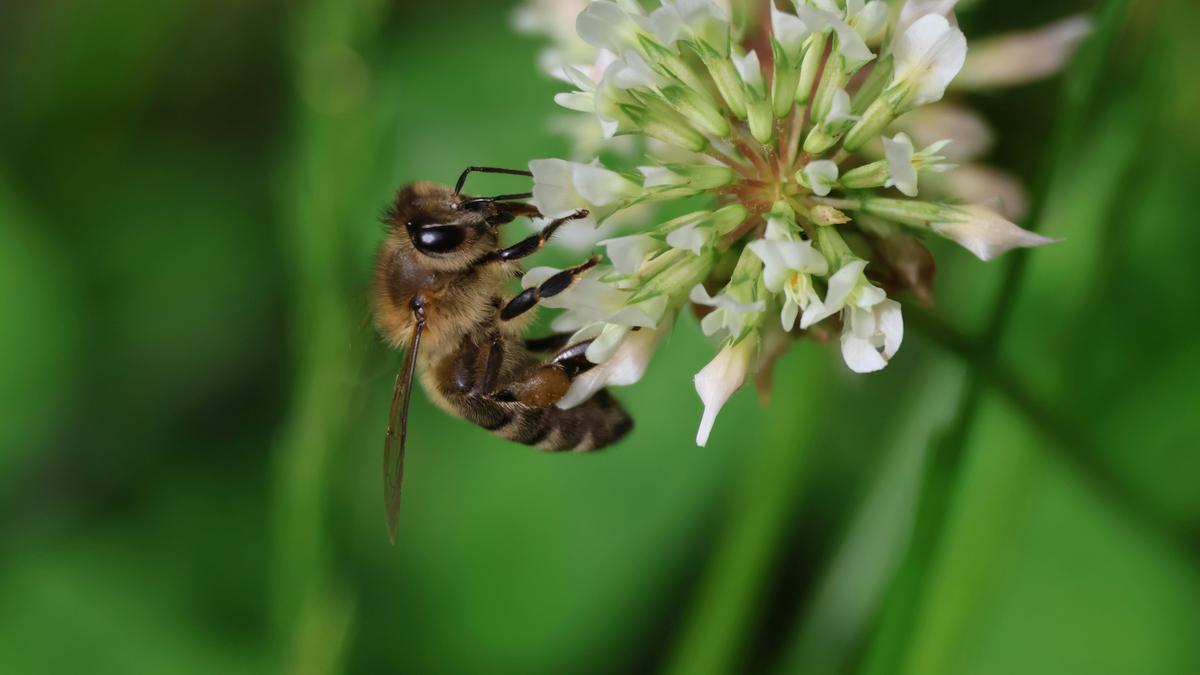
A significant chunk of the world’s agricultural productivity and nutritional security relies on small insect pollinators. More than 75% of food crops, fruits, and flowering plants need bees, wasps, beetles, flies, moths, and butterflies to yield successful harvests.
This is why threats to insect pollinators, including pesticides, pollution, and climate change, endanger the economies of entire countries. A new actor on this list is infectious diseases made worse by habitat loss.
While the declining populations of pollinators, particularly bees, has been well-documented in Europe and North America, data from biodiversity-rich regions like the Indian subcontinent are scarce. In fact, most of what scientists know about bees comes from research on managed western honey bees (Apis mellifera).
Diversity is better, again
“In many cases, wild bees are more efficient pollinators than the western honey bees. It is essential to study wild bee communities and look at their state of health,” Corina Maurer, a postdoctoral researcher at ETH Zürich, wrote in an email to this reporter.
Research has uncovered the transmission of pathogens between managed honey bees and wild pollinators, a process called pathogen spillover and spillback. Western honey bees are often viral reservoirs and can infect wild species when they share habitats. These emerging infectious diseases also threaten the wider pollinator community.
Maurer and her team recently published a paper in Nature Ecology and Evolution exploring the presence of deformed wing virus and black queen virus in 19 wild bee and hoverfly species across different landscapes in Switzerland. They found higher loads of these pathogens in wild pollinators that used floral resources the honey bees accessed as well. The loads were 10-times higher among the wild pollinators in these shared habitats.
Based on these findings, the researchers suggested that diverse pollinator-friendly habitats with more floral resources lowered the chance of pathogens being transmitted between wild pollinators and managed western honey bees. Habitat loss, on the other hand, could force pollinators into smaller suitable habitats and increase the risk of disease transmission.
“We cannot exclude the possibility of spillover if wild species are forced to share spaces due to loss of habitat or if managed species are transported into new habitats,” Axel Brockmann, a retired professor who studied honey bee behaviour at the National Centre for Biological Sciences, Bengaluru, said.
Habitat overlap and native bees
India hosts more than 700 bee species, including four indigenous honey bees: Asiatic honey bee (Apis cerana indica), giant rock bee (Apis dorsata), dwarf honey bee (Apis florea), and the stingless bee (sp. Trigona). Western honey bees were introduced in India in 1983 to increase the country’s honey yield.
In 1991-1992, a Thai sacbrood virus outbreak devastated around 90% of Asiatic honey bee colonies in South India and reemerged in 2021 in Telangana. The virus has been reported from other parts of the world, including China and Vietnam.
The Thai sacbrood virus is one of the greatest threats facing the Asiatic honey bee. The disease caused by the virus’s infection kills the bees’ larvae. The particular viral strain that attacks western honey bees is less virulent.
Importantly, researchers don’t know how the virus is transmitted between bee populations.
“Transmission of viruses from a managed species, such as the honeybee, to wild pollinators could be a problem for the honeybee and wild pollinators,” Maurer said. “The viruses spilling over from honeybees to wild pollinators could mutate in the wild pollinators and then spill back to honeybees in a more virulent form, … being more detrimental to honeybees. In the case of wild pollinators, diseases which are not naturally occurring in wild pollinators but spill over from the managed honeybee may severely affect their health.”
When bees migrate
“Since 2009, we have been surveying different states such as Gujarat, Madhya Pradesh and Maharashtra. In some of these areas, local bee populations are absent probably because they are on the migratory route of managed western honeybees,” Sujana Krishnamoorthy, executive director of Under the Mango Tree Society, a non-profit organisation that trains small farmers to work with native honey bees, said.
When managed honey bees migrate, beekeepers carry their bee boxes along a specific route where there are more bee flora. In North India, for example, they move through the mustard or sunflower fields of Uttar Pradesh and Madhya Pradesh. In Jammu and Kashmir, the bees migrate from plains to apple orchards, where bumble bees live.
A study published in Scientific Reports in February estimated that 40% of bumblebee species in the Indian Himalaya could lose more than 90% of their habitat by 2050, raising concerns about the competition for resources with western honey bees.
“During our surveys in Kolhapur in Maharashtra many years ago, conversations with local beekeepers and experts informed us that after a few western honey bee colonies were brought in, some disease completely decimated the indigenous pollinator populations,” Krishnamoorthy said. “Kolhapur used to produce eight to 10 tonnes of forest honey but it struggled to produce even a tonne after that.”
“There is no discussion about what these diseases could be.”
Need for focused research
Experts agree that more research and surveillance are required to monitor emerging diseases in bees and other pollinators.
“Surveying wild pollinators is probably difficult and a huge effort, as there are so many species,” Maurer said. “A better approach is to survey the managed honeybee colonies and control their diseases to minimise transmission to wild pollinators.”
Dedicated research on viral threats like the Thai sacbrood virus is crucial for protecting the health of pollinators because it can pave the way for early warnings and help researchers and policymakers devise prevention strategies.
“Understanding the basic ecology of pollinators is key to conservation-oriented studies of how they will respond to threats such as climate change, habitat loss or infectious diseases,” Brockmann said.
Rupsy Khurana is Science Communication and Outreach Lead at the National Centre for Biological Sciences, Bengaluru.
Published – November 18, 2024 05:30 am IST