


Skip to content
  • Facebook
  • X
  • Linkedin
  • WhatsApp
  • YouTube
  • Associate Journalism
  • About Us
  • Privacy Policy
  • 033-46046046
  • editor@artifex.news
Artifex.News

Artifex.News

Stay Connected. Stay Informed.

  • Breaking News
  • World
  • Nation
  • Sports
  • Business
  • Science
  • Entertainment
  • Lifestyle
  • Toggle search form
  • Irani Cup: Mukesh and Akash blow away J&K as RoI triumphs
    Irani Cup: Mukesh and Akash blow away J&K as RoI triumphs Sports
  • UK Polls Set To Deliver More Diverse Parliament, Many British Indian MPs
    UK Polls Set To Deliver More Diverse Parliament, Many British Indian MPs World
  • Access Denied
    Access Denied Nation
  • Chinese Warships Sailing Toward Sensitive Strait Amid Tensions: Taiwan
    Chinese Warships Sailing Toward Sensitive Strait Amid Tensions: Taiwan World
  • Access Denied Sports
  • Norway to ban social media for under-16s
    Norway to ban social media for under-16s World
  • U.S. tariffs will have long-term effect on trade: Commerce Ministry to PAC
    U.S. tariffs will have long-term effect on trade: Commerce Ministry to PAC Business
  • Biden, Trump agree on debates in June and September, but working out details could be challenging
    Biden, Trump agree on debates in June and September, but working out details could be challenging World
Thanks to two special genes, a single atom can change the colour of a bird

Thanks to two special genes, a single atom can change the colour of a bird

Posted on November 12, 2024 By admin


Nearly all birds with bright red, orange, and yellow feathers or bills use a group of pigments called carotenoids to produce their colours.
| Photo Credit: Shutterstock

Across the animal kingdom, birds are some of the most colourful creatures of all. But how did all the amazingly coloured different bird species arise?

Nearly all birds with bright red, orange, and yellow feathers or bills use a group of pigments called carotenoids to produce their colours. However, these animals can’t make carotenoids directly. They must acquire them through their diets from the plants they eat. Parrots are the exception to this rule, having evolved an entirely new way to make colourful pigments, called psittacofulvins.

Although scientists have known about these different pigments for some time, understanding the biochemical and genetic basis behind how birds use them to vary in colour has been less clear. But two recent separate studies about parrots and finches have provided vital insight into this mystery.

One study, published in Current Biology, was led by one of us (Daniel Hooper), and the other was led by Portuguese biologist Roberto Abore and published in Science. Together, they advance our understanding of how birds produce their colourful displays – and how these traits have evolved.

A single enzyme

The two new studies involved large teams of international researchers. They used recent advances in genetic sequencing to examine which regions of the genome (an animal’s complete set of DNA) determine natural yellow-to-red colour variation in parrots and finches.

Remarkably, even though these two groups of birds produce their colourful displays using different types of pigments, scientists found they have evolved in similar ways.

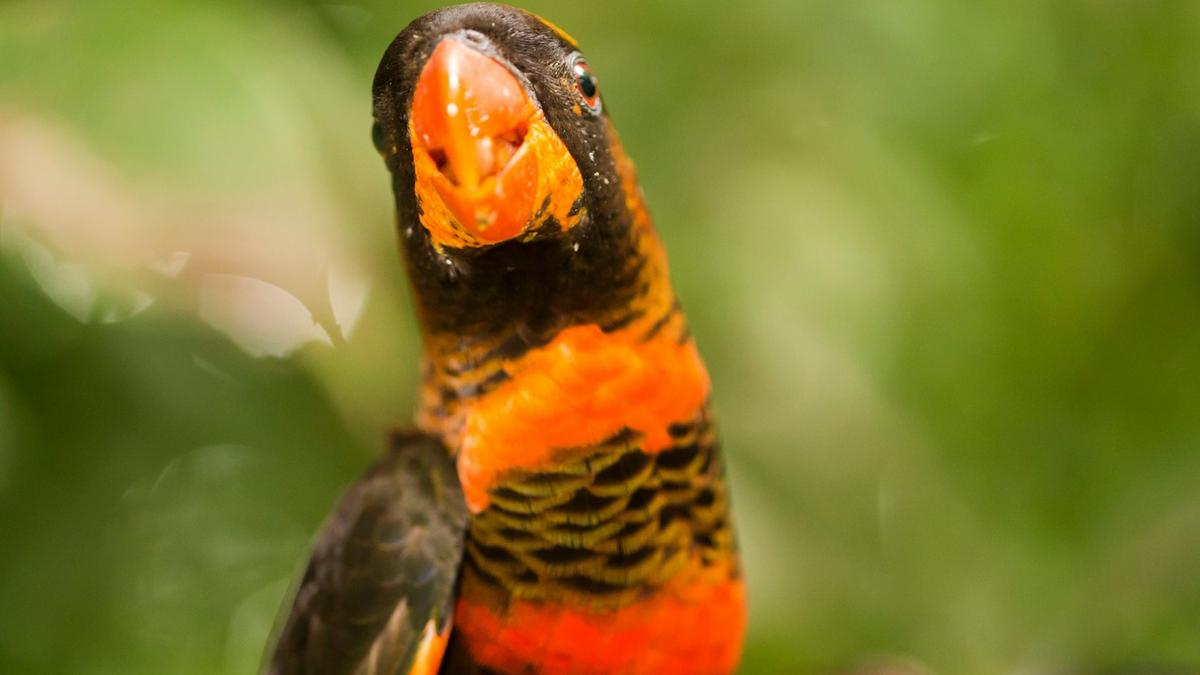
Arbore’s study looked at the dusky lory (Pseudeos fuscata), a parrot native to New Guinea with bands of feathers that may be coloured yellow, orange or red. The research found that shifts between yellow and red feather colouring were associated with an enzyme called ALDH3A2. This enzyme converts red parrot pigments to yellow ones. When developing feathers contain large amounts of the enzyme, they end up yellow; when they have less, they end up red.

Scientists found the ALDH3A2 enzyme also explains colour variation in many other species of parrots which have independently evolved yellow-to-red colour variation.

Two special genes

The long-tailed finch (Poephila acuticauda) is a species of songbird native to northern Australia. There are two hybridising subspecies with different coloured bills. One is yellow-billed while the other is red-billed.

Most carotenoid pigments that birds might consume from their diet are yellow or orange, so birds’ bodies must somehow change the chemistry of the pigments after eating them to produce red colours.

Hooper’s study examined variation in this trait across the whole distribution of the long-tailed finch in the wild, and variation in the genomes of the measured birds. It turned out bill colour in these finches was mostly linked to two genes, CYP2J19 and TTC39B.

Together, these two genes drive the conversion of yellow dietary carotenoids to red ones.

In the long-tailed finch, yellow coloration appears to result from mutations that turn these genes off in the bill specifically while keeping them on in other parts of the body, such as the eyes.

By comparing the DNA code of these colour genes to other finch species, the researchers also found the ancestors of the modern long-tailed finch had red bills, but mutant yellow bills have slowly been growing more common.

Like a lightbulb dimmer

Together these studies show how colours can evolve in natural populations.

In both parrots and finches, the mutations responsible for yellow-to-red colour variation did not change the function of the enzymes involved. Instead they influenced where and when these enzymes were active. Think of it as changing the lighting in a room by installing a dimmer on an existing light switch, rather than removing an entire light fitting.

The scientists also showed that in wild populations of both parrots and finches, mutations to just a few genes can alter the chemical structure of the pigments profoundly – enough to make the difference between red and yellow.

The key genes change the chemical structure of the pigment molecule through the actions of an enzyme which adds just one atom of oxygen to the pigment. This changes it from a bright red to a bright yellow in parrots, and the opposite in finches, from bright yellow to bright red.

The wonder of nature

The evolution of colour in birds has been the focus of attention since Charles Darwin used them in outlining his theory of evolution by natural selection. The most obvious difference between the closely related species of birds that we see around us is their colour.

These two new studies have shown us how a few genes and the addition of that single oxygen atom can change the course of evolution, creating a new form that looks so dramatically different. If this improves the animal in an evolutionary sense – perhaps they look more attractive to potential partners or stand out more – it can lead to the origin of a new species.

This work reminds us of the wonder of nature and shows that evolution is an ongoing process.

To conserve species we need to protect as much of their genetic complexity as possible. Every individual in a population contains a unique genome and every small bit of variation is the product of millions of years of evolution in the past. It could also be the key to the development of a new species in the future.

This article is republished from The Conversation under a Creative Commons license. Read the original article here.

Published – November 12, 2024 02:56 pm IST



Source link

Science Tags:animals news, Birds, Colour of birds, How birds get their colours

Post navigation

Previous Post: Mohammed Shami to return to competitive cricket; to play for Bengal against M.P. in Ranji Trophy
Next Post: 4 Dead, 2 Critically Injured After Car Falls Off Bridge in Assam

Related Posts

  • What role does CSTT play in standardising technical terms?
    What role does CSTT play in standardising technical terms? Science
  • Sci-Five | The Hindu Science Quiz: On Eusociality
    Sci-Five | The Hindu Science Quiz: On Eusociality Science
  • Why Kerala is witnessing a decline in winter migratory birds
    Why Kerala is witnessing a decline in winter migratory birds Science
  • Cyclone Fengal: What is landfall?
    Cyclone Fengal: What is landfall? Science
  • India lost 18 times more forest than it gained between 2015–2019, study finds  
    India lost 18 times more forest than it gained between 2015–2019, study finds   Science
  • NMAMIT team wins Boeing National Aeromodelling Competition in India
    NMAMIT team wins Boeing National Aeromodelling Competition in India Science

More Related Articles

How deep in the ocean does life exist? How deep in the ocean does life exist? Science
India’s rice fields now rank among world’s top methane hotspots India’s rice fields now rank among world’s top methane hotspots Science
After great apes, scientists find African elephants self-medicate too After great apes, scientists find African elephants self-medicate too Science
Is there any evidence that eyes have evolved several times independently of one another? Is there any evidence that eyes have evolved several times independently of one another? Science
What was the Chemistry Nobel Prize given for? | Explained What was the Chemistry Nobel Prize given for? | Explained Science
Argentine scientists find speedy 90-million-year-old herbivore dinosaur Argentine scientists find speedy 90-million-year-old herbivore dinosaur Science
SiteLock

Archives

  • October 2026
  • September 2026
  • August 2026
  • July 2026
  • June 2026
  • May 2026
  • April 2026
  • March 2026
  • February 2026
  • January 2026
  • December 2025
  • November 2025
  • October 2025
  • September 2025
  • August 2025
  • July 2025
  • June 2025
  • May 2025
  • April 2025
  • March 2025
  • February 2025
  • January 2025
  • December 2024
  • November 2024
  • October 2024
  • September 2024
  • August 2024
  • July 2024
  • June 2024
  • May 2024
  • April 2024
  • March 2024
  • February 2024
  • January 2024
  • December 2023
  • November 2023
  • October 2023
  • September 2023
  • August 2023
  • July 2023
  • June 2023
  • May 2023
  • April 2023
  • March 2023
  • February 2023
  • January 2023
  • December 2022
  • November 2022
  • October 2022
  • September 2022
  • August 2022
  • July 2022
  • June 2022
  • May 2022

Categories

  • Business
  • Nation
  • Science
  • Sports
  • World

Recent Posts

  • Shooting at elementary school in Oregon leaves several hospitalised, shooter dead
  • Experts’ poll: RBI may hike rates by 0.25% in October policy amid inflationary pressures
  • Sheikh Hasina’s extradition possible via ‘well-structured’ process: India’s High Commissioner to Bangladesh
  • Five workers dead, one injured in a boiler explosion at a Sri City SEZ facility
  • Ramlila Maidan among spots for which police issued surveillance camera tender in July

Recent Comments

  1. Danielwhipt on UP Teacher Who Asked Students To Slap Muslim Classmate
  2. CharlesGah on UP Teacher Who Asked Students To Slap Muslim Classmate
  3. Danielwhipt on UP Teacher Who Asked Students To Slap Muslim Classmate
  4. MerleEsozy on UP Teacher Who Asked Students To Slap Muslim Classmate
  5. hETRtxRDsALjPmoDyIQPomm on UP Teacher Who Asked Students To Slap Muslim Classmate
  • Conduct of Telugu writers’ conference in Vijayawada a matter of pride: Andhra Pradesh Chief Minister
    Conduct of Telugu writers’ conference in Vijayawada a matter of pride: Andhra Pradesh Chief Minister Nation
  • White House says Nobel Committee places ‘politics over peace’ after Venezuela’s Maria Corina Machado wins Peace Prize
    White House says Nobel Committee places ‘politics over peace’ after Venezuela’s Maria Corina Machado wins Peace Prize World
  • Women garment workers protest transport cuts, allege harsh conditions at MEPZ unit
    Women garment workers protest transport cuts, allege harsh conditions at MEPZ unit Nation
  • Mohammedan Sporting Club Joins Indian Super League For 2024-25 Season
    Mohammedan Sporting Club Joins Indian Super League For 2024-25 Season Sports
  • FIFA World Cup 2026: Argentina squad closer to full health ahead of opener
    FIFA World Cup 2026: Argentina squad closer to full health ahead of opener Sports
  • Ishan Kishan, Shreyas Iyer exclusion from central contracts was chief selector Agarkar’s call: Jay Shah
    Ishan Kishan, Shreyas Iyer exclusion from central contracts was chief selector Agarkar’s call: Jay Shah Sports
  • Access Denied
    Access Denied Nation
  • Lok Sabha Election 2024 Phase 1 Live Updates: Voting Begins
    Lok Sabha Election 2024 Phase 1 Live Updates: Voting Begins Nation

Editor-in-Chief:
Mohammad Ariff,
MSW, MAJMC, BSW, DTL, CTS, CNM, CCR, CAL, RSL, ASOC.
editor@artifex.news

Associate Editors:
1. Zenellis R. Tuba,
zenelis@artifex.news
2. Haris Daniyel
daniyel@artifex.news

Photograher:
Rohan Das
rohan@artifex.news

Associate Journalists
1. Subrata Paul - AN/2020/01
2. Quamruz Zaman - AN/2021/22
3. Ahmed Sha - AN/2021/035
4. Ajay Kumar Shaw - AN/2021/39
5. Tahqiqul Hoda - AN/2021/21

Artifex.News offers Online Paid Internships to college students from India and Abroad. Interns will get a PRESS CARD and other online offers.
Send your CV (Subjectline: Paid Internship) to internship@artifex.news

Links:
Associate Journalism
About Us
Privacy Policy

News Links:
Breaking News
World
Nation
Sports
Business
Entertainment
Lifestyle

Registered Office:
72/A, Elliot Road, Kolkata - 700016
Tel: 033-22277777, 033-22172217
Email: office@artifex.news

Editorial Office / News Desk:
No. 13, Mezzanine Floor, Esplanade Metro Rail Station,
12 J. L. Nehru Road, Kolkata - 700069.
(Entry from Gate No. 5)
Tel: 033-46011099, 033-46046046
Email: editor@artifex.news

Copyright © 2023 Artifex.News Newsportal designed by Artifex Infotech.