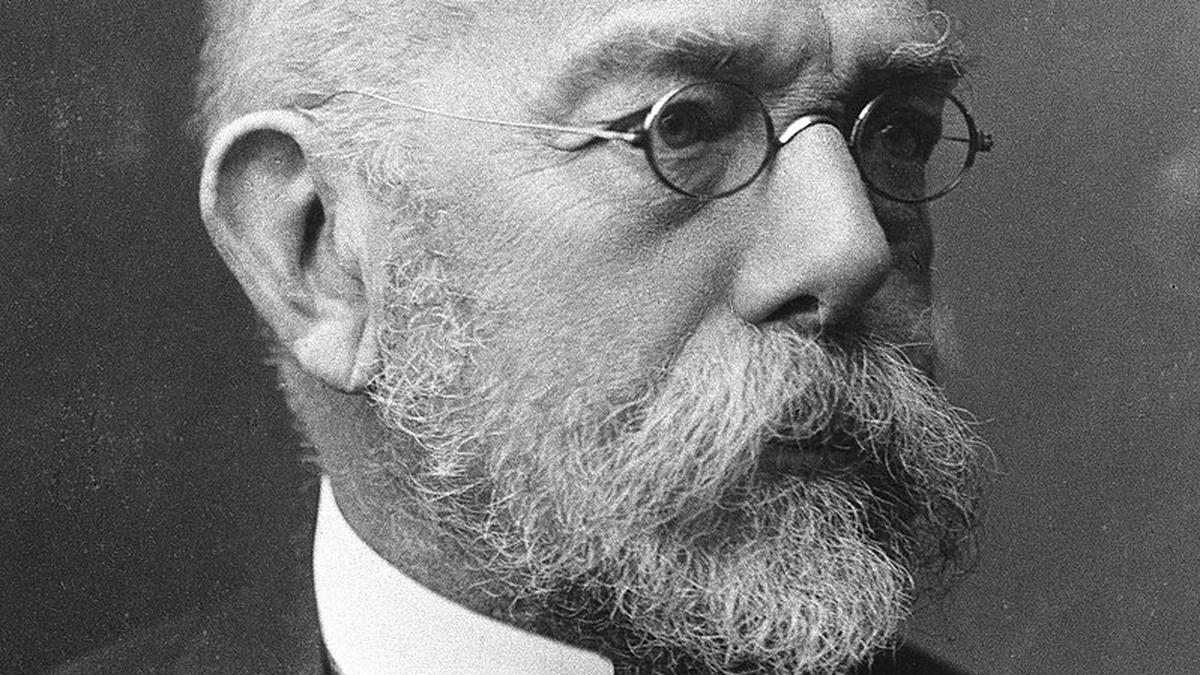
STORY SO FAR: The 2026 Nobel Prize in Chemistry has been awarded to Henri Kagan and Kenso Soai for showing that it is possible to amplify a molecule’s “handedness,” and direct it in a way that it can be used to produce pharmaceutical products of a very high purity. Their work also offers clues to explaining how life on earth could have evolved from simple molecules.
What are chirality and “handedness”?
Your left and right hand have the same number of fingers with ring fingers and thumbs on both of the same length yet why is that you can’t wear the left hand’s glove on the right? The reason is ‘chirality,’ from the Greek kheir, hand. Many chemical molecules that make up substances, including the organic molecules that make up things like DNA, also possess this property of chirality. The mirror-images of a molecule, the left and right-glove so to say, are called ‘enantiomers.’ Paradoxically the organic molecules that make up living organisms are overwhelmingly either left-handed or right-handed and in nature do not present themselves in 50:50 proportions. This property, of ‘homochirality,’ is as if a fashion house decided to base its entire business on making only left-handed gloves and accessories customised to it. Or as we observe, most people are right-handed and urban fixtures like door-knobs, car wipers and a whole lot of implements seem actively biased against left-handed people.
Every amino acid, the building blocks of protein, comes in the “left” (L) form, every sugar in your DNA the “right” (D) form. The puzzle is that an ordinary laboratory reaction cannot manage this in sufficient numbers. When amino acids are synthesised in labs they yield a 50:50 mix, or a ‘racemate,’ as the term goes. The French chemist Louis Pasteur observed this as far back as 1848, when bacteria devoured one mirror form of tartaric acid and left the other untouched.
Editorial | Chance and happenstance: On the Nobel Prize in Chemistry
Why does chirality matter to the pharmaceutical industry?
A drug works by attaching to the surface of enzymes or receptors; like a password fits to lock. In the world of enantiomers, the same letters of the password in the wrong order can at best be harmless and at worst be positively harmful. Like repeated wrong passwords can completely lock you out of a system. The drug thalidomide offers a cautionary tale. First marketed as a sedative, it left thousands of children with birth defects in the early 1960s. For a long time it was attributed to the presence of both enantiomers when the drug was made available, however subsequent analysis says that’s only part of the explanation. However the broader principle is that enantiomers matter. Another example is ethambutol, a first-line tuberculosis drug. Its (S,S) form is about 500 times more potent against the bacillus than its (R,R) mirror image. Yet the optic-nerve damage that is its chief side effect is, according to the pharmacology literature, equal across the isomers and rises with dose and duration. Therefore ensuring that labs must try making and administering as much of the (S,S) form and minimise the other matters because it means that a patient might need less of the curative drug and be less exposed to nerve damage. But the problem remains, how to ensure that labs make extremely pure versions of the desired form.
Visual story | Nobel Prize 2026 Winners: Full List
What was Frank’s model and how was it tested?
In 1953 Charles Frank, a theoretical physicist at the University of Bristol, used mathematics to analyse why the molecules of life presented themselves so biased. His model needs three things: a substance that catalyses its own production (autocatalysis), one that does so for a single hand (enantioselective catalysis), and one that suppresses its mirror twin, what he called an “anti-catalyst” for its antimer. Combine them and even a tiny initial difference, where one form is present slightly more than the other, snowballs exponentially. It took decades. Autocatalysis was known. Asymmetric, or enantioselective catalysis, had already earned Nobels in 2001 and 2021. What nobody had shown was mutual antagonism, or the marriage of autocatalysis and asymmetry and this was where Kagan, in 1986, and Soai, in 1995, made their contribution.
What did each laureate do, and what set them apart?
Kagan, then at Paris-Sud, challenged a dogma. Chemists believed that for more product purity, more of a catalyst’s chiral ingredient had to be proportionally pure. Therefore the race was for ever purer ingredients. Kagan asked what the metal in a catalyst actually does, and reasoned that it grips not one but two chiral molecules (the “ligands” that give the catalyst its handedness). Suppose you build the catalyst from a mix of the two enantiomers, say 75 per cent right-handed and 25 per cent left-handed. The metal picks its two partners at random, so three kinds of catalyst form: right-right (about 56 per cent), left-left (about 6 per cent) and a mixed right-left pair (about 38 per cent). The two matched pairs work well. The mixed pair barely works at all, so it sits idle and takes its share of both hands out of play. Because the minority hand mostly ends up paired with a majority-hand partner in an idle mixed complex, left-left catalysts are rare, and the reaction is driven almost entirely by right-right ones. The product comes out roughly 90:10 in favour of the right hand, purer than the 75:25 mix you started with.

This overturned the old assumption that a product could be no purer than the catalyst’s ingredients. Kagan’s distinction was therefore twofold. He found a new rule, that purity can be amplified and he also gave chemists a diagnostic to determine how many ligands a catalyst could hold and which forms do the work. Soai’s contribution was to build the reaction Frank had imagined: a molecule that makes more of itself, and in the process making itself purer. In his reaction, the product is also the catalyst. Each batch of product is added to the next batch as catalyst, and each round comes out more lopsided than the last. Starting from a pyrimidyl alcohol with a 5 per cent excess of one hand, five rounds lifted it to 90 per cent. In a later version, an excess of just 0.00005 per cent, far too small to measure by ordinary means, became more than 99.5 per cent pure in three rounds. That is an amplification of roughly 630,000-fold. Then came the decisive step. Soai showed that no chiral starting point is needed. Begin with ingredients that have no handedness at all, and the reaction ends up almost entirely one-handed over repeated runs, with the hand chosen by chance. This was the first time anyone had made a one-handed product from non-chiral ingredients in this way, and the reaction remains the only known example of its kind.
Is this a model for the evolution of life?
Not an answer, and the Nobel Committee says so itself. The Frank model is one possible solution among several to an event 3.5 to 4 billion years ago, of which we will probably never have a definitive account. Soai’s reaction runs on zinc reagents in organic solvent that is nothing like a watery ‘prebiotic soup.’ The Nobel Committee calls it a ‘proof of concept.’
Kagan and Soai essentially showed that the Frank model was applicable in the lab. Were Frank alive, he might have shared in the prize.
Published – October 11, 2026 07:25 am IST