





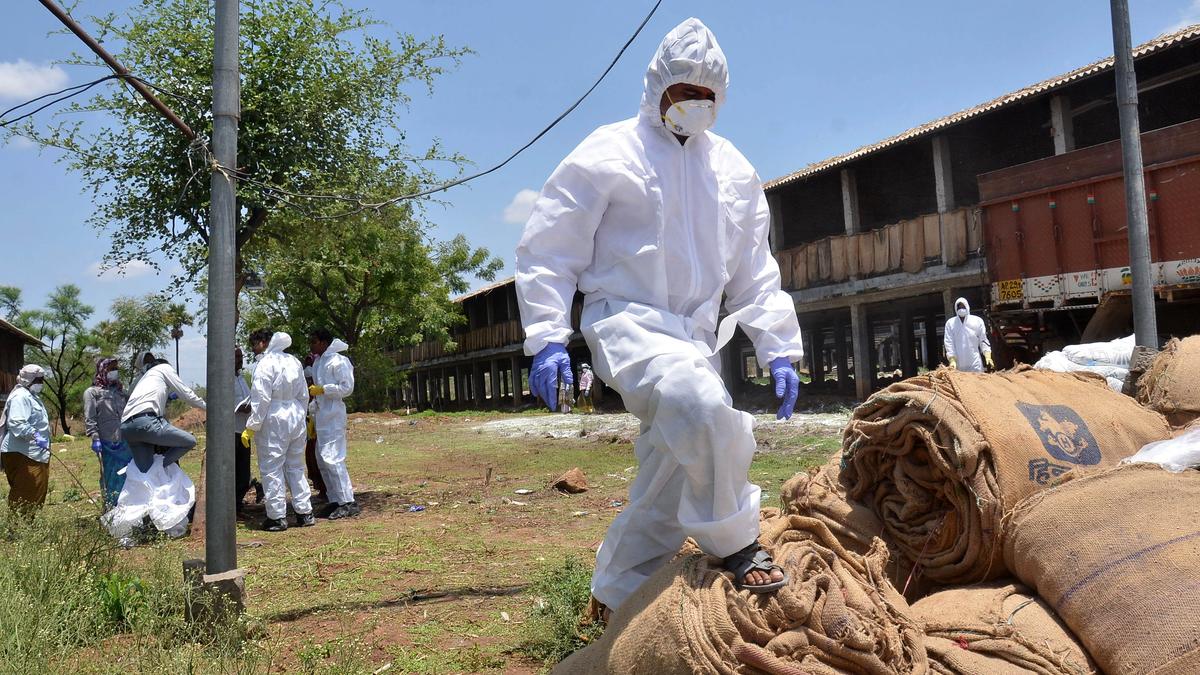
Since October 2023, the reassortant virus has caused 14 human cases and three deaths
| Photo Credit: NAGARA GOPAL
More than 10 years without any H5N1 case, Cambodia suddenly witnessed a spurt of H5N1 cases in humans, with 16 cases reported between February 2023 and August 2024 caused by A/H5 clade 2.3.2.1c viruses. If the sudden spurt in cases was already concerning, 14 cases were caused by a novel mixing or reassortment of A/H5N1 virus. The reassortment was due to mixing of the gene segments from clade 2.3.2.1c known to circulate in Southeast Asia with the newer 2.3.4.4b clade that has spread globally.
Investigations found that three human cases were in contact with sick poultry or bird droppings. Till date, three deaths caused by the reassortant virus have been reported. However, no human-to-human spread has been reported till date.
In a preprint, which is yet to be peer-reviewed, posted on November 5, a team led by the Pasteur Institute in Cambodia published a detailed genetic analysis of the novel H5N1 reassortant, which yielded new details on the spillover timeline and emphasized the need for stepped-up surveillance.
For each human case, a collaborative One Health investigation was conducted, which was able to link the human cases to infected poultry through rapid whole genome sequencing. The rapid assessment through genome sequencing and linking the human cases to poultry enabled rapid response and control measures.
Clade 2.3.2.1c viruses in poultry were first reported in Cambodia in March 2014 and one human case caused by this clade thereafter was also reported from Cambodia. The clade 2.3.2.1c viruses continued to circulate since 2014. However, clade 2.3.4.4b viruses were first detected in live bird markets in Cambodia in 2021, co-circulating with clade 2.3.2.1c viruses.
There were two spillovers to humans, with the first occurring in February 2023 involving clade 2.3.2.1c viruses when two related individuals were detected and death of one person. The second spillover to humans began in October 2023. Between October 2023 and the end of August 2024, Cambodia has reported 14 cases with six deaths. The second spillover is marked by a novel reassortant virus.
According to the authors, the exact origins of this reassortment are still unclear. However, the reassortment has very likely been “facilitated by high-density poultry farming, wild bird migration, and cross-border poultry trade in the region, highlighting the ongoing risk of zoonotic transmission in Southeast Asia”.
Apparently, after the emergence of the novel reassortant genotype, the clade 2.3.2.1c is no longer in circulation in poultry in Cambodia. “Novel reassortant replaced the circulating 2.3.2.1c clade in Cambodian poultry,” Jurre Y. Siegers, from the Institut Pasteur du Cambodge, Phnom Penh, Cambodia and the first author of the preprint said in a post in X (formerly Twitter). “All available data suggest human infections are attributed to direct poultry-to-human transmission, with no evidence of human-to-human spread.”
Phylogenetic analysis of the HA gene segment undertaken by the researchers reveals that all A/H5 viruses sequenced from human cases belong to clade 2.3.2.1c. According to the authors, the virus responsible for the February 2023 case in humans was closely related to clade 2.3.2.1c A/H5N1 viruses that has been circulating in Cambodian poultry and wild birds since 2013.
But since October 2023, the hemagglutinin (HA) sequences from both humans and poultry in Cambodia displayed significant divergence from earlier Cambodia strains. “These HA genes clustered with two duck samples from Vietnam during July and August 2023, and were derived from a sublineage of clade 2.3.2.1.c continuously detected in Laos during October 2020 and May 2023,” they write. “Together, this indicates an introduction of a sublineage of clade 2.3.2.1c viruses with a common ancestor detected in poultry in Vietnam and Laos, but the exact introduction pathway cannot be pinpointed due to gaps in available surveillance data.”
Though the phenotypic contributions of newly introduced clade 2.3.4.4b internal gene segments have yet to be elucidated, the presence of certain amino acid mutations in both human and poultry viruses in the gene segment of 2.3.4.4b suggests enhanced capacity for mammalian infection, they note. “To better understand the zoonotic risk that these viruses pose, further risk assessment in silico, ex vivo, in vivo, and in vitro is critical. In addition, the detection of the PB2 627K mutation in the novel reassortant genotype in poultry is also a concern, as it may become established in widespread circulation,” they caution. The PB2 627K mutation is associated with increased mammalian adaptation and airborne transmission in ferrets. This underscores the need for close monitoring of the novel reassortant genotype for signs of increased mammalian adaptation.
This makes it critical to carry out sustained surveillance of avian influenza virus circulation in poultry and wild birds, particularly in high-risk regions like Southeast Asia. Simultaneously, awareness programmes to reduce human exposure to infected poultry is paramount. Also important is building awareness about safe handling practices, and encouraging early healthcare seeking behaviour, says Dr. Siegers.
Published – November 09, 2024 11:00 pm IST