


Skip to content
  • Facebook
  • X
  • Linkedin
  • WhatsApp
  • Associate Journalism
  • About Us
  • Privacy Policy
  • 033-46046046
  • editor@artifex.news
Artifex.News

Artifex.News

Stay Connected. Stay Informed.

  • Breaking News
  • World
  • Nation
  • Sports
  • Business
  • Science
  • Entertainment
  • Lifestyle
  • Toggle search form
  • Pakistan women ride economic crisis to carve out a place among workforce World
  • Turkiye arrests 99 suspected Islamic State members World
  • Swiggy secures shareholders’ nod to raise over ₹10,400 crore via IPO Business
  • “My Heart Rate Was Up”: MS Dhoni’s First Reaction After India’s T20 World Cup Win Is All Of Us Sports
  • Indian Equity Market Enters Coveted USD 4 Trillion Club For 1st Time Ever Business
  • 9 Maoists Killed In Encounter With Security Forces In Chhattisgarh Nation
  • When Jamsetji did not shy away from shutting the first business of Tata Group that bore the Tata name Business
  • “Helps Parties With Deeper Pockets”: Opposition Questions 7-Phase Election Nation

What is helium and why is it used in rockets?

Posted on September 7, 2024 By admin


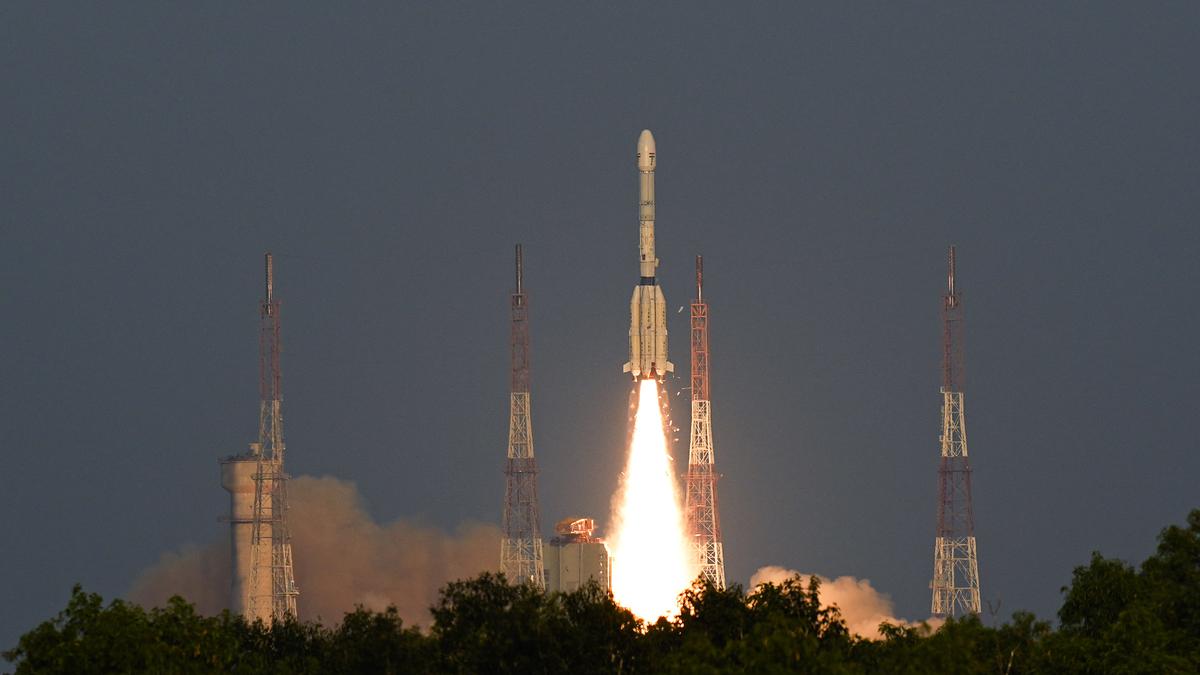
The GSLV-F14 carrying INSAT-3DS satellite lifts off from the Satish Dhawan Space Centre (SDSC-SHAR) in Sriharikota, February 17, 2024.
| Photo Credit: PTI

Two NASA astronauts aboard Boeing’s Starliner will stay on the International Space Station for months because of a faulty propulsion system whose problems included helium leaks. Back on Earth, SpaceX’s Polaris Dawn mission has been delayed because of helium issues on ground equipment.

Boeing’s Starliner spacecraft landed uncrewed in a New Mexico desert late on Friday.

Past missions have that have been affected by pesky helium leaks include ISRO’s Chandrayaan 2 and ESA’s Ariane 5. Why do spacecraft and rockets use helium, and what is so tricky about it?

Why helium?

Helium is inert – it does not react with other substances or combust – and its atomic number is 2, making it the second lightest element after hydrogen.

Rockets need to achieve specific speeds and altitude to reach and maintain orbit. A heavier rocket requires more energy, not only increasing fuel consumption but also needing more powerful engines, which are more expensive to develop, test, and maintain.

Helium also has a very low boiling point (-268.9° C), allowing it to remain a gas even in super-cold environments, an important feature because many rocket fuels are stored in that temperature range.

The gas is non-toxic, but cannot be breathed on its own, because it displaces the oxygen humans need for respiration.

How is it used?

Helium is used to pressurize fuel tanks, ensuring fuel flows to the rocket’s engines without interruption; and for cooling systems.

As fuel and oxidiser are burned in the rocket’s engines, helium fills the resulting empty space in the tanks, maintaining the overall pressure inside.

Because it is non-reactive, it can safely mingle with the tanks’ residual contents.

Is it prone to leaks?

Helium’s small atomic size and low molecular weight mean its atoms can escape through small gaps or seals in storage tanks and fuel systems.

But because there is very little helium in the Earth’s atmosphere, leaks can be easily detected – making the gas important for spotting potential faults in a rocket or spacecraft’s fuel systems.

In May, hours before Boeing’s Starliner spacecraft made an initial attempt to launch its first astronaut crew, tiny sensors inside the spacecraft detected a small helium leak on one of Starliner’s thrusters that NASA spent several days analysing before deeming it low-risk.

Additional leaks were detected in space after Starliner launched in June, contributing to NASA’s decision to bring Starliner back to Earth without its crew.

The frequency of helium leaks across space-related systems, some engineers say, have highlighted an industry-wide need for innovation in valve design and more precise valve-tightening mechanisms.

Are there alternatives?

Some rocket launches have experimented with gases such as argon and nitrogen, which are also inert and can sometimes be cheaper. Helium, however, is much more prevalent in the industry.

Europe’s new Ariane 6 rocket ditched the helium of its predecessor Ariane 5 for a novel pressurization system that converts a small portion of its primary liquid oxygen and hydrogen propellants to gas, which then pressurizes those fluids for the rocket engine.

That system failed in space during the final phase of Ariane 6’s otherwise successful debut launch in July, adding to the global rocket industry’s long list of pressurization challenges.

Published – September 07, 2024 04:41 pm IST


Source link

Science

Post navigation

Previous Post: 3-Year-Old Critical After Shooting Self In Face With Mother’s Gun In US
Next Post: BJP’s Haryana Rebellion Intensifies, Another Senior Leader Quits Party

Related Posts

  • Zoopharmacognosy: the study of how animals self-medicate Science
  • Sweltering public hospitals turn into ‘death traps’ for poor communities Science
  • Daily Quiz | On India’s first satellite ‘Aryabhata’ Science
  • Yellow dye makes live mouse temporarily transparent Science
  • 3 craters discovered on Mars by scientists of Physical Research Laboratory Science
  • Risky geoengineering should be banned, climate group says Science

More Related Articles

Melting polar ice due to climate change is making earth’s days longer Science
The Science Quiz | The Skylab ‘incident’ Science
76% of TB patients received payment for nutritional support Science
Can ‘good sounds’ help coral islands recover from bleaching? Science
India-made typhoid vaccine efficacy lasts for four years: study Science
Reproduce or it didn’t happen: why replicable science is better science Science
SiteLock

Archives

  • September 2024
  • August 2024
  • July 2024
  • June 2024
  • May 2024
  • April 2024
  • March 2024
  • February 2024
  • January 2024
  • December 2023
  • November 2023
  • October 2023
  • September 2023
  • August 2023
  • July 2023
  • June 2023
  • May 2023
  • April 2023
  • March 2023
  • February 2023
  • January 2023
  • December 2022
  • November 2022
  • October 2022
  • September 2022
  • August 2022
  • July 2022
  • June 2022
  • May 2022

Categories

  • Business
  • Nation
  • Science
  • Sports
  • World

Recent Posts

  • Avesh Khan Teased With RCB Chants In Chinnaswamy, His Reply Wins Internet. Watch
  • Pakistan women ride economic crisis to carve out a place among workforce
  • PM Narendra Modi To Attend Quad Summit In US This Month, India Likely To Host It In 2025
  • Adani Green redeems $750 mn bonds
  • AI Started As A Dream To Save Humanity. Then, Big Tech Took Over.

Recent Comments

  1. TpeEoPQa on UP Teacher Who Asked Students To Slap Muslim Classmate
  2. xULDsgPuBe on UP Teacher Who Asked Students To Slap Muslim Classmate
  3. KyJtkhneiLmcq on UP Teacher Who Asked Students To Slap Muslim Classmate
  4. mOyehudovB on UP Teacher Who Asked Students To Slap Muslim Classmate
  5. GFBvgSrWPcsp on UP Teacher Who Asked Students To Slap Muslim Classmate
  • Over 79,000 Model Code Violations Reported through Poll Body’s C-Vigil App Nation
  • Heat Waves In Mexico Lead To Submerged Homes World
  • Delhi Gym Owner Stabbed To Death, Attacked 21 Times On Face Nation
  • Ex BJP Rajasthan Ally Hanuman Beniwal To Fight Lok Sabha Polls From Nagaur Nation
  • Inter Beat Genoa To Take Further Step Towards Serie A Title Sports
  • Quiz | Easy like Sunday morning: Know your flora and fauna Science
  • Hardik Pandya And Wife Natasa Stankovic “Mutually Part Ways”, To Co-Parent Son Agastya Sports
  • Delhi Lt Governor Suspends Health Official In Hospital Fire Row Nation

Editor-in-Chief:
Mohammad Ariff,
MSW, MAJMC, BSW, DTL, CTS, CNM, CCR, CAL, RSL, ASOC.
editor@artifex.news

Associate Editors:
1. Zenellis R. Tuba,
zenelis@artifex.news
2. Haris Daniyel
daniyel@artifex.news

Photograher:
Rohan Das
rohan@artifex.news

Artifex.News offers Online Paid Internships to college students from India and Abroad. Interns will get a PRESS CARD and other online offers.
Send your CV (Subjectline: Paid Internship) to internship@artifex.news

Links:
Associate Journalism
About Us
Privacy Policy

News Links:
Breaking News
World
Nation
Sports
Business
Entertainment
Lifestyle

Registered Office:
72/A, Elliot Road, Kolkata - 700016
Tel: 033-22277777, 033-22172217
Email: office@artifex.news

Editorial Office / News Desk:
No. 13, Mezzanine Floor, Esplanade Metro Rail Station,
12 J. L. Nehru Road, Kolkata - 700069.
(Entry from Gate No. 5)
Tel: 033-46011099, 033-46046046
Email: editor@artifex.news

Copyright © 2023 Artifex.News Newsportal designed by Artifex Infotech.