




As we focused our microscope on the soil sample for the first time, bits of organic material came into view: a tiny poppy seed, the compound eye of an insect, broken willow twigs and spikemoss spores. Dark-coloured spheres produced by soil fungi dominated our view.
These were unmistakably the remains of an arctic tundra ecosystem – and proof that Greenland’s entire ice sheet disappeared more recently than people realise.
These tiny hints of past life came from a most unlikely place – a handful of soil that had been buried under 2 miles of ice below the summit of the Greenland ice sheet. Projections of future melting of the ice sheet are unambiguous: When the ice is gone at the summit, at least 90% of Greenland’s ice will have melted.
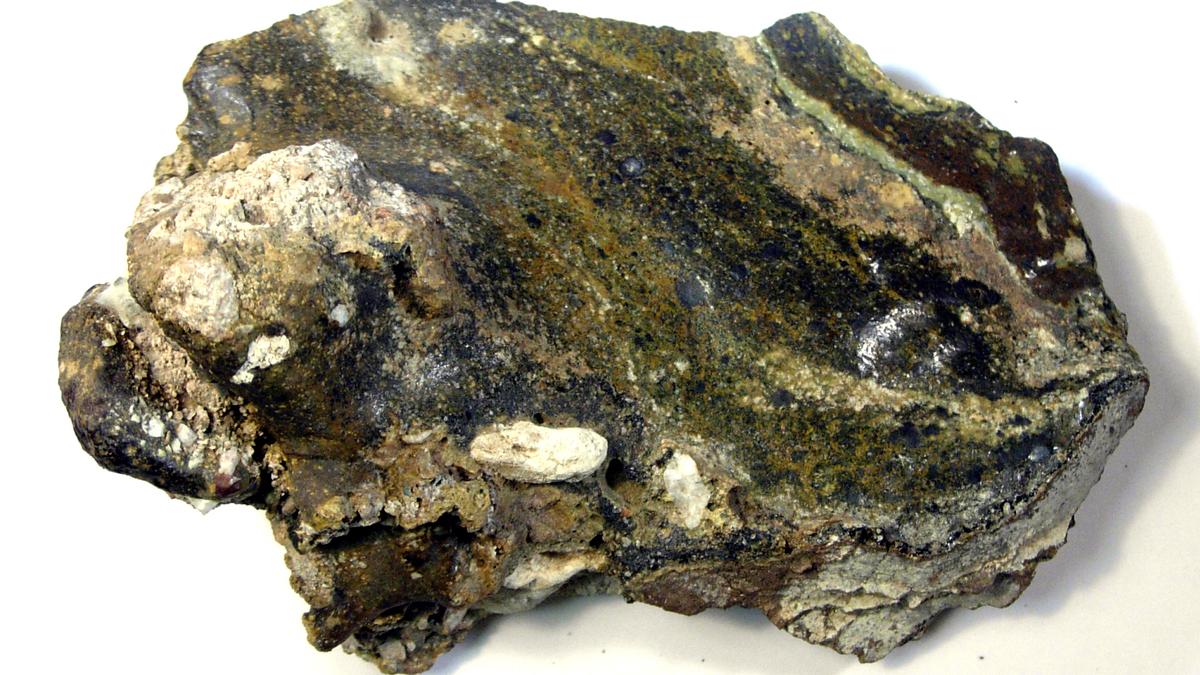
In 1993, drillers at the summit completed the Greenland Ice Sheet Project 2 ice core, or GISP2, nicknamed the two-mile time machine. The seeds, twigs and spores we found came from a few inches of soil at the bottom of that core — soil that had been tucked away dry, untouched for three decades in a windowless Colorado storage facility.
Our new analysis builds on the work of others who, over the past decade, have chipped away at the belief that Greenland’s ice sheet was present continuously since at least 2.6 million years ago when the Pleistocene ice ages began. In 2016, scientists measuring rare isotopes in rock from above and below the GISP2 soil sample used models to suggest that the ice had vanished at least once within the past 1.1 million years.
Now, by finding well-preserved tundra remains, we have confirmed that Greenland’s ice sheet had indeed melted before and exposed the land below the summit long enough for soil to form and for tundra to grow there. That tells us that the ice sheet is fragile and could melt again.
A landscape with Arctic poppies and spikemosses
To the naked eye, the tiny bits of past life are unremarkable – dark flecks, floating between shiny grains of silt and sand. But, under the microscope, the story they tell is astounding. Together, the seeds, megaspores and insect parts paint a picture of a cold, dry and rocky environment that existed sometime in the past million years.
Above ground, Arctic poppies grew among the rocks. Atop each stalk of this small but tenacious herb, a single cupped flower tracked the Sun across the sky to make the most of each day’s light.
Tiny insects buzzed above mats of diminutive rock spikemoss, creeping across the gravelly surface and bearing spores in summer.
In the rocky soil were dark spheres called sclerotia, produced by fungi that team up with plants’ roots in soil to help both get the nutrients they need. Nearby, willow shrubs adapted to life in the harsh tundra with their small size and fuzzy hair covering their stems.
Each of these living things left clues behind in that handful of soil – evidence that told us Greenland’s ice was once replaced by a hardy tundra ecosystem.
Greenland’s ice is fragile
Our discoveries, published on August 5, 2024, in the Proceedings of the National Academy of Sciences, demonstrate that Greenland’s ice is vulnerable to melting at atmospheric carbon dioxide concentrations lower than today. Concerns about this vulnerability have driven scientists to study the ice sheet since the 1950s.
In the 1960s, a team of engineers extracted the world’s first deep ice core at Camp Century, a nuclear-powered Army base built into the ice sheet over 100 miles from the northwest Greenland coast. They studied the ice, but they had little use for the chunks of rock and soil brought up with the bottom of the core. Those were stored and then lost until 2019, when they were rediscovered in a lab freezer. Our team was among the scientists called in to analyse them.
In the Camp Century soil, we also found plant and insect remains that had been frozen beneath the ice. Using rare isotopes and luminescence techniques, we were able to date them to a period about 400,000 years ago, when temperatures were similar to today.
Another ice core, DYE-3 from south Greenland, contained DNA showing that spruce forests covered that part of the island at some point in the past million years.

The biological evidence makes a convincing case for the fragility of Greenland’s ice sheet. Together, the findings from three ice cores can only mean one thing: With the possible exception of a few mountainous areas to the east, ice must have melted off the entire island in the past million years.
Losing the ice sheet
When Greenland’s ice is gone, world geography changes – and that’s a problem for humanity.
As the ice sheet melts, sea level will eventually rise more than 23 feet, and coastal cities will flood. Most of Miami will be underwater, and so will much of Boston, New York, Mumbai, and Jakarta.
Today, sea level is rising at more than an inch each decade, and in some places, several times faster. By 2100, when today’s kids are grandparents, sea level around the globe is likely to be several feet higher.
Using the past to understand the future
The rapid loss of ice is changing the Arctic. Data about past ecosystems, like we have collected from under Greenland’s ice, helps scientists understand how the ecology of the Arctic will change as the climate warms.
When temperatures rise, bright white snow melts and ice shrinks, exposing dark rock and soil that soaks up heat from the Sun. The Arctic is becoming greener with every passing year, thawing underlying permafrost and releasing more carbon that will further warm the planet.
Human-caused climate change is on pace to warm the Arctic and Greenland beyond temperatures they have experienced for millions of years. To save Greenland’s ice, studies show the world will need to stop greenhouse gas emissions from its energy systems and reduce carbon dioxide levels in the atmosphere.
Understanding the environmental conditions that triggered the ice sheet’s last disappearance, and how life on Greenland responded, will be crucial for gauging the future risks facing the ice sheet and coastal communities around the world.
Paul Bierman is a fellow of the Gund Institute for Environment, professor of natural resources and environmental science, University of Vermont. Halley Mastro is a graduate fellow of the Gund Institute for Environment and a graduate research assistant in natural resources and environmental science, University of Vermont. This article is republished from The Conversation.