





Neutrinos are a type of subatomic particle. They don’t have an electric charge, have a small mass, and are left-handed (a physics term meaning the direction of its spin is opposite to the direction of its motion). And they are flooding the universe. They are the second-most abundant particles after photons (particles of light) and the most abundant among particles that make up matter.
The study of neutrinos is an area of immense current interest among particle physicists and astrophysicists. These particles are produced when particles called leptons interact with matter. For example, when a type of lepton called a muon interacts with matter, the interaction produces a muon-neutrino. The same goes for electrons (electron-neutrino) and tauons (tau-neutrino). However, the neutrinos themselves interact with matter very, very rarely to produce a corresponding muon, electron or tauon.
This small interaction rate makes studying neutrinos difficult. For example, a muon-neutrino will scatter off an atom’s nucleus only once out of a million times or so, producing a muon and a proton. So to study them, physicists have built detectors with very fine tracking capabilities. They are also large to maximise the number of interactions between the neutrinos and the detectors’ matter.
New data from NOvA
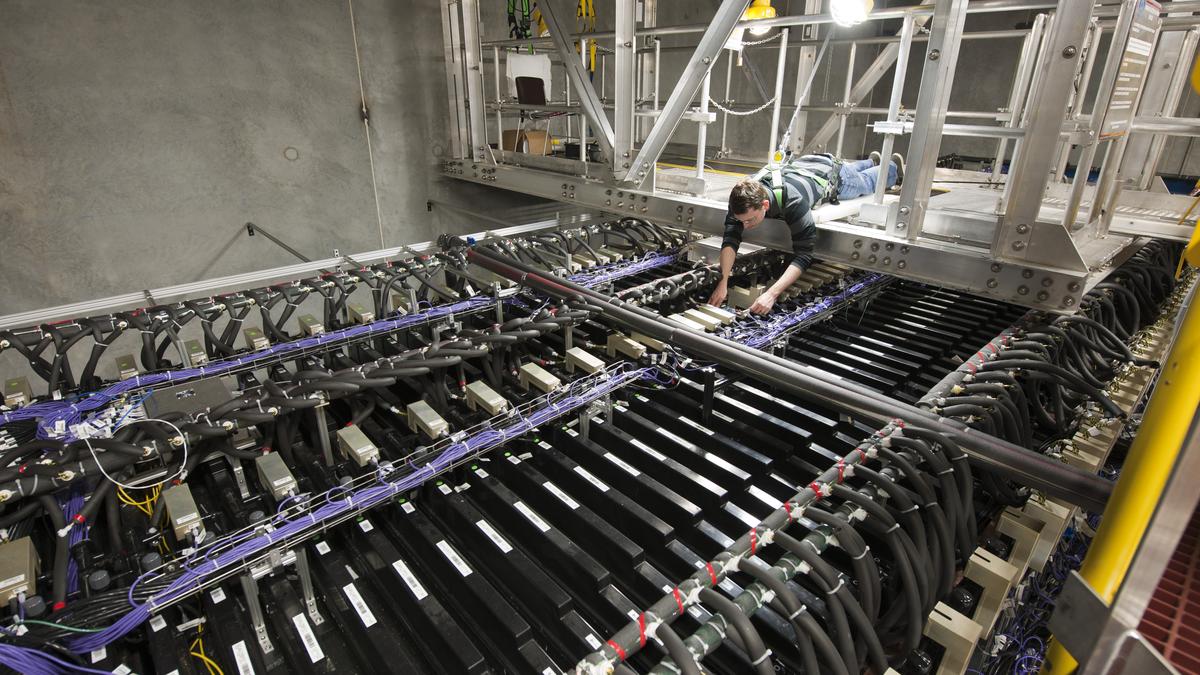
One such experiment is NovA, an acronym for ‘NuMI Off-axis e Appearance’, in Minnesota in the U.S. It creates a beam of neutrinos that fly towards a 14,000-tonne detector located 800 km away. NOvA is managed by the Fermi National Accelerator Laboratory.
Scientists presented the latest results from the NOvA collaboration at a conference in Italy on June 17. They said the collaboration had acquired twice as much data as it had during NOvA’s previous run, four years ago. The new results complemented the previous ones with greater precision.
NOvA was designed to determine the role of neutrinos in the evolution of the cosmos. It does this by trying to understand which neutrino type has the most mass and which type the least. This is an important detail because neutrinos may get their mass through a different mechanism from other matter particles. Unravelling it could answer many open questions in physics.
In pursuit of this goal, on July 11, a study at the Large Hadron Collider in Europe also reported observing electron-neutrinos at a particle collider for the first time.
The surprise of mass
Physicists first detected extraterrestrial neutrinos coming from a supernova in 1987, when a star exploded around 150,000 light years away. Three hours before light from the explosion reached the earth, three underground detectors in Japan, Russia, and the U.S. recorded a spike in the number of neutrinos coming from the explosion. This event was the birth of neutrino astronomy.
For almost 50 years, physicists thought neutrinos were massless particles, like photons. According to the special theory of relativity, a massive particle can’t travel at the speed of light (in vacuum). So a light signal could overtake the neutrino and it would appear right-handed when viewed in the opposite direction, i.e. with its directions of motion and spin aligned with each other. However, physicists had never detected right-handed neutrinos, so they concluded neutrinos are massless.

But from the late 1990s, scientists in Japan and Canada found evidence to overturn this view and prove neutrinos actually have mass. They found that when neutrinos travel through space, they can change from one type to another, which massless particles can’t do.
The existing theory of how particles behave and their properties, called the Standard Model of particle physics, doesn’t predict massive neutrinos. Incorporating them in the Standard Model will require far-reaching changes that physicists are still working out.
Ordering the neutrinos
This is why physicists study how neutrinos (and their antimatter counterparts, antineutrinos) change their type as they travel large distances. This quantum mechanical phenomenon is called neutrino oscillation. For example, all neutrinos from the Sun are electron-neutrinos, yet we receive a big chunk of them on the earth as muon-neutrinos.
Theoretical models predict two possible solutions for the neutrino mass hierarchy problem, called normal and inverted. The normal order proposes that one of the three types is much heavier and that the other two have comparable lower masses. In the inverted order, one of the neutrino types is lighter and the other two have comparable heavier masses.
The new NOvA data favours the normal order, but not conclusively.
Cracking the hierarchy problem is closely related to the universe’s evolution. Their low interaction rate means neutrinos are excellent carriers of information from the universe’s past, from sources like exploding stars and black holes. We can’t otherwise access a lot of this information today. Supernovae are known to release 99% of their radiant energy in a short, 10-second burst of neutrinos.
Studying these neutrinos can reveal how light or radio waves from the explosion diffuse after travelling a certain distance.
The best information carriers
Indeed, because neutrinos pass through most matter untouched, they can carry information across large distances. Humans currently use electromagnetic waves to do this job because they are easier to transmit and to detect. But in some situations, they don’t work well.

For example, seawater is opaque to electromagnetic radiation of shorter wavelength, which impedes the transmission of waves of certain frequencies to submarines. Neutrinos on the other hand can easily pass through 1,000 light years (9,400 million million km) of lead, so an ocean will hardly be a barrier.
We only need to find a way to transmit and capture them, which is tied to understanding them fully. If this happens, it wouldn’t be far-fetched to say we can replace electromagnetic waves in communication channels with neutrino beams within a few decades.
Eyes on the neutrino universe
Given all these advantages, the world’s more scientifically endowed countries are racing to study neutrinos. A few of the experiments involved are the Super-K III in Japan; the Sudbury Neutrino Observatory (in its new SNO+ avatar) in Canada; the MiniBOONe, the MicroBOONe, and NOνA in the U.S.; the Double CHOOZ in France; the Jiangmen Underground Neutrino Observatory in China; the OPERA experiment in Switzerland; and the IceCube Neutrino Observatory in Antarctica.
India’s own India-based Neutrino Observatory, funded by the Department of Atomic Energy, was supposed to come up in Tamil Nadu but currently faces an uncertain future over procedural lapses and lack of political support.
Just as more matter increases the number of interactions with neutrinos, a large number of experiments increase the chances of cracking the mass hierarchy and other problems, and bring us closer to a complete picture of the universe.
Qudsia Gani is an assistant professor in the Department of Physics, Government Degree College Pattan, Baramulla.