
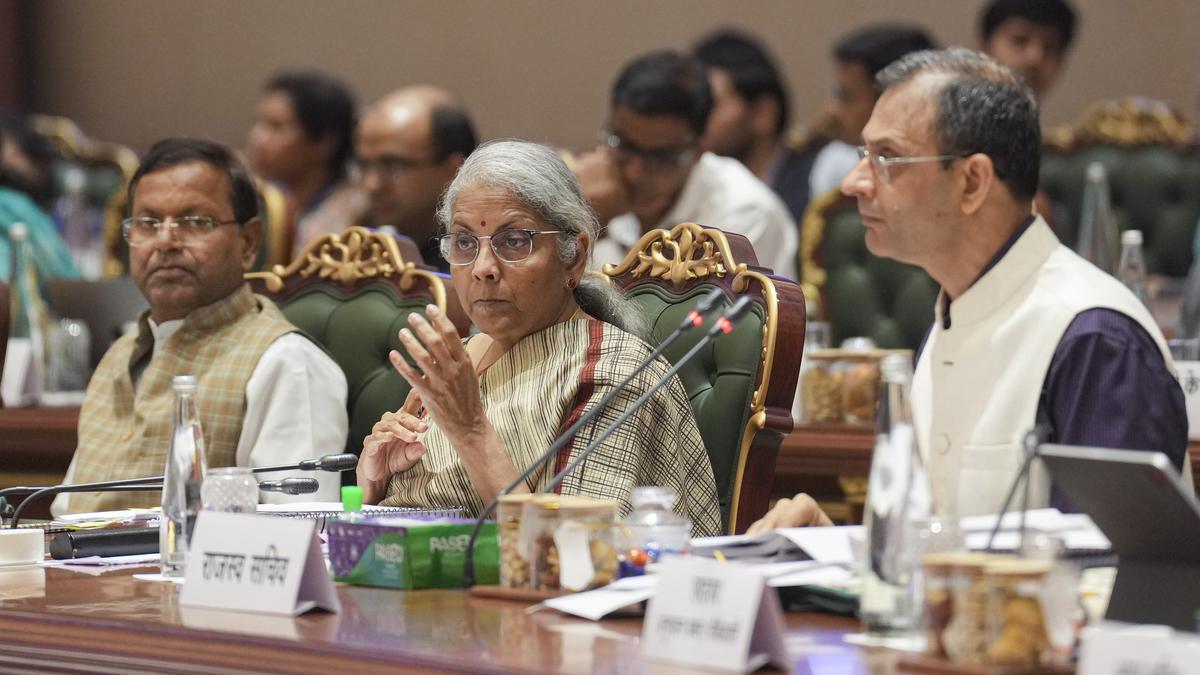
New Delhi: Union Finance Minister Nirmala Sitharaman chairs the 53rd GST Council meeting, in New Delhi, Saturday, June 22, 2024.
The story so far: On June 22, the GST council recommended introducing biometric-based Aadhaar authentication for GST registrations, in a phased manner. In a media interaction after the conclusion of the council meeting, Finance Minister Nirmala Sitharaman stated that the measures endeavour to combat fraudulent input tax credit (ITC) claims made through fake invoices. She highlighted that the measure was formalised based on “good inputs” received from pilot projects run in Gujarat and Puducherry, in addition to a study in Andhra Pradesh. This is soon expected to be implemented across India.

What fraud the measure is trying to mitigate?
Input tax credit (ITC) claims are a means to reduce tax liability by indemnifying the tax already paid on inputs for the tax liability computed on the output. Let us say, a manufacturer pays Rs 120 as tax for purchasing certain inputs or raw materials for their business. Now, their direct tax liability – which is based on the production incurred, is Rs 300. This is where the manufacturer can make an ITC claim. Since s/he has paid a certain portion in taxes for the input procurement, the difference of Rs 180 would be the net payable tax. Rs 120 is offset by claiming ITC.
Since the rollout of the GST regime, a large number of GST frauds involving the use of fake invoices to fraudulently avail an ITC claim, inflate turnovers and/or assist in money laundering have been observed. These frauds are facilitated with the use of fake invoices, that is, invoices generated without the actual supply of goods or services.
Central Board of Indirect Taxes and Customs (CBIC) in a 2019 office memorandum had noted three ways in which this was executed. The first is more direct, wherein the invoice is used, without receiving any goods or service, to show payment of tax. This is then used to avail an ITC claim translating to a loss for the exchequer.
The second entails issuing an invoice to one entity and the goods being diverted to some other entity. The purchaser in this case may actually not be involved in creating an output product or service – a prerequisite of an ITC claim. However, they too may avail a claim on their tax liability which could be unrelated to the transaction incurred. All in all, it may potentially entail shifting ITC from exempted supplies to taxable supplies.
Finally, the last of these observed methods entails routing of invoices through a series of shell and/or dummy companies and transfer of ITC from one company to another in a circular fashion to increase the turnover. Again, there is no supply of goods or services but the credit is availed based on fake invoices. In such instances, utilising inadmissible credit alongside the utilisation of credit emanating from actual regular supplies results in a loss to the exchequer.
In May last year, CBIC had launched a drive against bogus registrations and issuance of fake invoices. Over a seven-month period since its initiation, the drive had detected a total of 29,273 bogus firms involved in suspected ITC evasion totalling to Rs 44,015 crore, a report in January 2024 noted. The CBIC further informed that the discovery translated to savings of Rs 4,646 crore, of which Rs 3,802 crore was because of the blocking of ITC claims. Rs 844 crores were saved by way of recovery. Lastly, 121 arrests were made in this regard.
What is the motive of such frauds?
Other than GST evasion, CBIC has observed that the frauds facilitate money laundering and showing fake purchases for getting income tax benefits. About the latter, showing reduced profit margins and higher expenses helps in reducing net profits while accounting. This helps entities acquire income tax benefits. On the other hand, those seeking to present an inflated turnover could benefit from a higher credit limit or overdraft from banks, obtain bank loans and improve their valuations for a stake sale or an IPO, among other things. The fake invoice paradigm could also be utilised to divert for company funds in a manner that helps the entity save up on taxes from the conventional route.
Would these measures help?
Shashi Mathews, Partner at INDUSLAW with a practice focussed on tax-related issues, states that the intent and objective of the measure might be “progressive in nature” and would help achieve its stated endeavour. However, he adds, “A lot does depend on each state government’s readiness including but not limited to ensuring adequate resources and training for GST officials to seamlessly carry out such functionalities to keep a check on GST frauds on a larger scale.” Further, Mr. Mathews states that, when the functionality is released on a large-scale, it must be user-friendly for it to be successful.
Mahesh Jaising, Partner at Deloitte India observed that the focus on high-risk applicants, particularly those with a history of cancelled or suspended registrations underscores the commitment to institute a “credible and transparent GST system.” The measures, supported by the Directorate General of Analytics and Risk Management (DGARM) and GSTN, would enhance the security and integrity of the registration process, Mr Jaising states. Additionally, he observed, “Industry hopes for a single biometric authentication across India, allowing one-time verification in any State for companies with a presence in multiple States.” In this context, he believes that this move would help streamline the process further and reduce redundancy.
While stating that the measures would avert fake invoicing to a large extent, Mr Mathews noted, “One cannot rule out discrepancies in the Aadhaar information itself. But that does not take away the fact that a majority of registrations in the future would have credibility due to this exercise.”