




Skip to content
  • Facebook
  • X
  • Linkedin
  • WhatsApp
  • YouTube
  • Associate Journalism
  • About Us
  • Privacy Policy
  • 033-46046046
  • editor@artifex.news
Artifex.News

Artifex.News

Stay Connected. Stay Informed.

  • Breaking News
  • World
  • Nation
  • Sports
  • Business
  • Science
  • Entertainment
  • Lifestyle
  • Toggle search form
  • PAK vs BAN first Test: Shadman Islam anchors Bangladesh’s good show on day 3
    PAK vs BAN first Test: Shadman Islam anchors Bangladesh’s good show on day 3 Sports
  • Access Denied World
  • “Not Worrying About Future”: Australia Great on Team’s Selection Plan In Tests vs India
    “Not Worrying About Future”: Australia Great on Team’s Selection Plan In Tests vs India Sports
  • PM Modi Congratulates Mithun Chakraborty On Dadasaheb Phalke Honour
    PM Modi Congratulates Mithun Chakraborty On Dadasaheb Phalke Honour Nation
  • Maruti Suzuki board approves land acquisition for ₹35,000 crore second plant in Gujarat
    Maruti Suzuki board approves land acquisition for ₹35,000 crore second plant in Gujarat Business
  • Andy Burnham poised to become Britain’s next PM after most Labour lawmakers support him
    Andy Burnham poised to become Britain’s next PM after most Labour lawmakers support him World
  • Access Denied Sports
  • On England’s Cricket World Cup 2023 Disaster, Gautam Gambhir Points Out ‘Most Damaging Thing’
    On England’s Cricket World Cup 2023 Disaster, Gautam Gambhir Points Out ‘Most Damaging Thing’ Sports
World’s oldest termite mounds found in South Africa, storing carbon for millennia

World’s oldest termite mounds found in South Africa, storing carbon for millennia

Posted on June 21, 2024 By admin


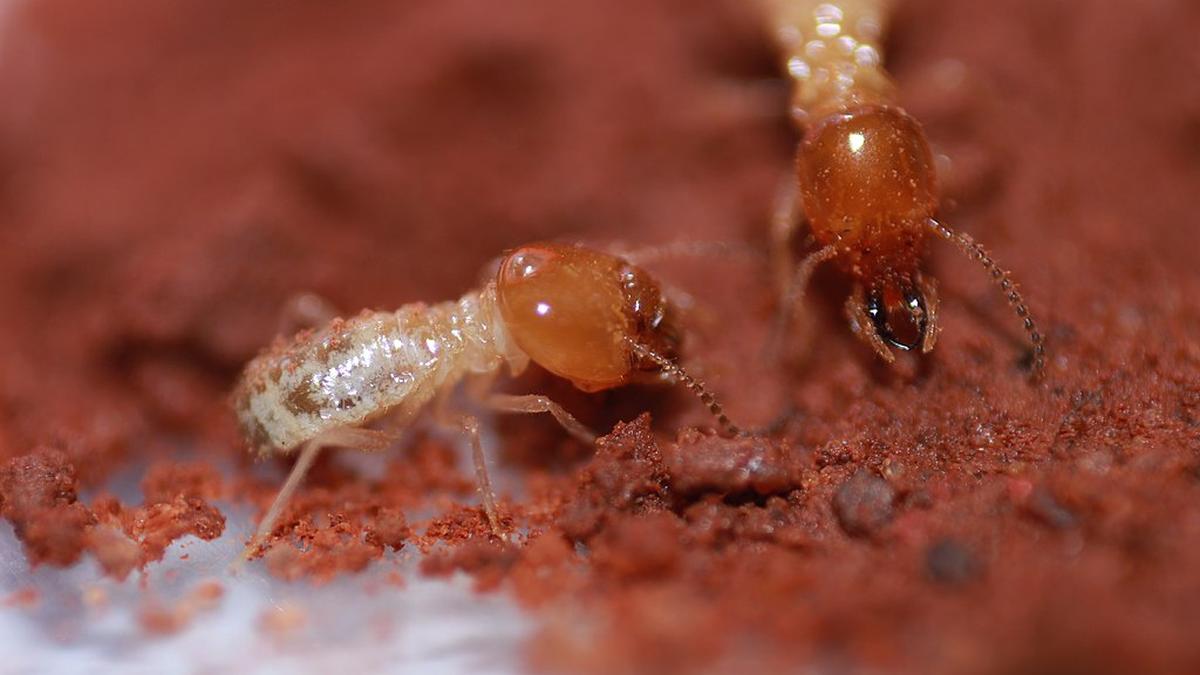
Image for Representation.
| Photo Credit: The Hindu

The landscape along the Buffels River in South Africa’s Namaqualand region is dotted with thousands of sandy mounds that occupy about 20% of the surface area. These heuweltjies, as the locals call them (the word means “little hills” in Afrikaans), are termite mounds, inhabited by an underground network of tunnels and nests of the southern harvester termite, Microhodotermes viator.

I’m part of a group of earth scientists who, in 2021, set out to study why the groundwater in the area, around 530km from Cape Town, is saline. The groundwater salinity seemed to be specifically related to the location of these heuweltjies. We used radiocarbon dating; dating the mounds, we reasoned, would allow us to see when minerals that were stored in the mounds were flushed to the groundwater.

The tests revealed far more than we expected: Namaqualand’s heuweltjies, it turns out, are the world’s oldest inhabited termite mounds. Some date as far back as between 34,000 and 13,000 years. The oldest previously known inhabited mounds were 4,000 years old (from a different termite species from Brazil) and 2,300 years old (from central Congo).

This is more than just an interesting scientific find or historical curiosity. It offers a window into what our planet looked like tens of thousands of years ago, providing a living archive of environmental conditions that shaped our world.

It is also hugely important today: there is growing evidence that termites have a substantial, but still poorly understood, role in the carbon cycle. By studying these and other termite mounds, scientists can gain a better understanding of how to sequester (store) carbon. This process removes CO₂ from the atmosphere and is vital for mitigating climate change.

Carbon storage

Namaqualand is a global biodiversity hotspot renowned for its spring flowers, but it is a dry area. Surface water is in short supply and the groundwater is saline.

Although most of Namaqualand receives very little rainfall, there are rare, high intensity rainfall events. When these do occur, the termite burrows on the mound surfaces serve as water flow paths that can harvest rain and channel water into the mound. This causes the salts that built up in the mounds over thousands of years to be flushed into the groundwater system via flow paths created by the tunnelling action of the termites, pushing the dissolved minerals ever deeper. This process also pushes down the carbon that slowly built up in the centre of the mounds when termites collected plant material and brought it into the mound over millennia.

The ability of these mounds to sequester carbon is linked to the termites’ unique behaviour. The insects transport organic material – such as small sticks about 2cm long and a few millimetres wide from small woody plants – deep into the soil. This way, fresh stores of carbon are continuously added at depths greater than one metre. Deep storage reduces the likelihood of organic carbon being released back into the atmosphere. So the mound acts as a long-term carbon sink.

Not only do the termites take the organic carbon material deep underground into their nests, but their tunnels also allow dissolved inorganic carbon (known as soil calcite or calcium carbonate) in the mound soil to move into the groundwater along with other soluble minerals. So the termite mounds also offer a mechanism to sequester carbon dioxide through dissolution and leaching of soil carbonate-bicarbonate to groundwater. This is a long term carbon storage method that carbon storage companies are trying to replicate to reduce atmospheric carbon.

The results of our radiocarbon dating of both the organic and inorganic carbon in this soil show that the mounds have been accumulating organic matter and nutrients, including carbon, for tens of thousands of years. This enrichment is one of the reasons that Namaqualand’s famous wildflowers are so prominent on the mounds in spring.

During the mounds’ formation, the region experienced more rainfall than it does today. Studying the layers of the mounds and looking at the carbon, sulphur, and oxygen isotopes preserved in the mounds and in the groundwater showed that periods of higher rainfall in the region were associated with global climate cooling. These cooler and wetter periods were associated with the leaching of accumulated carbon and other minerals to the groundwater.

Tiny engineers

These findings are further evidence that termites fully deserve their reputation as ecosystem engineers. They modify their soil surroundings to maintain ideal humidity and temperature conditions, and their foraging paths extend many tens of metres.

We argue that, given what we’ve uncovered in Namaqualand, termite activity should be incorporated into carbon models. These primarily focus on forests and oceans; including termite mounds can help provide a more comprehensive understanding of global carbon dynamics. In Namaqualand, mounds occupy 27% of the total area but contribute 44 % of the total soil organic carbon stock. This highlights the disproportionate contribution termite mounds make to carbon stocks in these semi-arid environments.

Public awareness and policy integration are key, too. Termite mounds are often cleared for agriculture or termites are considered pests. Raising awareness about the ecological importance of termite mounds and integrating these findings into environmental policies can help promote practices that support natural carbon sinks.

This research was conducted by a dedicated team from Stellenbosch University in South Africa (Department of Soil Science and Department of Earth Sciences), in collaboration with experts from the Institute for Nuclear Research in Hungary. C.E. Clarke, M.L. Francis , M. Hattingh, J.A. Miller, T. Nel, B. J Sakala, J. van Gend, N Vermonti, M. Vermooten (Kleyn), A. Watson (South Africa), L. Palcsu , A. Horvaěth M. Molnár T. Kertész (Hungary).

This article is republished from The Conversation under a Creative Commons license. Read the original article.


Source link

Science Tags:carbon sequestration, Climate change, science news, Termites

Post navigation

Previous Post: Babar Azam And Co. Face Match-Fixing Allegation, PCB Breaks Silence
Next Post: Slovakia vs Ukraine Live Streaming Euro 2024 Live Telecast: When And Where To Watch

Related Posts

  • Budget 2024: Under-spending brightens allocations for science ministries, depts.
    Budget 2024: Under-spending brightens allocations for science ministries, depts. Science
  • Microplastics finally found in human brains, but that’s not the full picture
    Microplastics finally found in human brains, but that’s not the full picture Science
  • Tech billionaire pulls off first private spacewalk high above Earth
    Tech billionaire pulls off first private spacewalk high above Earth Science
  • Auction of world’s largest Mars meteorite sparks ownership debate
    Auction of world’s largest Mars meteorite sparks ownership debate Science
  • Google’s new AI model offers new pathway in cancer drug research
    Google’s new AI model offers new pathway in cancer drug research Science
  • NISAR mission will showcase Indian space engineering on global scale: ex-ISRO scientist
    NISAR mission will showcase Indian space engineering on global scale: ex-ISRO scientist Science

More Related Articles

‘10,000 genome’ project completed, says government ‘10,000 genome’ project completed, says government Science
Cows can use tools, and one Austrian cow has now shown it clearly Cows can use tools, and one Austrian cow has now shown it clearly Science
75 years since Assam quake, Himalayas prep for large hydro projects 75 years since Assam quake, Himalayas prep for large hydro projects Science
Nicobarese oppose proposal for three wildlife sanctuaries Nicobarese oppose proposal for three wildlife sanctuaries Science
Race to global eradication of Guinea worm disease nears finish line Race to global eradication of Guinea worm disease nears finish line Science
What is the NASA Artemis II mission? What is the NASA Artemis II mission? Science
SiteLock

Archives

  • October 2026
  • September 2026
  • August 2026
  • July 2026
  • June 2026
  • May 2026
  • April 2026
  • March 2026
  • February 2026
  • January 2026
  • December 2025
  • November 2025
  • October 2025
  • September 2025
  • August 2025
  • July 2025
  • June 2025
  • May 2025
  • April 2025
  • March 2025
  • February 2025
  • January 2025
  • December 2024
  • November 2024
  • October 2024
  • September 2024
  • August 2024
  • July 2024
  • June 2024
  • May 2024
  • April 2024
  • March 2024
  • February 2024
  • January 2024
  • December 2023
  • November 2023
  • October 2023
  • September 2023
  • August 2023
  • July 2023
  • June 2023
  • May 2023
  • April 2023
  • March 2023
  • February 2023
  • January 2023
  • December 2022
  • November 2022
  • October 2022
  • September 2022
  • August 2022
  • July 2022
  • June 2022
  • May 2022

Categories

  • Business
  • Nation
  • Science
  • Sports
  • World

Recent Posts

  • France protests: Macron vows to hold accountable those who ‘sought to bring down the Republic’
  • Temple development works worth ₹2,500 crore under way across Telangana: Bhatti Vikramarka
  • History sheeter among four arrested in Thanjavur on robbery charge
  • J&K Police book Army officer’s wife for sharing sensitive information with foreign intelligence operatives
  • RINL promotes over 1,200 executives after seven years

Recent Comments

  1. plinko idle on UP Teacher Who Asked Students To Slap Muslim Classmate
  2. Harrishor on UP Teacher Who Asked Students To Slap Muslim Classmate
  3. ArthurLal on UP Teacher Who Asked Students To Slap Muslim Classmate
  4. JamesHaddy on UP Teacher Who Asked Students To Slap Muslim Classmate
  5. Davidaccum on UP Teacher Who Asked Students To Slap Muslim Classmate
  • 42,000 Israeli Women Apply For Gun Permit
    42,000 Israeli Women Apply For Gun Permit World
  • Centre relaxes norms for start-ups to avail funds from DSIR
    Centre relaxes norms for start-ups to avail funds from DSIR Nation
  • France Set To Make Abortion Constitutional Right
    France Set To Make Abortion Constitutional Right World
  • Access Denied
    Access Denied Nation
  • Access Denied World
  • India vs New Zealand Tests | We want to be a team that can make 400 in a day and bat two days to get a draw: Gambhir
    India vs New Zealand Tests | We want to be a team that can make 400 in a day and bat two days to get a draw: Gambhir Sports
  • Profit Rises 8%; Dividend Of Rs 2.75 Declared Business
  • Shaheen Afridi Refused To Be Pakistan’s Vice-Captain For T20 World Cup 2024 – Report Makes Big Claim
    Shaheen Afridi Refused To Be Pakistan’s Vice-Captain For T20 World Cup 2024 – Report Makes Big Claim Sports

Editor-in-Chief:
Mohammad Ariff,
MSW, MAJMC, BSW, DTL, CTS, CNM, CCR, CAL, RSL, ASOC.
editor@artifex.news

Associate Editors:
1. Zenellis R. Tuba,
zenelis@artifex.news
2. Haris Daniyel
daniyel@artifex.news

Photograher:
Rohan Das
rohan@artifex.news

Associate Journalists
1. Subrata Paul - AN/2020/01
2. Quamruz Zaman - AN/2021/22
3. Ahmed Sha - AN/2021/035
4. Ajay Kumar Shaw - AN/2021/39
5. Tahqiqul Hoda - AN/2021/21

Artifex.News offers Online Paid Internships to college students from India and Abroad. Interns will get a PRESS CARD and other online offers.
Send your CV (Subjectline: Paid Internship) to internship@artifex.news

Links:
Associate Journalism
About Us
Privacy Policy

News Links:
Breaking News
World
Nation
Sports
Business
Entertainment
Lifestyle

Registered Office:
72/A, Elliot Road, Kolkata - 700016
Tel: 033-22277777, 033-22172217
Email: office@artifex.news

Editorial Office / News Desk:
No. 13, Mezzanine Floor, Esplanade Metro Rail Station,
12 J. L. Nehru Road, Kolkata - 700069.
(Entry from Gate No. 5)
Tel: 033-46011099, 033-46046046
Email: editor@artifex.news

Copyright © 2023 Artifex.News Newsportal designed by Artifex Infotech.