

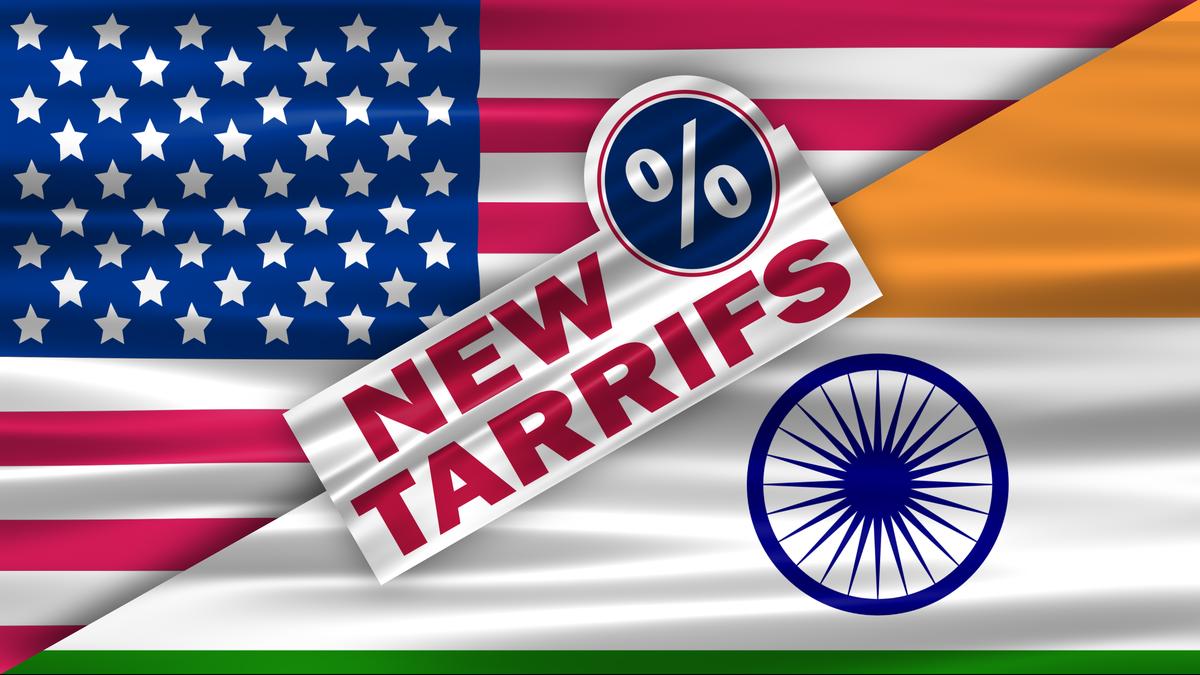
The new 25% tariffs proposed by the U.S. on India do not pose a substantial risk to Indian exports, and India should go ahead with a trade deal only if it is balanced and reciprocal, according to exporters and trade and tariff experts.
An analysis of India’s trade relationship with the U.S. over the last two years showed that the latest tariffs announced by the U.S. have returned the tariff relationship to where it was at the start of trade deal negotiations.
The Office of the U.S. Trade Representative on Wednesday proposed a net tariff of 25% on goods imported from India, which could be reduced to 17% if a trade deal is signed by the two countries.
The tariffs are not final yet, with the U.S. government opening a window for written comments and requests to testify by January 5, 2027. Public hearings will begin on January 25, 2027, following which the final action will be communicated.
Back to square one
The proposed 25% tariff is nearly the same as the 26% tariff U.S. President Donald Trump had originally proposed in his ‘Liberation Day’ reciprocal tariff measure in April 2025. A week later, Mr. Trump paused these tariffs in a bid to secure trade deals with other countries.

In July 2025, he announced a 25% tariff on India, the same as what the USTR is now proposing. But Mr. Trump soon announced an additional 25% tariff as a penalty for India’s Russian oil imports taking the total tariff on Indian goods to 50%.
During that time, Mr. Trump also announced a 50% tariff on the import of steel and aluminium from all countries. The latest tariffs by the USTR are not in addition to those tariffs, meaning Indian steel and aluminium will continue to attract a 50% duty.
In February 2026, India and the U.S. issued a joint statement announcing the framework for an interim deal on trade, under which the U.S. would reduce its tariffs on Indian goods to 18%. This is very close to the 17% the U.S. is proposing now, should a deal be signed, nearly 10 months after the joint statement was issued.

As such, the pre-deal, post-deal, and steel and aluminium tariffs by the U.S. on India largely remain where they were at the start of negotiations.
Experts recommend waiting
Exporters and trade experts have said that India should proceed with a trade deal only if it satisfies Indian interests.
“FIEO supports the government’s efforts to conclude the Bilateral Trade Agreement at an early date,” said S.C. Ralhan, president of the Federation of Indian Export Organisations. “The agreement should be balanced and reciprocal, safeguard India’s long-term economic and developmental interests, and ensure that Indian exporters can compete on a level-playing field with suppliers from other countries in the U.S. market.”
The president of the PHD Chamber of Commerce and Industry, Anil Gupta, pointed out that the tariffs will have a limited impact on Indian exports due to the nature of the commodities that India predominantly exports to the U.S.
“India’s top exports to the U.S. include electronic goods, drugs and pharmaceuticals, gems and jewellery, and textiles and apparel,” Mr. Gupta said. “As these products account for more than 50% of Indian exports to the U.S. and are price-sticky, there will be limited impact in the short to medium term.”
Threats and opportunities
Manoj Mishra, partner and tax controversy management leader at Grant Thornton Bharat, acknowledged that the proposed tariffs could weaken India’s export competitiveness, put pressure on profit margins, and dampen manufacturing investments. However, he was also of the view that India should not rush into a deal.
“While the possibility of a lower tariff rate of 17% underscores the need to expedite bilateral trade negotiations, India could also leverage its expanding Free Trade Agreement (FTA) network, and diversify export markets and global supply chains to reduce dependence on the U.S. and mitigate the impact of evolving tariff measures.”
Meanwhile, Ajay Srivastava, founder of Global Trade Research Initiative (GTRI), a think tank, pointed out that the 100% tariffs applicable under the Lindsey O. Graham Sanctioning Russia and Iran Act of 2026 persist, even though they have been temporarily paused.
“Because these manipulated rates are a deliberate bait to extract one-sided concessions — and with the threat of Graham tariffs of up to 100% still hanging over it — India must reject the trade deal and instead answer the allegations [on excess capacity made by the USTR] sector by sector, showing that its investment serves domestic buyers, overseas customers, and future demand rather than letting exports alone be treated as proof of excess capacity,” Mr. Srivastava argued.
Published – November 26, 2026 04:06 pm IST