

Skip to content
  • Facebook
  • X
  • Linkedin
  • WhatsApp
  • YouTube
  • Associate Journalism
  • About Us
  • Privacy Policy
  • 033-46046046
  • editor@artifex.news
Artifex.News

Artifex.News

Stay Connected. Stay Informed.

  • Breaking News
  • World
  • Nation
  • Sports
  • Business
  • Science
  • Entertainment
  • Lifestyle
  • Toggle search form
  • Access Denied World
  • House returns for vote to end government shutdown after nearly 2 months away
    House returns for vote to end government shutdown after nearly 2 months away World
  • As PM Narendra Modi And Joe Biden Hold Bilateral Talks, A Mega Drone Deal Firms Up
    As PM Narendra Modi And Joe Biden Hold Bilateral Talks, A Mega Drone Deal Firms Up World
  • Access Denied
    Access Denied Nation
  • “Brij Bhushan Singh’s Dominance And Bullying…”: Sakshi Malik’s Heartfelt Plea To PM Narendra Modi
    “Brij Bhushan Singh’s Dominance And Bullying…”: Sakshi Malik’s Heartfelt Plea To PM Narendra Modi Sports
  • WazirX freezes first tranche of stolen funds worth  million
    WazirX freezes first tranche of stolen funds worth $3 million Business
  • Access Denied
    Access Denied Nation
  • Adani Defence & Aerospace Acquires Air Works For Rs 400 Crore
    Adani Defence & Aerospace Acquires Air Works For Rs 400 Crore Nation
Berlin to BITS Pilani: How Nobel-winning optogenetics connects to parasite research in Hyderabad

Berlin to BITS Pilani: How Nobel-winning optogenetics connects to parasite research in Hyderabad

Posted on October 13, 2026 By admin


The 2026 Nobel Prize in Physiology or Medicine, awarded to Karl Deisseroth, Peter Hegemann, and Georg Nagel “for their discoveries concerning light-gated ion channels and optogenetics”, has brought renewed attention to using light to investigate fundamental biological processes. These include memory formation, feelings, and behaviours relevant for neurological and psychiatric disorders, as well as processes involved in infectious disease.

Editorial | Let there be light: On the 2026 Nobel Prize in Physiology/Medicine

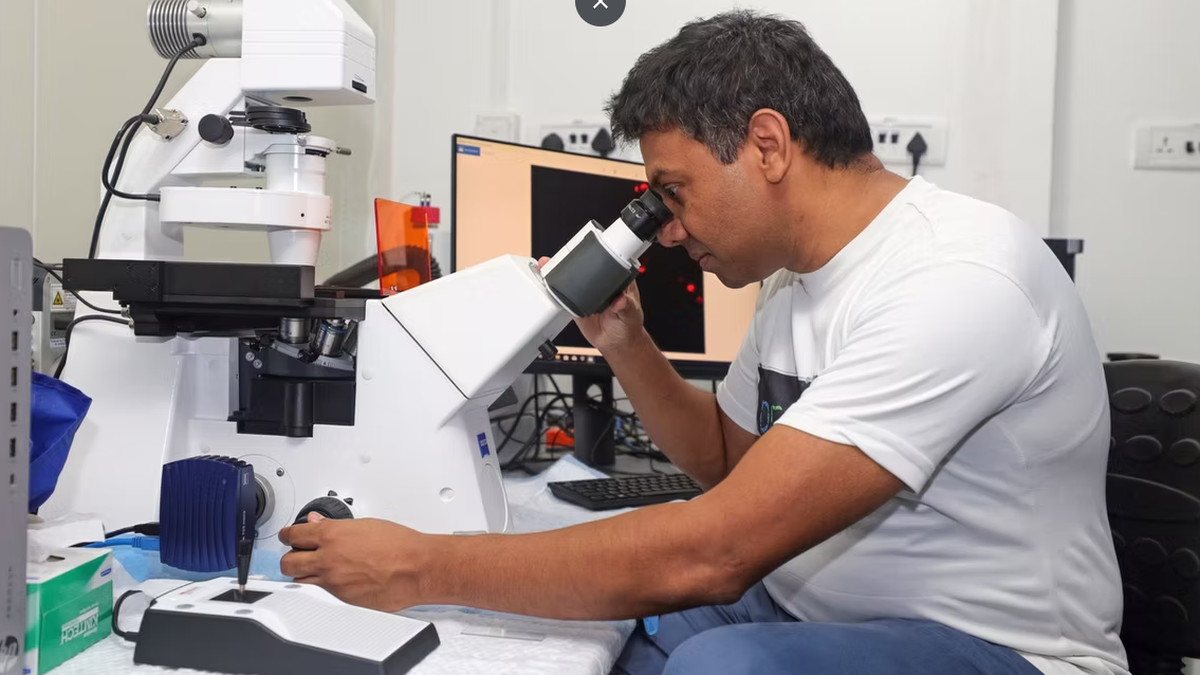
For Nishith Gupta, professor of Biological Sciences at BITS Pilani, Hyderabad, and founder of the Intracellular Parasite Education and Research Labs (iPEARL), the recognition has a personal significance in his own scientific journey.

Mr. Gupta’s decades-long collaboration with Hegemann at Humboldt University of Berlin, where Hegemanna is Hertie Senior Professor of Neuroscience, helped extend optogenetic approaches beyond neuroscience into his study of Toxoplasma gondii, an intracellular parasite that infects humans, mammals, and birds.

Interactive Guide | Nobel Prize 2026

Professor of Biological Sciences at BITS Pilani-Hyderabad Campus, Nishith Gupta with Peter Hegemann, 2026 Nobel Prize in Physiology or Medicine laureate.

Optogenetics enables scientists to control selected cells or biological processes using light-sensitive proteins.

The Nobel Committee for Physiology or Medicine stated: “It all began with Peter Hegemann’s curiosity. He wondered how Chlamydomonas, a single-celled alga, is able to swim towards a light source. In the early 2000s, he and Georg Nagel discovered channelrhodopsin, an algal protein with unique properties, found on the surface of the cell. When it is illuminated by blue light, a channel opens through the protein. Charged ions then flow into the cell, creating an electrical impulse. They found that regardless of which cell they put the protein in, those cells became light sensitive.” In 2005, Deisseroth showed that introducing channelrhodopsin into rat neurons allowed blue light to trigger nerve signals. In 2007, he showed light-based control in mice.

A researcher at iPEARL, BITS Pilani-Hyderabad Campus with Peter Hegemann, 2026 Nobel Prize in Physiology or Medicine laureate.

A researcher at iPEARL, BITS Pilani-Hyderabad Campus with Peter Hegemann, 2026 Nobel Prize in Physiology or Medicine laureate.

In contrast, Mr. Gupta, Mr. Hegemann and others used light-regulated enzyme adenylate cyclase, which converts adenosine triphosphate (ATP), the primary energy of a living cell, to produce cyclic Adenosine Monophosphate (cAMP). This molecule acts as messengers, helping transmit signals within cells.

Put simply, the researchers showed that light controls the enzyme, the enzyme produces cAMP, and cAMP helps regulate what happens inside the parasite (Toxoplasma gondii): how it enters cells, moves, and exits cells. This landmark study was published in the Journal of Biological Chemistry in 2013.

While Mr. Deisseroth, Mr. Hegemann, and Mr. Nagel’s optogenetics “solves one of humanity’s great mysteries, how our incredible brain works”, Mr. Gupta, Mr. Hegemann and others’ found light-regulated signalling to investigate parasite’s lifestyle, and infection.

A researcher at iPEARL, BITS Pilani-Hyderabad Campus with Peter Hegemann, 2026 Nobel Prize in Physiology or Medicine laureate.

A researcher at iPEARL, BITS Pilani-Hyderabad Campus with Peter Hegemann, 2026 Nobel Prize in Physiology or Medicine laureate.

Mr. Gupta says that working alongside Hegemann in Berlin, with their laboratories in neighbouring departments, was an important part of this scientific journey. Joint funding from the German Research Foundation (DFG) supported their collaboration.

After Mr. Gupta relocated to India, Mr. Hegemann continued to support his research through Mr. Gupta’s Wellcome Trust–DBT Senior Fellowship project at BITS Pilani. Researchers from his team continued to visit Hegemann’s group in Berlin.

Peter Hegemann, 2026 Nobel Prize in Physiology or Medicine laureate.

Peter Hegemann, 2026 Nobel Prize in Physiology or Medicine laureate.

For Mr. Gupta, the Nobel Prize awarded to Mr. Hegemann and his fellow laureates underscores the far-reaching consequences of fundamental research. A protein that evolved to help an alga sense light has become a tool for probing the brain, investigating infection and understanding how cells function. He says the broader lesson is that technologies developed to answer one biological question can open entirely new avenues of research.

“Light has become more than a means of observation; it is a way to intervene, test, and uncover cause-and-effect relationships,” Mr. Gupta says.

Published – October 11, 2026 11:14 am IST



Source link

Science Tags:bits pilani, Nishith Gupta, optogenetics

Post navigation

Previous Post: Berlin to BITS Pilani: How Nobel-winning optogenetics connects to parasite research in Hyderabad
Next Post: Anti-CEC protests LIVE: Supreme Court registry points out 10 defects in Rahul Gandhi’s plea in SIR case

Related Posts

  • Odisha tribal healer’s remedies for chronic diseases to undergo scientific validation under Ministry of Ayush initiative
    Odisha tribal healer’s remedies for chronic diseases to undergo scientific validation under Ministry of Ayush initiative Science
  • What is volcanic lightning? – The Hindu
    What is volcanic lightning? – The Hindu Science
  • More than 800 coal plants worldwide could be profitably decommissioned, research group says
    More than 800 coal plants worldwide could be profitably decommissioned, research group says Science
  • Using the body’s own defences to fight cancer: new research offers a clue from COVID-19
    Using the body’s own defences to fight cancer: new research offers a clue from COVID-19 Science
  • Why do so many contemporary vaccines have low durability? | Explained
    Why do so many contemporary vaccines have low durability? | Explained Science
  • NASA IMAP to show how solar particles are energised and shield us
    NASA IMAP to show how solar particles are energised and shield us Science

More Related Articles

Lego to replace oil in its bricks with pricier renewable plastic Lego to replace oil in its bricks with pricier renewable plastic Science
What is a GPU? How does it work? | Explained What is a GPU? How does it work? | Explained Science
Jane Goodall: the scientist who gave chimps names, not numbers Jane Goodall: the scientist who gave chimps names, not numbers Science
What is suborbital tourism? – The Hindu What is suborbital tourism? – The Hindu Science
First fossilised snake traces discovered in South Africa First fossilised snake traces discovered in South Africa Science
Availability of predictable food through garbage and intentional feeding linked to India’s street-dog population: Study Availability of predictable food through garbage and intentional feeding linked to India’s street-dog population: Study Science
SiteLock

Archives

  • October 2026
  • September 2026
  • August 2026
  • July 2026
  • June 2026
  • May 2026
  • April 2026
  • March 2026
  • February 2026
  • January 2026
  • December 2025
  • November 2025
  • October 2025
  • September 2025
  • August 2025
  • July 2025
  • June 2025
  • May 2025
  • April 2025
  • March 2025
  • February 2025
  • January 2025
  • December 2024
  • November 2024
  • October 2024
  • September 2024
  • August 2024
  • July 2024
  • June 2024
  • May 2024
  • April 2024
  • March 2024
  • February 2024
  • January 2024
  • December 2023
  • November 2023
  • October 2023
  • September 2023
  • August 2023
  • July 2023
  • June 2023
  • May 2023
  • April 2023
  • March 2023
  • February 2023
  • January 2023
  • December 2022
  • November 2022
  • October 2022
  • September 2022
  • August 2022
  • July 2022
  • June 2022
  • May 2022

Categories

  • Business
  • Nation
  • Science
  • Sports
  • World

Recent Posts

  • AIADMK, BJP leaders slam TVK-led Tamil Nadu government over electricity purchase at high rate
  • Two arrested for attacking security guard with knife in Besant Nagar
  • Women stage silent demonstration at Kathipara against police action on anti-CEC protesters in Delhi
  • DGCA bans specific power banks on flights
  • Saudi Supreme Court sets aside Sri Lankan migrant worker’s death penalty

Recent Comments

  1. RobertTes on UP Teacher Who Asked Students To Slap Muslim Classmate
  2. Manuelret on UP Teacher Who Asked Students To Slap Muslim Classmate
  3. RobertTes on UP Teacher Who Asked Students To Slap Muslim Classmate
  4. RobertTes on UP Teacher Who Asked Students To Slap Muslim Classmate
  5. BrentWes on UP Teacher Who Asked Students To Slap Muslim Classmate
  • Access Denied
    Access Denied Nation
  • Cheetahs At Kuno Park To Be Released Into Wild This Month In Phases
    Cheetahs At Kuno Park To Be Released Into Wild This Month In Phases Nation
  • Access Denied Sports
  • Volodymyr Zelensky Says Ukraine Controls 74 Russian Settlements
    Volodymyr Zelensky Says Ukraine Controls 74 Russian Settlements World
  • Access Denied Sports
  • Access Denied
    Access Denied Nation
  • Access Denied
    Access Denied Nation
  • Iran Says It Didn’t Deliver Missiles To Russia After Western Sanctions
    Iran Says It Didn’t Deliver Missiles To Russia After Western Sanctions World

Editor-in-Chief:
Mohammad Ariff,
MSW, MAJMC, BSW, DTL, CTS, CNM, CCR, CAL, RSL, ASOC.
editor@artifex.news

Associate Editors:
1. Zenellis R. Tuba,
zenelis@artifex.news
2. Haris Daniyel
daniyel@artifex.news

Photograher:
Rohan Das
rohan@artifex.news

Associate Journalists
1. Subrata Paul - AN/2020/01
2. Quamruz Zaman - AN/2021/22
3. Ahmed Sha - AN/2021/035
4. Ajay Kumar Shaw - AN/2021/39
5. Tahqiqul Hoda - AN/2021/21

Artifex.News offers Online Paid Internships to college students from India and Abroad. Interns will get a PRESS CARD and other online offers.
Send your CV (Subjectline: Paid Internship) to internship@artifex.news

Links:
Associate Journalism
About Us
Privacy Policy

News Links:
Breaking News
World
Nation
Sports
Business
Entertainment
Lifestyle

Registered Office:
72/A, Elliot Road, Kolkata - 700016
Tel: 033-22277777, 033-22172217
Email: office@artifex.news

Editorial Office / News Desk:
No. 13, Mezzanine Floor, Esplanade Metro Rail Station,
12 J. L. Nehru Road, Kolkata - 700069.
(Entry from Gate No. 5)
Tel: 033-46011099, 033-46046046
Email: editor@artifex.news

Copyright © 2023 Artifex.News Newsportal designed by Artifex Infotech.