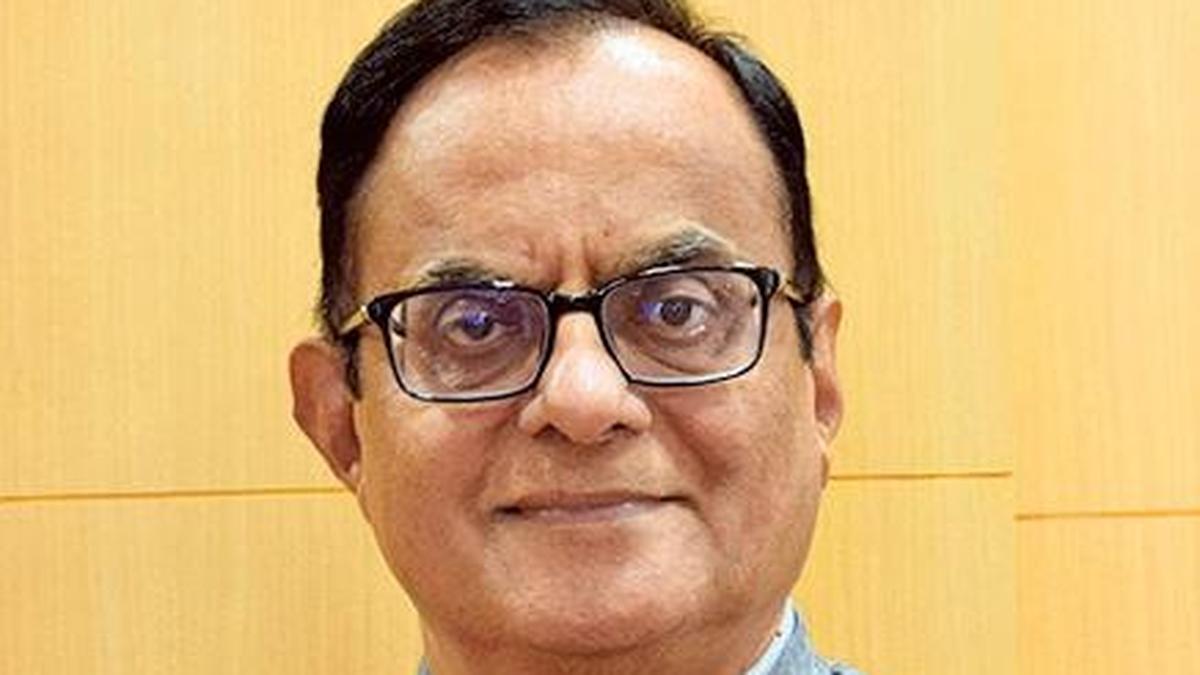




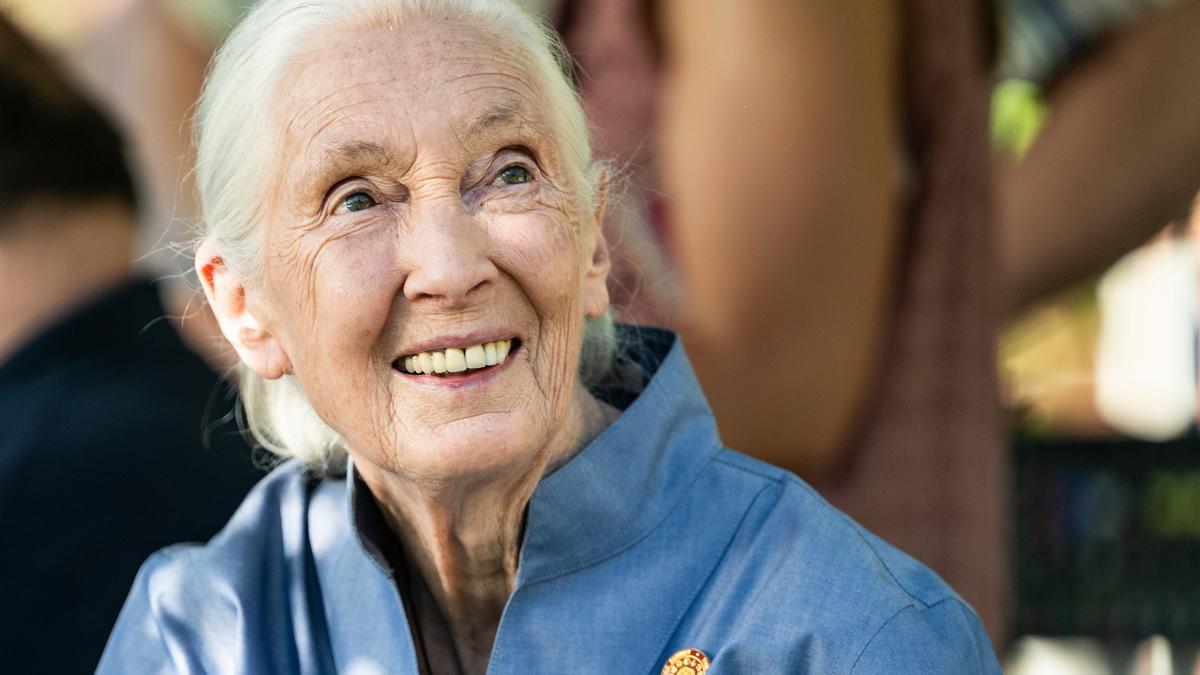
Jane Goodall, a primatologist and ethologist known worldwide for chronicling the life of chimpanzees in East Africa, died on October 1 at the age of 91. Goodall died of natural causes in Los Angeles while on a speaking tour of the U.S., a statement from the Jane Goodall Institute said.
Goodall’s films and books reshaped primatology and public understanding alike. In her later years, she became a champion of conservation and climate action. She was honoured as a Dame in 2003 and with the U.S. Presidential Medal of Freedom in 2025.
Living among chimpanzees
Born in London in 1934, Goodall grew fascinated by animals after reading books such as Tarzan and The Story of Dr. Doolittle. She was also gifted a stuffed toy chimpanzee, named Jubilee, by her father. In her memoir Reason for Hope: A Spiritual Journey (1999), she wrote, “Some people were horrified by Jubilee, thinking he would frighten me and give me nightmares. But I loved him, and he is still with me today — nearly 60 years later.”
When she was in her mid-20s, Goodall travelled to Kenya. She met the noted archaeologist Louis Leakey, who later sent her to Gombe. In 1960, despite having no formal scientific training, Goodall began her landmark studies, documenting tool use, social bonds, and conflict among chimpanzees in the Gombe Stream Chimpanzee Reserve (now Gombe Stream National Park). At a time when primatology prized controlled experiments and short field visits, Goodall settled in for long periods, recording daily activities, interactions, and individual differences among the primates. Her immersion yielded discoveries to alter the boundaries of what ‘separated’ humans from animals.
Goodall’s research was supported by the National Geographic Society. In 1963, the National Geographic magazinepublished a 37-page feature on her studies, which brought global attention to her work. The article also carried visuals by a Dutch photographer named Hugo van Lawick, who Goodall married the following year. Three years later, she gave birth to Hugo Eric Louis van Lawick, her only child, and nicknamed him Grub. She later divorced van Lawick and married Derek Bryceson, the director of Tanzania’s national parks.
In Gombe, Goodall spent months habituating the chimpanzees to her presence, slowly mitigating their fear until they allowed her to observe them up close. This patience led to one of her first landmark findings: that chimpanzees fashioned and used tools to extract termites from mounds. In 1964, Nature published her observation, shattering prevailing assumptions that tool use was uniquely human.
Among the several challenges she faced on the field, Goodall also mentioned being a woman as an important one in several interviews. “I had no training, I had no degree — and I was female! Women didn’t do that kind of thing in those days,” Goodall said. She often credited her mother Vanne for providing both emotional and practical support to her, especially during the early days of her work. In later years, several primatologists, including Dian Fossey and Birutė Galdikas, publicly credited Goodall for opening doors for women in the field.
In 1965, Goodall earned her Ph.D. in ethology from the University of Cambridge, becoming one of the very few people to be admitted to the programme without first having an undergraduate degree.
‘Her own way’
Goodall’s career has often been described as transformative for primatology and for the ways in which her science approached the place of animals in human understanding. There are also good reasons why her work is celebrated beyond the academy: they are rooted in her long-term observations, reshaping of scientific conventions, and later, conservation and education efforts.
In the 1970s, Goodall documented what came to be called the ‘Gombe Chimpanzee War’: one community split into factions and engaged in years of violent conflict. Some observers found the revelation that chimpanzees could form coalitions and wage attacks unsettling because it undermined assumptions of their peacefulness. Yet Goodall also recorded extensive practices of reconciliation and grooming — a documentation virtuous in its honesty for neither idealising nor demonising chimpanzees but revealing their full social repertoire.
Goodall’s ability to communicate her findings to broad audiences has often been seen as a scientific virtue, not merely a rhetorical flourish. Her books, such as My Friends, the Wild Chimpanzees (1967), In the Shadow of Man (1971), and Through a Window (1990), and films helped broaden public support for conservation and raised funds for research.
Her later decades were marked by conservation initiatives, including the Jane Goodall Institute, founded 1977, and the Roots & Shoots programme in 1991. These institutions fostered education, habitat protection, and youth engagement in dozens of countries.
Few figures in 20th century science have enjoyed the cultural stature according to Goodall. Yet the very qualities that made Goodall an icon have also made her a focal point of scholarly critique. Anthropologists, historians of science, and other primatologists have repeatedly debated what is endangered when scientific observation is blended with (human) narratives and activism.
Perhaps the most enduring criticism concerns Goodall’s use of names, personalities, and even ‘moods’ to describe the chimpanzees she observed. Unlike the numbering conventions her contemporaries preferred, she bestowed individuals with names such as “David Greybeard” and “Flo”. For critics, this anthropomorphic practice blurred the line between human and non-human categories. In 2016, the historian Etienne Benson traced how her choice risked smuggling human traits into ethological science.
“Jane violated a scientific taboo by naming the chimpanzees she recognised rather than assigning them numbers,” Galdikas recalled in Reflections of Eden (1995). “Part of the reason Jane did this was practical: names are easier to remember. But she also felt that … numbering chimpanzees robbed them of their individuality. … From the beginning, Jane was accused of anthropomorphising the chimpanzees of Gombe, treating them like family members or pets. The not-so-hidden message was that Jane was a typically sentimental female.”
But Jane? “Jane blithely went her own way.”
Constant vigilance
Goodall was also a jet-setting advocate for conservation and animal rights, drawing fire from those who believed her activism sometimes exceeded her disciplinary authority. The Genetic Literacy Project for instance challenged her opposition to genetic modification, suggesting her authority as a primatologist had been repurposed for domains where Goodall was evidently not an expert. The 2013 plagiarism allegations surrounding Goodall’s 2013 book Seeds of Hope, later acknowledged and corrected, fed into a narrative that her iconic status shielded her from the standards expected of less celebrated scholars.
In fact the critiques taken together were less a dismissal of Goodall’s contributions than a collective insistence that her fame shouldn’t insulate her from scrutiny. To name, narrate, provision, and advocate is to introduce values and judgments into science, whether or not Goodall admitted that, and her career itself has demonstrated the power of such moves — yet it also demonstrated why science requires constant vigilance.
Reflecting on her legacy is thus to see in one career both the promise and the perils of expanding science’s boundaries. As Galdikas wrote, “If you don’t immerse yourself in your subjects’ world, you only gather facts and figures, a computerised image; if you do become involved, you’re accused of being unscientific. If you continue to study from a safe scientific distance subjects who are endangered, your time runs out.”
To her credit, Goodall recognised early that just because something can be criticised doesn’t mean that that thing isn’t worth doing. This is of course easier said than done: while Goodall “didn’t give a hoot what they thought,” as Galdikas put it, Fossey’s experiences in the Congo and Rwanda struck a sharp contrast with Goodall’s in a more politically stable and ecologically more progressive state. It still took Goodall’s courage to inspire Galdikas, Fossey, and others, to open doors to discoveries that reshaped how humans understand animals.