




The story so far: The Government of Pakistan on Sunday (October 11, 2026) imposed emergency rule in Khyber Pakhtunkhwa, the restive northwestern Province where the PTI — Pakistan Tehreek-e-Insaf, the party founded by imprisoned former Prime Minister Imran Khan — has been in power. In a social media post, President Asif Ali Zardari said he had approved the summary recommendations of the Cabinet that had earlier met under the leadership of Prime Minister Shehbaz Sharif.
Mr. Zardari cited growing incidents of terrorism in the Province and dismissed the provincial government saying “terrorist attacks have increased to an unprecedented level of violent intensity posing grave threat to the lives and properties of the people of the province”.
With the announcement of the proclamation of emergency under Articles 232 and 234 of the Constitution of Pakistan, political power has passed on to the Province’s Governor, drawing widespread protest and outrage on the streets.
The political crisis behind the emergency
The PTI, the ruling party in the Province, has been agitating for the release of its leader Mr. Khan for over three years. In recent months, they had announced plans for a long march to capital Islamabad. The march that had been scheduled for September 27 was later postponed to October 4, as the government and the PTI continued to negotiate.

Police officers stand guard with tear gas launchers as a security measure following a protest call by supporters of jailed former Pakistani Prime Minister Imran Khan’s party, Pakistan Tehreek-e-Insaf (PTI), a day after Pakistan imposed a state of emergency in Khyber Pakhtunkhwa
| Photo Credit:
Reuters
As talks foundered, the military-backed federal government attracted attention as a security blanket consisting of shipping containers and blast-proof barricades came up in vital locations of the capital conveying the message that the government would not allow the protest to reach Islamabad. The war of nerves between the PTI in Khyber Pakhtunkhwa and the Centre in Islamabad has been brewing since August 2023 when Mr. Khan was arrested.
While Chief Minister Sohail Afridi came to power in October 2025, the province has been dealing with multiple centres of power as Faisal Karim Kundi, the Governor, was chosen as the representative of the federal government.

But popular support remains firmly with the imprisoned former Prime Minister who is viewed as a leader who chose not to enter into a political settlement with the powerful military establishment in Rawalpindi.
The Opposition’s response
Mahmood Khan Achakzai, Leader of the Opposition in the National Assembly (NA) of Pakistan, has announced they will launch a peaceful protest against the decision of invoking emergency provisions of the Pakistani Constitution while dismissing a democratically elected government in Khyber Pakhtunkhwa.
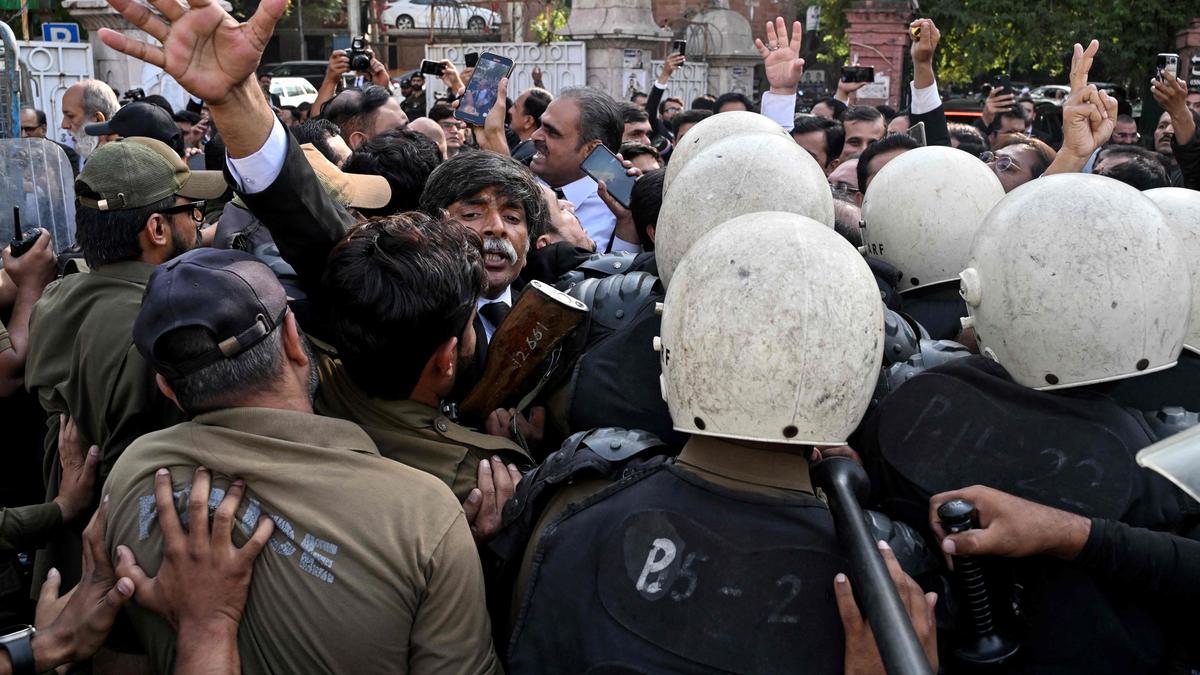
Separately, the PTI is holding rallies and protests in different parts of the country and hundreds of leaders of the party, including Mr. Khan’s three sisters, have courted arrest. In addition, according to social media reports, some of the tribal chiefs of the region have called for armed resistance against the military-backed government of Islamabad.

Police officers detain a supporters of imprisoned former Prime Minister Imran Khan’s party during a protest
| Photo Credit:
AP
Since coming to power in October 2025, Mr. Afridi has made the release of Mr. Khan as the main agenda of his government and shortly before the imposition of emergency, he had reiterated that the only way to diffuse the situation was to release Mr. Khan from Adiala Jail. The Federal government accused the provincial government of failing to control terrorism whereas the PTI is accusing Islamabad of highhanded repression.
The real picture
The security situation in Khyber Pakhtunkhwa has been volatile for decades but in recent months, the main factor behind the worsening security situation has been the disjuncture between Islamabad and the provincial ruling party which has been accusing Islamabad’s military establishment of disregarding their demands.
In brief, the Province has been facing a two pronged crisis — one a political battle with the Centre and second a worsening security situation involving terror groups with cross border links.
Khyber Pakhtunkhwa’s Chief Minister Sohail Afridi and other leaders of the Province have been blaming Islamabad for following “wrong policies” that have helped in the flourishing of terrorism in the province.

Police officers stand guard at a road barricaded by authorities to maintain law and order situation in Peshawar
| Photo Credit:
AP
The PTI had gone to the Supreme Court seeking intervention to help Mr. Khan. The top court permitted the former Prime Minister to receive better treatment at the Shifa International Hospital of Islamabad and allowed his family members to meet him. However, the government did not follow the instructions. Instead, he was taken to the state-run PIMS (Pakistan Institute of Medical Sciences) during the night of August 20-21, where he was declared medically fit.
The Taliban trouble
The military-backed federal government has been alleging the Taliban is sending the Tehreek e Taliban Pakistan (TTP) fighters for attacks inside Pakistan using the Province as a staging ground for attacks in different parts of Pakistan.
On the other hand, critics of the government have been alleging that Pakistan has been training the officials of the pre-Taliban Afghan security establishment for launching attacks against the Taliban.
Khalilullah Safi, an expert on Islamic State-Khorasan Province (ISKP), pointed out to The Hindu there is considerable ground to suspect the military establishment in Pakistan is extending support to the ISKP because it serves a larger plan of the military establishment in Rawalpindi. “What’s happening in KP [Khyber Pakhtunkhwa] is linked to the overall plans that Pakistan military has for Afghanistan, Iran and even Central Asia,” said Mr. Safi.
The Taliban in Afghanistan holds the dominant position, and as a result, the ISKP has been pushed out. The situation inside Khyber Pakhtunkhwa is amplified by the frequent border clashes between the Taliban and the Pakistani military.
Atif Mashal, Afghanistan’s former ambassador to Pakistan, said the Pakistani military is acting according to its regional agenda by getting the PML-PPP (Pakistan Muslim League (N) and Pakistan Peoples Party) government to impose emergency in Khyber-Pakhtunkhwa.
“The declaration of emergency in Khyber Pakhtunkhwa, in my view, has not occurred solely due to the protests of the PTI. It appears the management of these protests serves as a superficial pretext. But behind it lies another regional agenda of Pakistan’s military leadership, one that deems the militarisation of these areas essential for its implementation,” Mr. Mashal said on X. In a warning to the Pakistan’s military establishment, he further said, “the era of managed instability seems to be drawing to a close”.
Published – October 13, 2026 06:15 am IST