


The story so far: Following sustained local protests and pressure from civil society groups, Google has reportedly said its planned 1-GW data centre in Visakhapatnam district will use air-cooling technology to cool its servers. While air-cooling requires less water, it comes with its own trade-offs.
Why does a large data centre generate heat?
A large data centre will have several million processors, each with billions of transistors. Each transistor manipulates the electrical current flowing through it to perform operations on data. As it does, the resistance the transistor’s material poses to the flow of current will release some heat, as will the charging and discharging of transistors. Across trillions of transistors, the amount of heat thus generated can be considerable.
A 1-GW data centre will in principle produce 1 GW of heat. The planned Google ‘hyperscaler’ near Visakhapatnam and the newly announced Tata Consultancy Services (TCS) ‘HyperVault’ will each be 1-GW facilities. How much of that power is for the data centre alone is unclear. Assuming it is 1 GW: each facility will effectively have to remove 1 GW of heat each out and into the environment.
In the very first step, the heat from each chip is moved from the silicon die holding it to a designated heat sink, such as a cooling plate. But what happens from the heat sink depends on which cooling technology the facility uses.
How does a data centre move heat?
Since the heat comes from transistors, it helps to understand the architecture first. Billions of transistors make a processor. One or more processors make up a server. Multiple servers fill a rack. Multiple racks are combined into clusters. Multiple clusters make up one data centre.
There are several cooling options depending on economic feasibility, scale of operations, and local conditions.
In air-cooling, fans push cool air through or around the server racks, and the hot air at the end is collected and cooled. Some common configurations include computer-room ACs (CRACs), which use ACs with refrigerants; computer-room air-handlers (CRAHs), which use chilled water to cool the air; hot-aisle/cold-aisle containment, where hot and cool air are kept physically separate; and free-cooling, heat from servers is simply expelled into naturally cooler outside air.
A related version is the rear-door heat exchanger: air leaving the servers passes through a heat-exchanger attached to the back of each rack, where chilled water absorbs the heat, and the cooler air is reflowed to the servers.

A cooling fan installed in a computer case.
| Photo Credit:
Bretwa (CC BY-SA)
Another popular option is direct liquid cooling, where a specific liquid is brought in contact with the components generating heat. In one version called cold-plate cooling, a metal plate embedded with channels to carry the liquid is placed directly against a processor. The liquid draws the heat via the plate and flows from there via tubes to a heat-exchanger, where it loses the heat, before returning. Liquid-cooling is usually more effective than air-cooling because water-based liquids typically have higher heat capacity than air, for the same volume.
The heat capacity of a substance is the amount of heat it has to be given to raise its temperature by, say, 1° C. So the higher its heat capacity, the more heat it can absorb before itself warming up.
That said, the server can still air-cool those components that do not merit liquid-cooling.
Third is an option called immersion cooling, where the electronics themselves are immersed in a non-conductive liquid. In single-phase immersion, the liquid draws heat, which is pumped away through a heat-exchanger. In two-phase immersion, the liquid boils as it draws heat, the heat is drawn away, e.g. by a fan, and the vapour condenses back. The latter is useful because heat transfer is more efficient at higher temperatures.
Because the heat-sink of a liquid is in contact with the electronics, the heat is moved more efficiently, and so immersion cooling can handle very high power densities. However, it requires specialised hardware and maintaining the coolant through complex processes.

This screenshot from a video shows server components immersed in a green-coloured liquid coolant.
| Photo Credit:
Mitsubishi Heavy Industries, Ltd./YouTube
Fourth is evaporative cooling: the heat is removed from the servers, e.g. using air-cooling, then transferred to water, which is then allowed to evaporate in cooling towers or evaporative condensors. If the local air isn’t very humid, evaporative cooling can be highly energy-efficient. However, it requires large quantities of water.
Another similar option is dry-cooling, where a heat-exchanger is simply exposed to the ambient air, and fit with large fins to encourage the heat to leave. While this avoids the water demand of evaporative cooling, it also incurs larger heat-exchange surfaces, especially in places with warm weather.
Then there are chilled-water systems that use a central chilled water plant; geothermal heat rejection, an experimental technology where the heat is pumped into heat-exchangers underground; natural water cooling, where a large, natural water body like a nearby lake is used as the heat sink; and heat reuse, where the heat is moved to serve applications like industrial processes or desalination.
All of them come with trade-offs. E.g. the geothermal option is hard to scale up while reusing heat is hard without heat pumps because the heat usually needs to be at a higher temperature to be useful.

Is air-cooling good?
Generally, air-cooling imposes lower infrastructure costs up front than a liquid-cooling setup. Current construction benchmarks suggest liquid-cooled facilities will incur a 7-10% premium on the total project cost due to the demand for complex piping and leak detection systems and special coolant distribution units.
Air-cooling is also a proven technology by now and comes with a deep and mature pool of technicians and maintenance protocols. In fact, irrespective of the cooling technology used in a cluster’s heat hotspots, engineers often prefer to air-cool racks producing 20 kW or less of heat. It is an added bonus if the ambient conditions are naturally cool or arid, in which case air-side economisers that pull in outside air for cooling purposes can reduce the energy diverted to mechanical cooling by 70%.
But all this said, as of 2026, using air-cooling alone to cool a 1-GW data centre is considered impractical, both physically and economically. While liquid-cooling imposes higher costs upfront, air-cooling levies a performance and efficiency tax, so to speak, that can increase the total cost of ownership for an air-cooled 1-GW facility within a few years of operation.
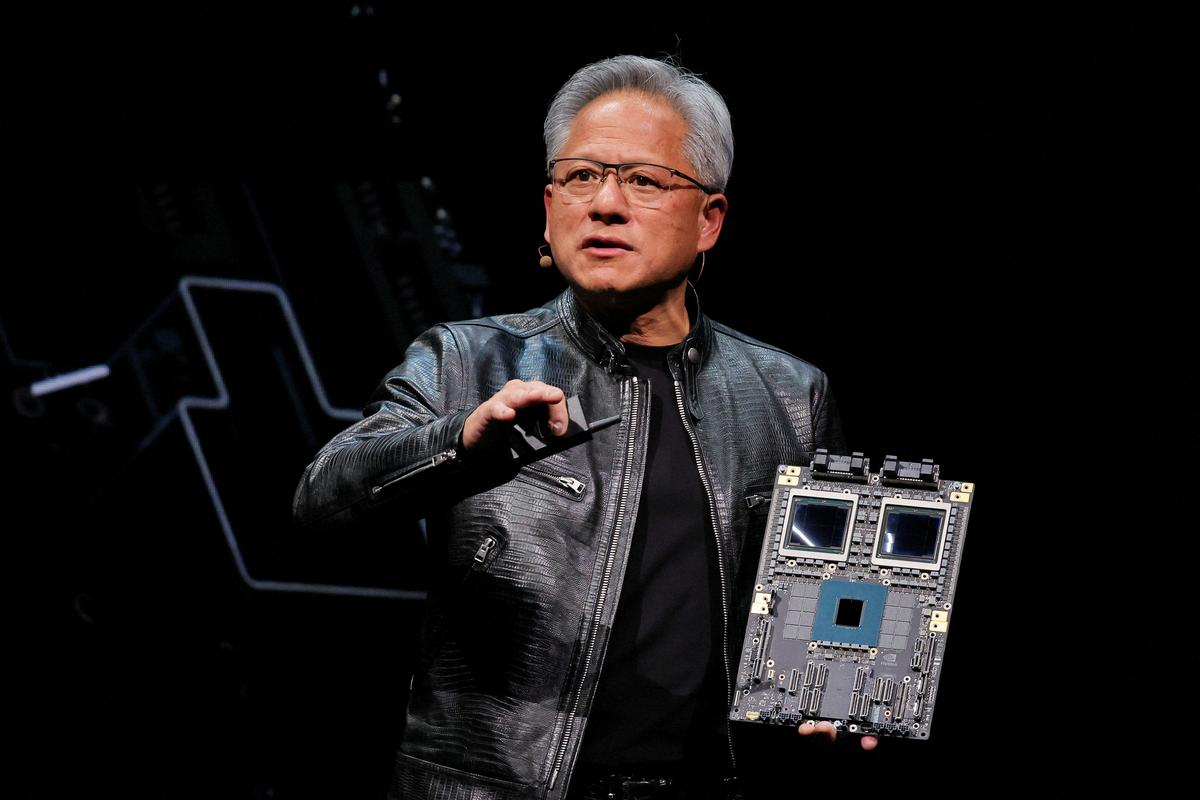
Nvidia CEO Jensen Huang presents the Blackwell platform at an event in Taipei, Taiwan, June 2, 2024.
| Photo Credit:
Reuters
The most important reason is the ‘thermal wall’: air-cooling can remove at best around 40 kW per rack. However, modern artificial intelligence (AI) chips like the Nvidia Blackwell generate 700-1,000 W per GPU, so a rack could emit around 120-150 kW. At this scale, air-cooling the racks will require them to be installed inside a wind tunnel, with the power consumption skyrocketing.
Air-cooling will also demand acoustic control as the number of fans and chillers required will create large amounts of noise. In fact, air-cooling chillers and air-handling units can produce up to 100 dB, and if the resulting low-frequency hum is not quickly dampened, it can travel several kilometres if atmospheric conditions are also favourable, disturbing the sleep of people in the way.
For this mix of pros and cons, many 1-GW data centres today use hybrid cooling: air-cooling for low-density servers and other areas, rear-door heat-exchangers to push air-cooling to remove up to 50 kW, and direct-to-chip (DTC) liquid-cooling for high-density AI clusters, including the Nvidia Blackwell.

What have Google and TCS committed to?
After concerns were raised about the water demands of the Google hyperscaler data centre, Visakhapatnam MP M. Sribharat said, “Google has confirmed it will use air-cooling technology… there is no question of impact to water supply.”
The tech giant has also said it will replenish 120% of water consumed for non-cooling needs across its operations by 2030, quantified under the Volumetric Water Benefit Accounting standard. Hindustan Times also quoted Alexander Smith, principal of Global Infrastructure and Energy, Asia Pacific, Google, as saying “Google is also planning integrated watershed-management measures, including rainwater catchment systems on data-centre buildings, groundwater recharge infrastructure, water pumps, and water ATMs”.
Likewise, Mint quoted HyperVault CEO Deepesh Kiran Nanda saying, “We are building infrastructure for where AI is going: higher density, liquid cooling, larger power blocks, and faster deployment”. Per news agency ANI, the HyperVault will also feature DTC cooling as well as use renewable energy.