



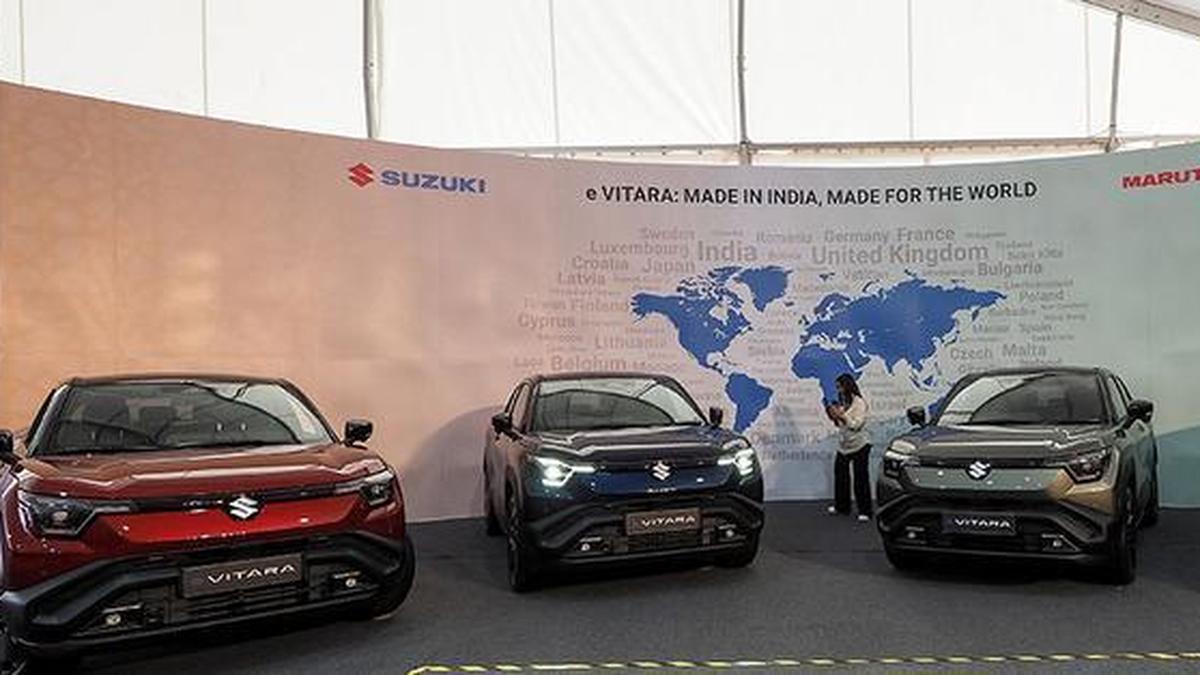
For illustration
| Photo Credit: AFP
India’s automobile industry needs to move beyond local assembly and build domestic capabilities across the entire value chain—from raw materials and components to advanced technologies and final systems—to reduce supply-chain risks and strengthen global competitiveness, industry leaders said.
Tata Motors Managing Director Shailesh Chandra said India’s localisation push should go beyond import substitution and focus on establishing the country as a major global automotive manufacturing and mobility hub.
“The opportunity before is much larger than just import substitution,” Chandra said, adding that India should aim to become “one of the world’s leading automotive manufacturing and mobility hubs.”
As vehicles become increasingly technology-intensive, retaining a larger share of value creation within India will be critical, he said. The vehicles of the future will rely heavily on electronics, semiconductors, sensors, power electronics, batteries, motors, software, connectivity and advanced materials.
“Hence to ensure global competitiveness, much of the value creation should reside within the country,” Chandra said.
He called for localisation to expand beyond conventional components to cover the full value chain, including raw materials, processing, components, sub-components and final systems. The recent disruption in rare-earth magnet supplies, he said, demonstrated how dependence on even a relatively small input could expose the industry to strategic supply-chain vulnerabilities.
Maruti Suzuki India Managing Director and CEO Hisashi Takeuchi said shifting global supply chains were creating an opportunity for India to emerge as a trusted manufacturing and supply-chain base.
“Cost is no longer the only consideration. Reliability and continuity have become equally important,” Takeuchi said.
Hyundai Motor India Chief Operating Officer Tarun Garg said India’s trade profile highlighted the need for faster technological capability-building. “Our exports remain concentrated in relatively mature technologies, while our imports are increasingly dominated by advanced, higher-value technologies, he said.
India must therefore “accelerate and leapfrog towards greater self-reliance” by designing, developing and manufacturing next-generation technologies domestically, Garg said. These include semiconductor chips, electric-vehicle battery cells and power electronics.

Published – September 02, 2026 08:47 pm IST