



On August 21, a three-judge Supreme Court Bench led by the Chief Justice of India dismissed a petition and sought a fresh one in a case on minimum wages in rural employment guarantee programmes. The Bench lauded MGNREGA’s role in rural development. It probed whether the ‘Right to Work’ should be treated on par with Article 21, the fundamental right to life, sparking an important discussion on the constitutional foundations of this right.
A guarantee under strain
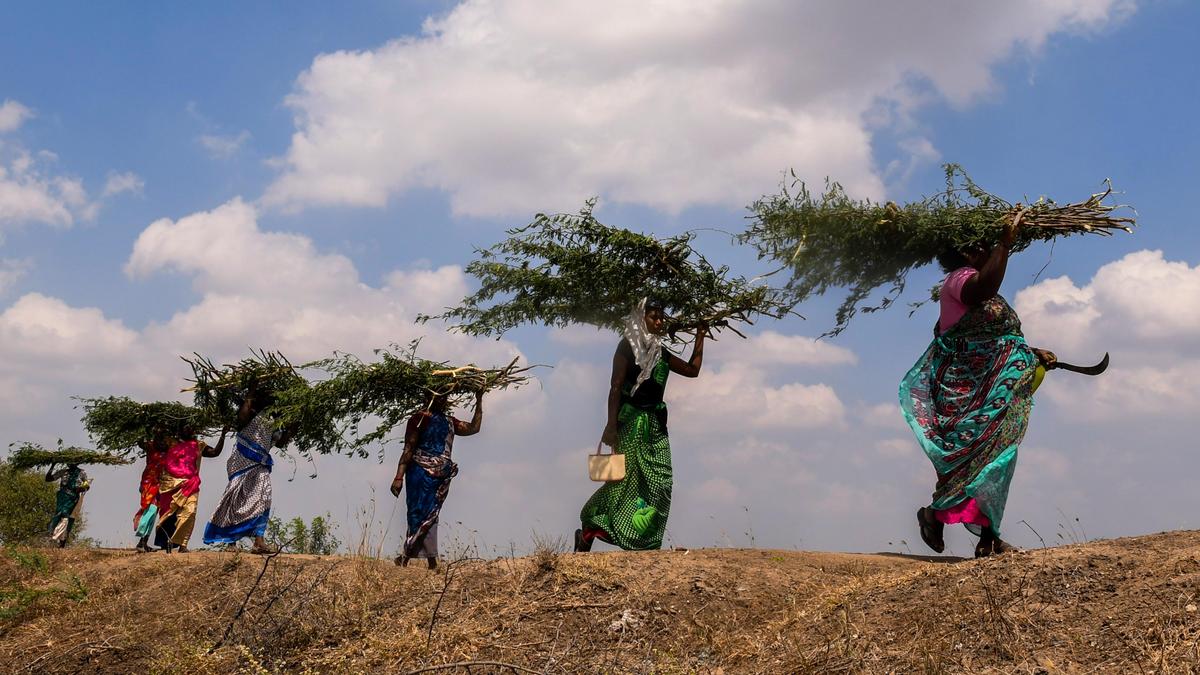
Despite its limited scope of only 100 days of work per rural household and chronic underfunding, the Mahatma Gandhi National Rural Employment Guarantee Act (MGNREGA) was the only law anchored in the core principle of the right to work. In December 2025, the Union government replaced MGNREGA with the Viksit Bharat — Guarantee for Rozgar & Ajeevika Mission (Gramin) (VB-GRAM G) Act, and its implementation began on July 1. About 3.44 crore households worked for about 44 crore person-days under MGNREGA in July and August, on average, over the previous five years (Table 1). There has been a 68% decrease in employment in July and August this year compared with the average of the preceding five years. Notwithstanding the proverbial ‘teething issues’, the dismantling of MGNREGA’s demand-driven right-to-work framework and the disproportionate fiscal burden that the new law places on States are likely to be major factors behind the dramatic fall in employment under the VB-GRAM G Act.
The impact of taking away even this limited right to work is therefore palpable. Discussions around the recent Supreme Court observations on the right to work can be traced back to the Constituent Assembly debates.
While most members agreed that a right to work was vital, the debate rested on whether it should be a fundamental right or be part of the Directive Principles of State Policy (DPSP). The DPSPs do not automatically constitute rights but are meant to serve as precepts for governments to formulate laws and policies. This became the basis of the differences in perspective.
Professor K.T. Shah had strongly advocated recognising the right to work as a fundamental right, arguing that the State needed a constitutional and positive legal mandate to guarantee socio-economic security to its citizens. Dr. B.R. Ambedkar, among others, held that while the right to work was an essential goal, its immediate universal enforcement was not fiscally and institutionally viable in a newly independent India that had been hollowed out of its resources. The placement of the right within the Directive Principles, rather than among the fundamental rights, thus reflected a deliberate constitutionalism of aspiration, rather than an abandonment of the welfare ideal. As scholars Anjani Kapoor and Manu Bhagwan have written in their essay ‘Ambedkar and the anti-isolation of Fellowship’, “The constitution does not establish the nation, but rather provides the tools to help achieve it.”
Therefore, Article 41 of the DPSP states: ‘The State shall, within the limits of its economic capacity and development, make effective provision for securing the right to work…” Embodying stronger progressive consecrations, Articles 39, 42 and 43 call for the “right to an adequate means of livelihood, equal pay for equal work for both men and women, just and humane conditions of work” and to “secure to all workers a living wage and decent standard of life.”
From aspiration to a statutory right
The Supreme Court, in Olga Tellis vs Bombay Municipal Corporation (1985), ruled that the right to livelihood was a necessary condition for the fundamental right to life, giving a judicial fillip to the right to work. Spurred by the collective efforts of activists and rural workers, the National Rural Employment Guarantee Act was passed in 2005. Although limited in scope, it made a pan-India right-to-work law a reality for the first time. The State had to ensure its statutory obligation to provide employment at minimum wages.
In 2009, MGNREGA wages were delinked from the Minimum Wages Act, 1948. Over time, MGNREGA wages barely kept pace with inflation and continued to remain lower than the minimum agricultural wages in most States. Low wages and an inadequate budget for generating employment have resulted in a steep decline in household earnings, with estimated total household earnings halving in July and August this year compared with the same months last year (Figure 1).
During the recent hearing, the Supreme Court Bench remarked that if financial resources remained the same, having a minimum wage threshold could reduce the number of workers who could be provided employment. This remark, which appears to align with the Union government’s approach to employment guarantee, merits scrutiny on at least two counts.
First, it vitiates the judgment in Sanjit Roy vs State of Rajasthan (1983) where the Supreme Court observed that payment of wages below minimum wages violates Article 23 of the Constitution and is akin to ‘forced labour.’ Second, it rests on a misleading economic logic that financial resources to implement a welfare programme must remain unchanged and constrained.
In reality, higher wages for rural workers increase their purchasing power, enhance their freedoms, and improve human development outcomes. These, in turn, increase effective demand for goods and services, creating a positive multiplier effect, resulting in higher economic productivity. Therefore, higher government spending on an employment guarantee programme at increased wages can yield a mutually reinforcing cycle between development and growth.
A retreat from the right to work
By putting an arbitrary cap on funds for the VB-GRAM G Act and not linking it with minimum wages, the very notion of employment guarantee stands delegitimised. States are already grappling with fiscal constraints and curtailed borrowing limits under the Fiscal Responsibility and Budget Management (FRBM) framework. The increased burden of funding the VB-GRAM G Act will prevent States from generating employment. The sharp drop in employment and earnings is a reflection of this change.
The VB-GRAM G Act also contains provisions to denotify certain areas and exclude them from the scheme, thereby limiting the universality of MGNREGA’s right to work.
Lawyer Purbayan Chakraborty highlights how the Supreme Court has affirmed the doctrine of non-retrogression in Navtej Singh Johar vs Union of India. The doctrine implies that once the State has achieved a certain level of progressive legislation and enforceability of a right, it cannot implement measures that deliberately undo it. Non-retrogression operates as a check on State power, ensuring that rights, once realised, are not diluted later. The replacement of MGNREGA with the VB-GRAM G Act appears to be in violation of this doctrine.
Rural wages have been stagnant for a decade, while women are increasingly employed as ‘unpaid family workers’. In such light, the minimal requirements for affirming the commitment to the right to work are: linking MGNREGA wages to living wages, timely payment of wages, a focus on social audits by empowering local institutions to be partners in mitigating corruption, and giving more powers to Panchayati Raj institutions.
All these measures could be implemented within a legal framework of the right to work. The VB-GRAMG Act, unfortunately, is silent on most of them. Reinstating the right to work would therefore not only be a legal course correction advancing constitutional aims, but would also be sound economics.
(The authors are affiliated with the Centre for the Study of the Indian Economy, Azim Premji University. The views expressed are personal)
Published – September 01, 2026 08:00 am IST