


Skip to content
  • Facebook
  • X
  • Linkedin
  • WhatsApp
  • YouTube
  • Associate Journalism
  • About Us
  • Privacy Policy
  • 033-46046046
  • editor@artifex.news
Artifex.News

Artifex.News

Stay Connected. Stay Informed.

  • Breaking News
  • World
  • Nation
  • Sports
  • Business
  • Science
  • Entertainment
  • Lifestyle
  • Toggle search form
  • Anti-Drone Units A New Tool To Keep Paris Safe For 2024 Olympics
    Anti-Drone Units A New Tool To Keep Paris Safe For 2024 Olympics World
  • Seat-Sharing To Be On Agenda At INDIA’s First Coordination Panel Meet Today
    Seat-Sharing To Be On Agenda At INDIA’s First Coordination Panel Meet Today Nation
  • Asia Cup | Saif and Hridoy help Bangladesh edge Sri Lanka  
    Asia Cup | Saif and Hridoy help Bangladesh edge Sri Lanka   Sports
  • Access Denied
    Access Denied Nation
  • Access Denied Business
  • Man Arrested For Raping 12-Year-Old Girl In UP’s Shahjahanpur
    Man Arrested For Raping 12-Year-Old Girl In UP’s Shahjahanpur Nation
  • Access Denied World
  • Access Denied Sports
Rotating detonation engines: the science and the promises

Rotating detonation engines: the science and the promises

Posted on August 17, 2026 By admin


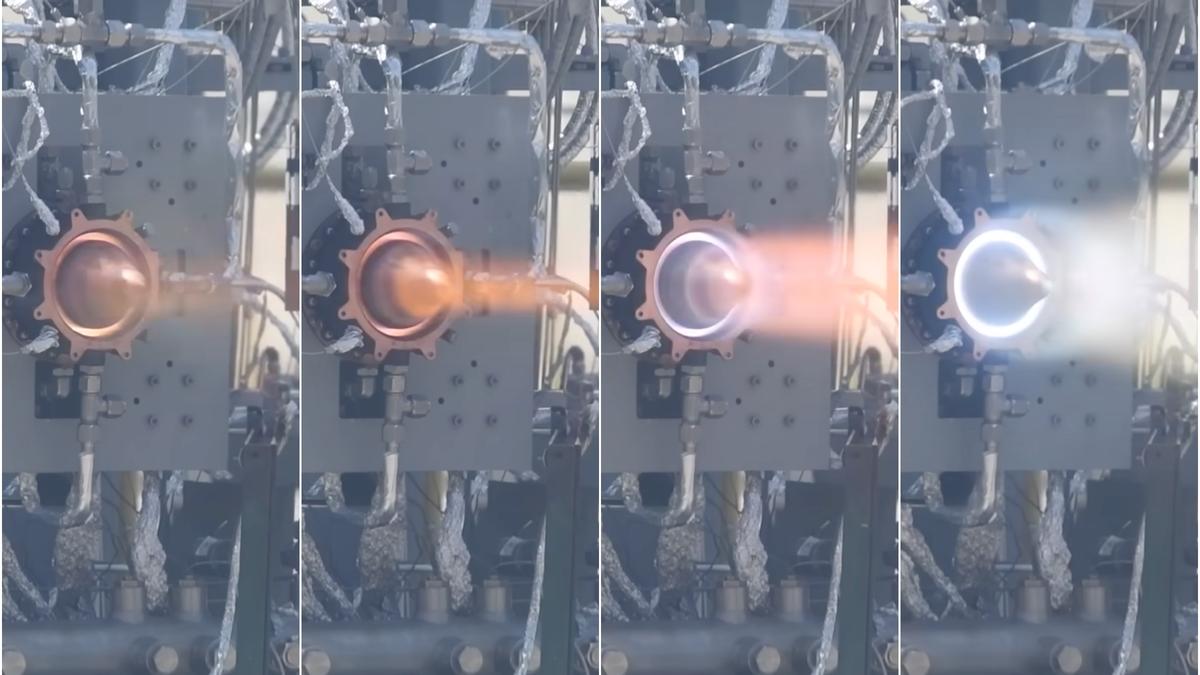
Recently, India-based defence start-up D-Propulse announced that it had successfully demonstrated a rotating detonation engine at a Defence Research & Development Organisation facility in Hyderabad.

A rotating detonation engine, or RDE, is an engine design that promises to use fuel more efficiently than conventional rocket engines. Launching satellites to space on rockets and carrying explosives to distant targets on missiles are both expensive. If an engine can use fuel more efficiently, it will need correspondingly less fuel to achieve the same task. This saving can be passed to the payload, whether a satellite or a warhead, increasing the profitability of the mission. At least on paper.

In January, GE Aerospace and Lockheed Martin demonstrated an RDE for hypersonic missiles (using air from the atmosphere). In February, U.S.-based SpaceWorks reported hot-fire tests of its RDE for rockets. Its compatriots Astrobotic test-fired its Chakram RDE continuously for 300 seconds and L3Harris announced that it had tested two RDEs, in April and May respectively.

The Swiss start-up Stellar Alpina completed a commercial RDE hot-fire test and raised CHF 3.5 million while Juno Propulsion raised $1.4 million to develop an RDE for spacecraft thrusters. In July, Venus Aerospace (then partnered with Lockheed Martin) raised $91 million to scale its tested RDE.

Wait for advances

RDEs are currently confined to research and development. There are no models known to be ready for commercial or military use. The actual data from many tests by commercial entities are also not available in the public domain. But going by their physics alone, RDEs offer around 10% to 25% more thermodynamic efficiency than conventional combustors. The exact value depends on real-world conditions and the engine’s design.

This is considered to be significant for rocket launches. Thermodynamic efficiency measures how much chemical energy becomes useful work. If an RDE improves thermodynamic efficiency by 20%, for instance, it could theoretically require around 17% less fuel for the same output, assuming other losses are unchanged.

Scientists figured out how an RDE could work by the 1960s. Building one was a different matter. Sustaining a continuous detonation in a compact chamber requires engineers to precisely control the injection of the fuel and the internal pressure. The chamber also needs to have a specific geometry to ensure the engine works as desired.

Unlike in regular engines, even small instabilities in the fuel-air mixture in an RDE can destabilise the engine.

The engine materials must also withstand more than 2,000° C, 10-100 atmospheres of pressure (and in brief moments much higher), detonation speeds of more than 1,500 m/s, pressures oscillating at several thousand cycles per second, and potentially tens to hundreds of g, depending on the design.

So to invent working RDEs, scientists and engineers had to wait for advances in high-speed computing, diagnostics, fuel injection, materials, and manufacturing.

Supersonic flame

In a regular engine, the combustion chamber holds the fuel-air mixture. When a flame is introduced in the chamber — like from a spark plug — it travels through the mixture at less than the speed of sound. This is called a deflagration.

When the flame travels through the mixture at more than the speed of sound, it imposes a shock wave on the mixture and heats it up, triggering rapid combustion behind it. This is called a detonation. It is also what happens in the combustion chamber of a detonation engine.

As the flame passes through the mixture in a regular engine, the combustion happens at constant pressure. This means the mixture is free to expand as it heats up instead of being confined under pressure.

But when the flame passes through the mixture as a detonation, the combustion happens at constant volume. This is because the detonation compresses the unburned mixture with a shock wave immediately before combustion, and the mixture doesn’t have enough time to expand under these ‘forces’.

This is also why a detonation engine produces combustion products at a higher pressure, and more of the fuel’s chemical energy is converted into pressure rather than being shed as heat. This is essentially the physics of how a detonation engine can have more fuel efficiency than a ‘regular’ engine with the same fuel.

Pulsed and rotating detonation

A simple type of the detonation engine is called the pulsed detonation engine, or PDE. A PDE has a long tube as the combustion chamber, to allow the detonation to pass through the whole mixture.

First, the detonation races down the tube, rapidly compressing and burning the fuel-air mixture. This leaves behind very hot, high-pressure combustion products. Those gases expand towards the open end of the tube, where they exit at a high speed.

By Newton’s third law, their momentum in one direction produces an equal and opposite momentum on the engine, pushing it forward. Alternatively, if the engine is connected to a piston, the same expanding gases would push on it, generating mechanical energy. The tube is then purged before the next cycle begins.

An RDE makes the detonation a continuous process. Instead of the detonation passing through a long tube, it is made to flow in a circle. In the general RDE design, the combustion chamber has an annular shape, i.e. two concentric cylinders with a narrow ring-shaped gap between them. The fuel and the oxidiser are injected continuously into this gap, called the annulus, even as one or more detonation waves race through.

As the detonation goes round and round, it continuously imposes high pressures and temperatures on the mixture.

And to keep the detonation going, fuel is continuously injected into the annulus just ahead of the detonation wave. The wave consumes the fresh fuel-air mixture and expels the products through the nozzle, along its axis. So as long as the fuel keeps coming at the right time and in the right conditions, the detonation can keep going — even at thousands of times per second.

This is how an RDE can continuously generate thrust (or mechanical energy).

Published – August 18, 2026 08:30 am IST


Source link

Science

Post navigation

Previous Post: The road to E20 is not without bumps
Next Post: Hockey World Cup: England exposes India’s shortcomings

Related Posts

  • ‘Online education is one of the biggest finds of the last decade’
    ‘Online education is one of the biggest finds of the last decade’ Science
  • From field to screen: the changing landscape of ecology research
    From field to screen: the changing landscape of ecology research Science
  • Trio win Chemistry Nobel 2025 for metal-organic frameworks
    Trio win Chemistry Nobel 2025 for metal-organic frameworks Science
  • Understanding of Earth’s flowering plants blossoms in genome study
    Understanding of Earth’s flowering plants blossoms in genome study Science
  • Indian cryptography research gears up to face the quantum challenge
    Indian cryptography research gears up to face the quantum challenge Science
  • ISRO successfully conducts third and final ‘Pushpak’ Reusable Launch Vehicle landing experiment
    ISRO successfully conducts third and final ‘Pushpak’ Reusable Launch Vehicle landing experiment Science

More Related Articles

Geroscience: the science related to aging Geroscience: the science related to aging Science
For elephants, like people, greetings are a complicated affair For elephants, like people, greetings are a complicated affair Science
The biological magic of shared laughter The biological magic of shared laughter Science
Artemis II breaks Apollo 13’s distance record with daring moon flyby that included a solar eclipse Artemis II breaks Apollo 13’s distance record with daring moon flyby that included a solar eclipse Science
Unmasking Guillain-Barré Syndrome: revelations from studies at NIMHANS Unmasking Guillain-Barré Syndrome: revelations from studies at NIMHANS Science
The physics of thermometers, temperatures and cold atoms The physics of thermometers, temperatures and cold atoms Science
SiteLock

Archives

  • August 2026
  • July 2026
  • June 2026
  • May 2026
  • April 2026
  • March 2026
  • February 2026
  • January 2026
  • December 2025
  • November 2025
  • October 2025
  • September 2025
  • August 2025
  • July 2025
  • June 2025
  • May 2025
  • April 2025
  • March 2025
  • February 2025
  • January 2025
  • December 2024
  • November 2024
  • October 2024
  • September 2024
  • August 2024
  • July 2024
  • June 2024
  • May 2024
  • April 2024
  • March 2024
  • February 2024
  • January 2024
  • December 2023
  • November 2023
  • October 2023
  • September 2023
  • August 2023
  • July 2023
  • June 2023
  • May 2023
  • April 2023
  • March 2023
  • February 2023
  • January 2023
  • December 2022
  • November 2022
  • October 2022
  • September 2022
  • August 2022
  • July 2022
  • June 2022
  • May 2022

Categories

  • Business
  • Nation
  • Science
  • Sports
  • World

Recent Posts

  • At least 13 Tunisians missing after migrant boat sinks off Tunisia, group says
  • Uttar Pradesh, Japan’s Yamanashi sign four MoUs; ₹600-crore fund for MSMEs
  • Beyond the walls of Siddhavatam Fort
  • Indian national arrested in U.S. over multi-million-dollar fraud targeting elderly
  • Australia vs Bangladesh Day 1: Starc takes five wickets in first four overs

Recent Comments

  1. StephenBeida on UP Teacher Who Asked Students To Slap Muslim Classmate
  2. Josephfep on UP Teacher Who Asked Students To Slap Muslim Classmate
  3. DavidOxile on UP Teacher Who Asked Students To Slap Muslim Classmate
  4. WilliamWrino on UP Teacher Who Asked Students To Slap Muslim Classmate
  5. StephenBeida on UP Teacher Who Asked Students To Slap Muslim Classmate
  • “This Is A Different India Today, Now Able To Seek Its Own Solutions”: S Jaishankar
    “This Is A Different India Today, Now Able To Seek Its Own Solutions”: S Jaishankar Nation
  • NSA Ajit Doval, US Counterpart Jake Sullivan Hold India-US iCET Meet In Delhi
    NSA Ajit Doval, US Counterpart Jake Sullivan Hold India-US iCET Meet In Delhi Nation
  • 5 Of Family, Out To Seek Medical Help For Sick Child, Die In Accident In Noida
    5 Of Family, Out To Seek Medical Help For Sick Child, Die In Accident In Noida Nation
  • Poland arrests man suspected of spying for Russia to aid Zelensky assassination plot
    Poland arrests man suspected of spying for Russia to aid Zelensky assassination plot World
  • Access Denied World
  • Elon Musk loses blockbuster OpenAI suit as jury says too late
    Elon Musk loses blockbuster OpenAI suit as jury says too late World
  • Access Denied Sports
  • Doctor can’t enrol as advocate without cancelling registration: HC
    Doctor can’t enrol as advocate without cancelling registration: HC Nation

Editor-in-Chief:
Mohammad Ariff,
MSW, MAJMC, BSW, DTL, CTS, CNM, CCR, CAL, RSL, ASOC.
editor@artifex.news

Associate Editors:
1. Zenellis R. Tuba,
zenelis@artifex.news
2. Haris Daniyel
daniyel@artifex.news

Photograher:
Rohan Das
rohan@artifex.news

Artifex.News offers Online Paid Internships to college students from India and Abroad. Interns will get a PRESS CARD and other online offers.
Send your CV (Subjectline: Paid Internship) to internship@artifex.news

Links:
Associate Journalism
About Us
Privacy Policy

News Links:
Breaking News
World
Nation
Sports
Business
Entertainment
Lifestyle

Registered Office:
72/A, Elliot Road, Kolkata - 700016
Tel: 033-22277777, 033-22172217
Email: office@artifex.news

Editorial Office / News Desk:
No. 13, Mezzanine Floor, Esplanade Metro Rail Station,
12 J. L. Nehru Road, Kolkata - 700069.
(Entry from Gate No. 5)
Tel: 033-46011099, 033-46046046
Email: editor@artifex.news

Copyright © 2023 Artifex.News Newsportal designed by Artifex Infotech.