



Skip to content
  • Facebook
  • X
  • Linkedin
  • WhatsApp
  • YouTube
  • Associate Journalism
  • About Us
  • Privacy Policy
  • 033-46046046
  • editor@artifex.news
Artifex.News

Artifex.News

Stay Connected. Stay Informed.

  • Breaking News
  • World
  • Nation
  • Sports
  • Business
  • Science
  • Entertainment
  • Lifestyle
  • Toggle search form
  • Denmark says new drone sightings overnight at military installations
    Denmark says new drone sightings overnight at military installations World
  • Amritpal Singh Approaches High Court For Temporary Release To Fight Polls
    Amritpal Singh Approaches High Court For Temporary Release To Fight Polls Nation
  • Vinesh Phogat Receives Hero’s Welcome From Fans At Delhi Airport, Breaks Down. Watch
    Vinesh Phogat Receives Hero’s Welcome From Fans At Delhi Airport, Breaks Down. Watch Sports
  • Fit-Again Hasan Ali Hit Straps, Batters Slog It Out In Pakistan Training
    Fit-Again Hasan Ali Hit Straps, Batters Slog It Out In Pakistan Training Sports
  • No Longer Running National Camps, Athletics Federation Of India To Monitor Athletes For Dope Testing
    No Longer Running National Camps, Athletics Federation Of India To Monitor Athletes For Dope Testing Sports
  • UN says Taliban suspended polio vaccination campaigns in Afghanistan
    UN says Taliban suspended polio vaccination campaigns in Afghanistan World
  • Access Denied Sports
  • Personal loans disbursed via digital apps have the highest share of overdue accounts: Data
    Personal loans disbursed via digital apps have the highest share of overdue accounts: Data Business
Unusual black hole found at universe’s dawn presents dusty mystery to astronomers

Unusual black hole found at universe’s dawn presents dusty mystery to astronomers

Posted on August 17, 2026 By admin


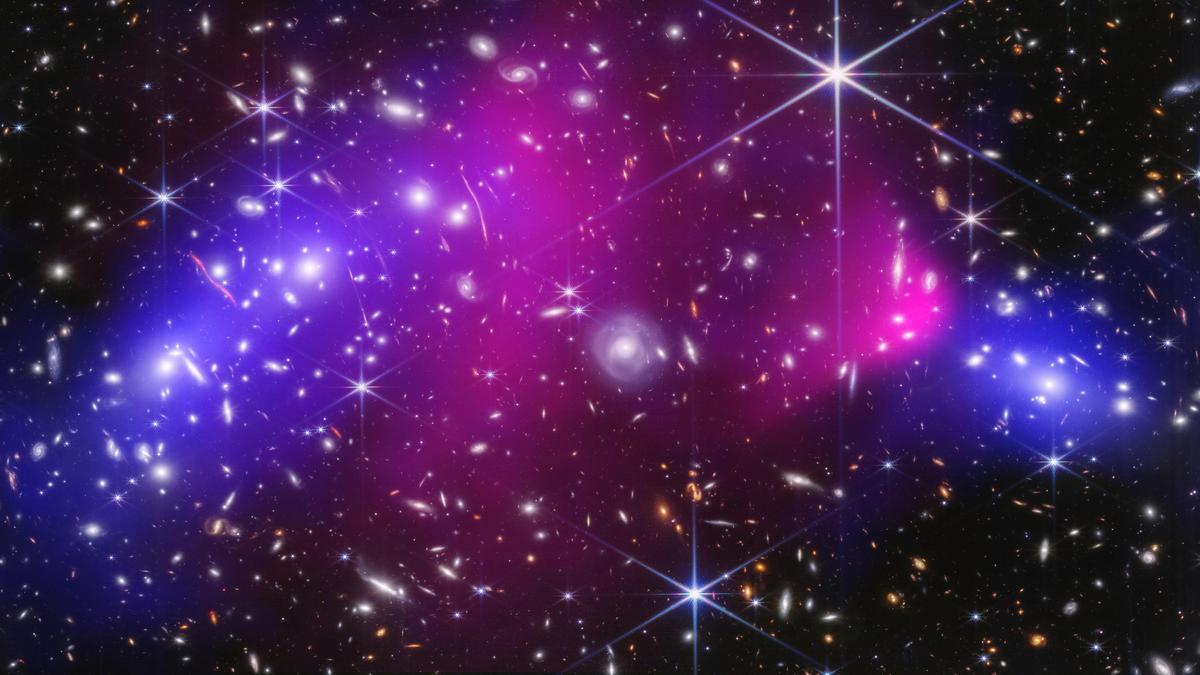
When the James Webb Space Telescope looks deep into the Universe, some of the objects it finds appear as small, red dots. Astronomers call them little red dots (LRDs), and they have become one of the telescope’s more intriguing discoveries.

Now, an international team of astronomers has found an unusual object that may help explain what at least some of these red dots actually are: unusually young and rapidly growing black holes surrounded by an enormous amount of dense gas.

The astronomers spotted the object in question in the study from when the universe was just around 660 million years old. Put another way, the light from this object has travelled for more than 13 billion years before reaching the earth, which the Webb telescope orbits.

The researchers’ observations suggest that almost all the light coming from the object is produced by a supermassive black hole. They were published in Nature on August 12.

Astronomers have generally thought that the red colour of LRDs is due to dust. This is because dust absorbs blue light more readily than red light, so more red light reaches the observer.

However, the team found the object to be telling a different story. Specifically, they found that its colour could instead be explained by a colossal cocoon of gas surrounding the black hole.

An unexpected break

The team first spotted the object in images taken by the Webb telescope because it was exceptionally red in colour. It appeared in some of the telescope’s infrared filters but virtually disappeared at shorter wavelengths.

The researchers then used one of Webb’s instruments to split its light into its spectrum — its various wavelengths. And this spectrum contained something extraordinary: a very large Balmer break. This is a gap in the spectrum that occurs because hydrogen is absorbing light at those wavelengths. Astronomers are used to seeing this break in light coming from stars, but it is still not so big.

The Balmer break in the light from the object suggested that the light was passing through a large and turbulent quantity of hydrogen gas.

According to the astronomers’ model, it would have to have around 100 billion particles per cubic centimetre, extend to several million kilometres around the black hole, and move at hundreds of kilometres per second.

(Aside: Even air at sea level on the earth contains around 25 billion particles per cubic centimetre — meaning the hydrogen cocoon is around 250 million times less dense than ordinary air! The cocoon is still exceptional because of the fact that this relatively thin gas is still spread across a large distance while also being concentrated around a violent black hole, and being dense enough to distort the light passing through it.)

The black hole is actively feeding on matter. As material falls towards it, it forms a hot, bright accretion disk and releases enormous amounts of radiation. That radiation escapes into space after passing through the surrounding gas. And to an observer on the earth, that light looks redder.

Growing so fast

In an independent commentary accompanying the paper, astronomers Dominik Schleicher of the Sapienza University of Rome and Rodrigo Herrera-Camus of the University of Concepción, Chile, wrote that the discovery could be important for scientists to understand other LRDs.

One notable implication is that if some of these black holes appear redder due to gas rather than dust, their masses could be substantially lower — up to a 100-times — than astronomers have previously estimated.

A study published in Nature on May 27 provided an important piece of the puzzle from a different direction. Astronomers studied a different LRD that existed when the universe was around 700 million years old. By measuring how gas was rotating around the object, they were able to estimate its mass: about 50 million-times that of the sun — which is high.

But equally remarkably, its host galaxy had less stellar mass than the black hole’s mass, suggesting that at least some of the universe’s early black holes may have grown much faster than their surrounding galaxies had accumulated most of their stars.

The new study (from August 12) also offered a clue to how this could happen. For some years now, astronomers have not been able to make sense of how very massive black holes could exist when the universe was so young, less than a billion years old. If a black hole formed with the mass of a star, they wouldn’t be able to grow at the conventional rate to become supermassive so quickly.

One possibility that the new study buttresses is that these black holes didn’t grow at the conventional rate. Astronomers had previously proposed that when a black hole is surrounded by a dense cloud of gas, it could grow faster than expected — and the hydrogen cocoon surrounding the newfound black hole presents just such a scenario.

More complicated explanation

The team’s model also found that the light from the object had a combination of properties that favoured the hydrogen surrounding the black hole rather than being far from the black hole but lying along the line of sight.

That said, the study’s authors also stressed that their observation does not establish the idea conclusively. For one, the exact mechanism by which the black hole and its dense envelope formed remains an open question.

There is another intriguing detail. According to the study, the object appears to be in a relatively small galaxy while a considerably more massive galaxy is located nearby. The two galaxies are also expected to merge in roughly 100 million years. The researchers pointed out that if the black hole’s light and the neighbouring galaxy were eventually seen together, the combined object would look remarkably similar to a typical LRD.

For decades, astronomers have used dust as the obvious explanation when distant objects appear unusually red. The Webb Space Telescope, which NASA launched in late 2021, is now showing that the explanation can be more complicated.

Schleicher and Herrera-Camus also noted that such gas-rich environments could help explain other peculiar properties of LRDs, including their surprisingly weak X-ray emissions. Future radio telescopes may also be able to probe the electrons moving through these environments and provide information that Webb is not designed to.

Published – August 17, 2026 01:15 pm IST


Source link

Science Tags:black holes, dusty mystery, James Webb Space Telescope, Unusual black hole found

Post navigation

Previous Post: DRI uncovers illegal use of SAFTA agreement in arecanut imports to India

Related Posts

  • Russian space agency chief blames decades of inactivity for Luna-25 lander’s crash on the moon
    Russian space agency chief blames decades of inactivity for Luna-25 lander’s crash on the moon Science
  • What is pyroprocessing?
    What is pyroprocessing? Science
  • Galactic tides: Pushing and pulling the heavens
    Galactic tides: Pushing and pulling the heavens Science
  • Nobel laureate supports India’s pursuit for a neutrino lab
    Nobel laureate supports India’s pursuit for a neutrino lab Science
  • NASA announces overhaul of Artemis lunar programme amid technical delays
    NASA announces overhaul of Artemis lunar programme amid technical delays Science
  • SpaceX rocket stage believed to have slammed into Moon
    SpaceX rocket stage believed to have slammed into Moon Science

More Related Articles

Human DNA will have to be edited if humans are to settle on other planets Human DNA will have to be edited if humans are to settle on other planets Science
Crown shyness: let our realms stay apart Crown shyness: let our realms stay apart Science
Sunita Williams, Butch Wilmore confident Boeing space capsule can safely return them to Earth, despite failures Sunita Williams, Butch Wilmore confident Boeing space capsule can safely return them to Earth, despite failures Science
Forest loss from SE Asia rubber is up to 3 times more than thought: study Forest loss from SE Asia rubber is up to 3 times more than thought: study Science
2024 physics Nobel for work on artificial neural networks | Explained 2024 physics Nobel for work on artificial neural networks | Explained Science
What is ‘Net Zero’, anyway? A short history of a monumental concept What is ‘Net Zero’, anyway? A short history of a monumental concept Science
SiteLock

Archives

  • August 2026
  • July 2026
  • June 2026
  • May 2026
  • April 2026
  • March 2026
  • February 2026
  • January 2026
  • December 2025
  • November 2025
  • October 2025
  • September 2025
  • August 2025
  • July 2025
  • June 2025
  • May 2025
  • April 2025
  • March 2025
  • February 2025
  • January 2025
  • December 2024
  • November 2024
  • October 2024
  • September 2024
  • August 2024
  • July 2024
  • June 2024
  • May 2024
  • April 2024
  • March 2024
  • February 2024
  • January 2024
  • December 2023
  • November 2023
  • October 2023
  • September 2023
  • August 2023
  • July 2023
  • June 2023
  • May 2023
  • April 2023
  • March 2023
  • February 2023
  • January 2023
  • December 2022
  • November 2022
  • October 2022
  • September 2022
  • August 2022
  • July 2022
  • June 2022
  • May 2022

Categories

  • Business
  • Nation
  • Science
  • Sports
  • World

Recent Posts

  • Unusual black hole found at universe’s dawn presents dusty mystery to astronomers
  • DRI uncovers illegal use of SAFTA agreement in arecanut imports to India
  • TNEA 2026: Nearly 60,000 students get provisional allotments in round two
  • India vs Sri Lanka 1st Test: India all out for 462 on Day 3
  • Squalor reigns at Thiruvanmiyur market

Recent Comments

  1. Michaelemath on UP Teacher Who Asked Students To Slap Muslim Classmate
  2. GoodiniAbelp on UP Teacher Who Asked Students To Slap Muslim Classmate
  3. GoodiniAbelp on UP Teacher Who Asked Students To Slap Muslim Classmate
  4. DavidOxile on UP Teacher Who Asked Students To Slap Muslim Classmate
  5. EltonCruch on UP Teacher Who Asked Students To Slap Muslim Classmate
  • Economic Survey 2023-24 cautions against significant increase in retail investors in stock market
    Economic Survey 2023-24 cautions against significant increase in retail investors in stock market Business
  • Access Denied
    Access Denied Nation
  • In Chhattisgarh School, Mid-Day Meal Is Just Rice And Turmeric
    In Chhattisgarh School, Mid-Day Meal Is Just Rice And Turmeric Nation
  • Donald Trump’s 4 million civil fraud judgment fine slashed to 5M by New York appeals court
    Donald Trump’s $454 million civil fraud judgment fine slashed to $175M by New York appeals court World
  • FIFA World Cup 2026: Cunha scores twice as Brazil win 3-0 and eliminate Haiti
    FIFA World Cup 2026: Cunha scores twice as Brazil win 3-0 and eliminate Haiti Sports
  • CRICKET | Indrajith’s opening salvo fires Tamil Nadu to an easy win
    CRICKET | Indrajith’s opening salvo fires Tamil Nadu to an easy win Sports
  • On Dhruv Jurel vs Rishabh Pant Selection Debate, Anil Kumble’s “MS Dhoni” Verdict
    On Dhruv Jurel vs Rishabh Pant Selection Debate, Anil Kumble’s “MS Dhoni” Verdict Sports
  • Access Denied Sports

Editor-in-Chief:
Mohammad Ariff,
MSW, MAJMC, BSW, DTL, CTS, CNM, CCR, CAL, RSL, ASOC.
editor@artifex.news

Associate Editors:
1. Zenellis R. Tuba,
zenelis@artifex.news
2. Haris Daniyel
daniyel@artifex.news

Photograher:
Rohan Das
rohan@artifex.news

Artifex.News offers Online Paid Internships to college students from India and Abroad. Interns will get a PRESS CARD and other online offers.
Send your CV (Subjectline: Paid Internship) to internship@artifex.news

Links:
Associate Journalism
About Us
Privacy Policy

News Links:
Breaking News
World
Nation
Sports
Business
Entertainment
Lifestyle

Registered Office:
72/A, Elliot Road, Kolkata - 700016
Tel: 033-22277777, 033-22172217
Email: office@artifex.news

Editorial Office / News Desk:
No. 13, Mezzanine Floor, Esplanade Metro Rail Station,
12 J. L. Nehru Road, Kolkata - 700069.
(Entry from Gate No. 5)
Tel: 033-46011099, 033-46046046
Email: editor@artifex.news

Copyright © 2023 Artifex.News Newsportal designed by Artifex Infotech.