



Conventional bombs explode on or near a target surface, with the explosion and fragments, e.g. shrapnel, rendering the bomb’s damage. But when a target is buried deep under a mountain, the soil and rock mass surrounding it can absorb enough of the blast’s energy to keep the target from being damaged too much.
This is the situation facing the Donald Trump administration as it mulls plans to bomb Pickaxe Mountain in Iran, where The Wall Street Journal has reported Israel believes Tehran has moved several centrifuges — the machines that purify uranium to make an a-bomb.
Bunker buster bombs
The need to bomb targets under a thick layer of earth led scientists to invent bunker buster bombs. Instead of exploding when they come in contact with the earth, these bombs are designed to penetrate soil, rock, and even reinforced concrete before detonating.
The U.S.’s most powerful conventional bunker buster is the GBU-57A/B Massive Ordnance Penetrator, shortened to MOP. The world’s largest non-nuclear bomb, a single MOP weighs around 13.6 tonnes and is currently delivered only by the U.S. Air Force’s B2 Spirit stealth bomber. The MOP entered combat for the first time during the U.S.’s June 2025 strikes against Iran in the 12-Day War.
The MOP does not drill through rock. Instead, it uses an enormous amount of kinetic energy to punch its way through. The B2 Spirit can cruise at an altitude of 50,000 ft. When a 13.6-tonne object is dropped from that height, it will have a theoretical maximum kinetic energy of 2 gigajoules (GJ) when it reaches the ground — about as much energy with which American Airlines Flight 11 smashed into North Tower on 9/11 — and at a speed of nearly 2,000 km/hr.
In reality, the MOP will face significant atmospheric drag and, from that altitude, will reach the ground at 1,000-1,300 km/hr, with a kinetic energy of 0.6-0.8 GJ. This is still equivalent to the energy released by detonating around 170 kg of TNT. And to ensure this helps the MOP get as close to the target as possible, it features a hardened steel casing, a nose only a few tens of centimetres across, and a delayed fuse that kicks off only after the bomb has burrowed underground.
If the MOP has a kinetic energy of 0.7 GJ, a nose 20 cm wide will exert a pressure 2.1-lakh-times the atmospheric pressure, and if it’s able to penetrate 1 m of rock, a force equivalent to 71,000 tonnes under earth’s gravity. If multiple MOPs are dropped in sequence over the same point, each one can penetrate deeper than the last.
Cost of making an MOP
The unit cost of an MOP is not available in the public domain but estimates in the media suggest $15-20 million per bomb. The need for multiple bombs may also weigh heavily on the U.S. government’s mind in terms of their demand for critical minerals.
As researchers from the Payne Institute of Public Policy wrote in March this year, “The biggest issue for the [American] defense industrial base will be sourcing the 77.3 kg of gallium needed” to rebuild the advanced radars in Bahrain and Qatar damaged by Iranian missiles, “a material for which China controls 98% of the global supply. … As the long conflict in Ukraine has already illustrated, war is being costed in the wrong units. The relevant metric is not merely how many launchers there are at the start of the war, but how many precision weapons and interceptors can be fired on days two, 20, and 200, and how quickly industry can replace them.”
Again, while a bill of materials isn’t available for the MOP, a survey of other precision-guided penetrators suggests each bomb may include up to a quintal of tungsten, tens to hundreds of grams of rare-earth elements, and several other critical minerals of varying quantities in between.

Bomb versus mountain
For all the impressive forces the MOP is capable of, a mountain can be much more formidable. Iran hasn’t released geological surveys of Pickaxe Mountain — which locals know as Kuh-e Kolang Gaz La. But the Karkas Range that it is part of is predominantly volcanic in origin, with surveys indicating it consists mainly of volcanic rocks from the Eocene period.
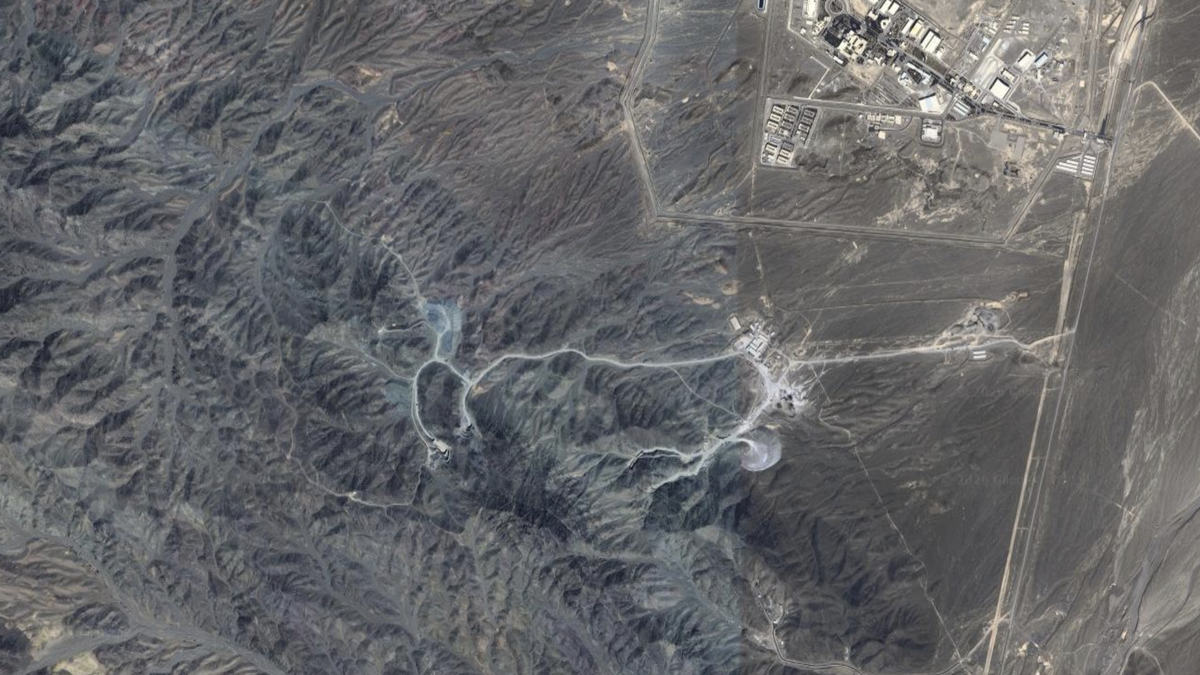
Volcanic rocks like andesites and rhyolites are generally hard and difficult to excavate. The mountain itself is also steep and rugged, a topology that lends itself to subterranean facilities as the valleys can host access roads while the ridges provide rock cover.

A satellite view shows vehicles at an entrance tunnel into Pickaxe Mountain, near the Natanz nuclear facility, Iran, June 21, 2026.
| Photo Credit:
Reuters
Based on satellite images provided by Vantor, the Institute for Science and International Security (ISIS), a U.S.-based think-tank, has suggested that the main access tunnels enter horizontally through the mountainside. Pickaxe Mountain rises 1,600 m above sea level and the nuclear complex is expected (but not confirmed) to be at least 100 m underground.
Bunker buster bombs like the MOP are generally most effective facilities whose location and layout are well-understood and when the target doesn’t lie beyond the bomb’s penetrative capability. A facility buried under tens of metres of soil or rock can be vulnerable if an MOP gets close enough for the explosion — of the bomb’s 2-2.5 tonnes of explosive charge — and shock waves to damage or destabilise the structure.
The bombs also fare better against targets that don’t move, such as underground buildings, centrifuge halls, command centres, and aircraft shelters.

When MOPs falter
On the flip side, the MOPs become less effective the more deeply a facility is buried, since every additional layer of rock or reinforced concrete can absorb some of the bomb’s energy before the facility itself becomes vulnerable.
Simply increasing the bomb’s speed at the moment of impact is also not an option. Beyond a threshold, the impact can deform the bomb’s casing, rendering it less effective.
Different rocks also transmit shock waves differently. Andesite and rhyolite are both stiff rocks and thus transmit shock waves well, but the rocks themselves can withstand high compressive stresses before fracturing. Rhyolite is also more brittle and can develop multiple cracks. Note, however, that Pickaxe Mountain’s actual response to multiple MOP strikes will depend on existing fractures as well as on the properties of the many other rock types present, plus the effects of any reinforcing structures.
Since the Trump administration is mulling bombing Pickaxe Mountain vis-à-vis Iran’s nuclear programme, to which the U.S. is opposed, military planners will be considering destroying the underground facility as much as rendering enough damage to delay the programme, and perhaps even disrupting operations by collapsing the access tunnels.

A B52 Stratofortress releases a test version of the MOP during an exercise over the White Sands Missile Range, U.S., 2009.
| Photo Credit:
Public domain
Lessons from Fordow
In fact, the June 2025 attack by the U.S. illustrates the possibilities at hand at present. Iran built its Fordow nuclear site inside a mountain so that it could survive air attacks. During Operation Midnight Hammer, seven B2 bombers dropped 12 MOPs on Fordow (and two on the Natanz site).
According to the Pentagon, the bombers delivered the bombs in sequence aiming for a pair of ventilation shafts. The first MOPs damaged the reinforced concrete over each shaft and the subsequent ones punched deeper.
However, in the aftermath, U.S. officials said the facility had suffered severe damage while independent assessments said the attack delayed the nuclear programme rather than eliminating it. On-ground inspection has of course been impossible.

The Wall Street Journal recently reported that Israeli intelligence believes Tehran moved several tonnes of centrifuges into the facility under Pickaxe Mountain after Operation Midnight Hammer. However, the facility is also believed to be even deeper than that at Fordow, potentially deliberately beyond the reach of MOPs.
In a July 14 assessment, ISIS experts wrote, “The site, in its present condition, would be more suitable for ground forces to attack or sabotage like the destruction of the advanced centrifuge assembly centre”. But as The Guardian put it, “The deployment of ground operations has so far been a red line for Trump and there has been no suggestion that he is any closer to considering such a move, even after the recent escalation”.
Given these constraints, future military operations could focus less on destroying the chambers housing the facility and more on collapsing the access points or damaging supporting infrastructure, such as power lines aboveground.
mukunth.v@thehindu.co.in