Skip to content
  • Facebook
  • X
  • Linkedin
  • WhatsApp
  • YouTube
  • Associate Journalism
  • About Us
  • Privacy Policy
  • 033-46046046
  • editor@artifex.news
Artifex.News

Artifex.News

Stay Connected. Stay Informed.

  • Breaking News
  • World
  • Nation
  • Sports
  • Business
  • Science
  • Entertainment
  • Lifestyle
  • Toggle search form
  • They are Crocheting Dolls In Manipur Relief Camps To Earn A Living
    They are Crocheting Dolls In Manipur Relief Camps To Earn A Living Nation
  • Access Denied Sports
  • Access Denied Sports
  • School students raise ₹10 lakh to help SMA patient
    School students raise ₹10 lakh to help SMA patient Nation
  • Access Denied World
  • “Our Party Will Win All Seats In Kashmir, INDIA Bloc Will Grow”: Farooq Abdullah
    “Our Party Will Win All Seats In Kashmir, INDIA Bloc Will Grow”: Farooq Abdullah Nation
  • India to be third top economy in few years, says Nirmala Sitharaman
    India to be third top economy in few years, says Nirmala Sitharaman Business
  • Lok Sabha MP Engineer Rashid’s Car Attacked During Poll Campaign In Jammu And Kashmir
    Lok Sabha MP Engineer Rashid’s Car Attacked During Poll Campaign In Jammu And Kashmir Nation
Kingmakers: Meet the insects that make India’s famed mangoes

Kingmakers: Meet the insects that make India’s famed mangoes

Posted on June 24, 2026 By admin


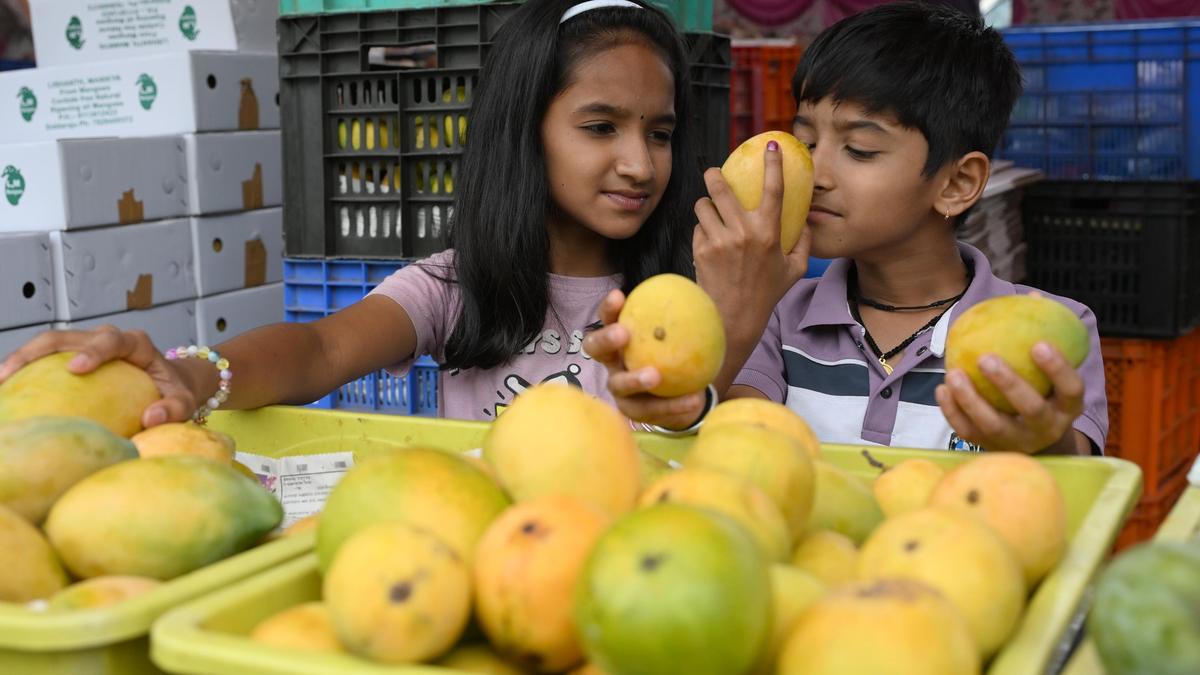
More than a thousand varieties of mangoes exist in India, the popular ones being Banganapalli, Dassheri, Alphonso, Badaami, Imaam Pasandh, and Mulgoa. There is even a “Lalbagh” variety in Bengaluru. Many of us associate the fruit with a summer childhood memory, of eating it with our bare hands, the mango juice dripping on our clothes.

More recently, the fruit has become popular on social media platforms, where users explain hundreds of ways to cook and eat it. This year, the fruit’s popularity reached a new height: the red carpet at the Met Gala in New York. Mangoes and Indian summers go hand-in-hand, yet do you know how this fruit comes to be?

In other words, the mango tree gives out flowers… and then what happens?

Making a mango

Between December and March every year, mango trees across the country bloom and issue a sweet yet slightly fermented odour. Look closer at a mango tree in this time and you will find a branch with several bouquets of small, cream-coloured flowers. Each branch, which botanists call a panicle, contains a few hundred to up to 10,000 individual flowers. And a single mango tree can carry up to some 3,000 panicles, depending on its size and branching.

Each one of these flowers is the start of a mango in the making. Some flowers carry only the male parts while others only the female parts, and sometimes there can be flowers with both (which are biologically called hermaphrodites). Regardless, for the mango to form, pollen must travel between these flowers.

A colony of bees is seen at a hive in the backyard of University of Maryland bee researcher Nathalie Steinhauer, June 21, 2023.

A colony of bees is seen at a hive in the backyard of University of Maryland bee researcher Nathalie Steinhauer, June 21, 2023.
| Photo Credit:
AP

This is where pollinators make their mark. There is a curious history here. Mango cultivars had once insisted that mango flowers are pollinated only by wind. But this theory could not explain why the flowers issued a sweet odour. It had to be to attract insects.

To confirm that insects were indeed pollinators, researchers in Bengaluru teamed up with their peers from Germany to survey several Badami mango farms in the city’s urban and rural areas. Their findings, published in 2023, were striking: when flying insects were excluded from visiting the flowers, the mango yield dropped as much as 350% compared to when flowers were left open to all visitors.

These flying insects were found to include wild bees such as the dwarf honey bee (Apis florea), giant honey bee (Apis dorsata), and stingless bees (Tetragonula sp.). Other important flying visitors included hoverflies, which look like bees (Syrphus sp.), the common house fly (Musca domestica), and the blow fly (Calliphoridae family).

Effective pollination

The researchers also observed that the mango yields dropped when they barred crawling insects, such as ants, from the flowers. Soubadra Devy, a senior researcher at the Ashoka Trust for Research in Ecology and the Environment, Bengaluru, and an author of the study, said ants are “messy pollinators” and that it is essential to investigate them as pollinators of mango in future studies.

Dr. Devy also said she anticipates that the pollinator community is not any different for other Indian mango varieties since the “floral traits, i.e. the flower structure, pollen, and nectar are likely to be very similar”.

A bee is covered with pollen as it approaches a dandelion blossom on a lawn in Klosterneuburg April 29, 2013.

A bee is covered with pollen as it approaches a dandelion blossom on a lawn in Klosterneuburg April 29, 2013.
| Photo Credit:
Reuters

Researchers have conducted similar studies in Mexico, on the ‘Ataulfo’ mango, and in Australia, on the ‘Kensington Pride’ variety — and have revealed similar findings. Both teams also took more steps to determine which insects were the pollinators. They calculated a ‘pollination effectiveness’ metric based on the abundance of pollinators, the number of visits to flowers (with a ‘legitimate’ visits quantified using video cameras on trees), and the number of pollen grains deposited. And both studies showed that wild and native insects were most efficient at pollination, producing a higher yield of fruits.

Non-native bees to Mexico, such as European honey bees (Apis mellifera), were abundant and contributed to 80% of the pollination. Paradoxically, however, that did not result in a higher yield. The reason was that these non-native bees stayed around the same trees or in the same orchard and delivered the wrong pollen, resulting in malformed fruits. On the other hand, the native bees transferred pollen between orchards, giving rise to more full and juicy fruits.

Farmers’ friends

Yet these native bees are under threat from the same insecticides that protect the mango crop from pests. Neonicotinoid insecticides, which are commonly sprayed on mango trees, are neurotoxic and affect cognitive functions in bees, such as navigation, learning, and memory, and eventually their survival. This ripples through the entire colony, as the insecticides travel to the pollen and nectar and are brought back to the hive by bees. 

The Bengaluru-based study observed that fewer bees visited the mango flowers, and the harvested fruits were lighter by almost 30%, resulting in a three-way loss for the farmer: expensive pesticides, loss of pollinators, and a loss in the fruit yield.

Dr. Devy said monoculture farms that prevail in rural areas are more prone to pest attacks, and hence suffer higher pollinator loss as well. However, she also said she sees hope in bee-safe pesticides and in farmers timing their sprays to avoid peak pollinator activity — practices already in use in several western countries.

Display of mangoes in Srirangam for the summer season in Tiruchi, Tamil Nadu, on April 29, 2018.

Display of mangoes in Srirangam for the summer season in Tiruchi, Tamil Nadu, on April 29, 2018.
| Photo Credit:
Srinath M./The Hindu

“One recent welcome move”, in her words, was the Indian government recognising pollinators in the country’s new ‘environmental accounting’ framework. This framework recognised that India has more than 800 bee species, plus butterflies, moths, beetles, birds, bats and flies as pollinators and that they are ecologically important for agriculture. The government has also attached a monetary value equivalent to 8-10% of the total crop output value, amounting to ₹2.6 lakh crore in 2021-22, to pollinators.

Rights of pollinators

Attaching a monetary value could nudge policy towards actively protecting  our pollinators, through changes at the farm and landscape levels. These could include, as the Mexico study suggested, increasing the spread of natural and semi-natural areas near orchards, such as native forest patches and wildflower strips, to attract more wild insects.

Dr. Devy also pointed out that in May, stingless bees in Peru had become the first insects to win the legal rights to exist, thrive, and be represented in court. This is significant for the conservation of the species against insecticides, climate change, and competition from non-native insects.

The question then arises: will India accord similar rights to its pollinators, which carry the weight of the country’s agriculture? As you relish this season’s mangoes, it could also be your food for thought.

Kavitha Kannan is a biologist and science writer.


Source link

Science

Post navigation

Previous Post: Need forces DR Congo gold miners to keep working despite Ebola
Next Post: Several trapped after warehouse shed collapses at Taratala in Kolkata

Related Posts

  • IIT-Kanpur team develops new way to predict solar cycles
    IIT-Kanpur team develops new way to predict solar cycles Science
  • Most pink diamonds were birthed by a disintegrating supercontinent. Where can we find more?
    Most pink diamonds were birthed by a disintegrating supercontinent. Where can we find more? Science
  • When did the duplication of a gene responsible for breaking down complex carbohydrate starch in the mouth occur?
    When did the duplication of a gene responsible for breaking down complex carbohydrate starch in the mouth occur? Science
  • Balancing two forms of SNCA protein could help manage Parkinson’s, study finds
    Balancing two forms of SNCA protein could help manage Parkinson’s, study finds Science
  • PM Modi I-Day speech: First made-in-India semiconductor chip to come in market by this year end, says Modi
    PM Modi I-Day speech: First made-in-India semiconductor chip to come in market by this year end, says Modi Science
  • With Sci-Hub gone, will the ‘One Nation, One Subscription’ scheme step up?
    With Sci-Hub gone, will the ‘One Nation, One Subscription’ scheme step up? Science

More Related Articles

Scientists pen letter to Principal Scientific Adviser demanding ‘transparency’ on Vigyan Puraskar Scientists pen letter to Principal Scientific Adviser demanding ‘transparency’ on Vigyan Puraskar Science
Archaeologists, Sanskrit scholars tie up to decipher Rigveda text Archaeologists, Sanskrit scholars tie up to decipher Rigveda text Science
Fishing communities as guardians of marine life | Green Humour by Rohan Chakravarty Fishing communities as guardians of marine life | Green Humour by Rohan Chakravarty Science
What causes the seas to foam? What causes the seas to foam? Science
Earth’s early evolution: fresh insights from rocks formed 3.5 billion years ago Earth’s early evolution: fresh insights from rocks formed 3.5 billion years ago Science
Why is microRNA discovery a big leap? Why is microRNA discovery a big leap? Science
SiteLock

Archives

  • June 2026
  • May 2026
  • April 2026
  • March 2026
  • February 2026
  • January 2026
  • December 2025
  • November 2025
  • October 2025
  • September 2025
  • August 2025
  • July 2025
  • June 2025
  • May 2025
  • April 2025
  • March 2025
  • February 2025
  • January 2025
  • December 2024
  • November 2024
  • October 2024
  • September 2024
  • August 2024
  • July 2024
  • June 2024
  • May 2024
  • April 2024
  • March 2024
  • February 2024
  • January 2024
  • December 2023
  • November 2023
  • October 2023
  • September 2023
  • August 2023
  • July 2023
  • June 2023
  • May 2023
  • April 2023
  • March 2023
  • February 2023
  • January 2023
  • December 2022
  • November 2022
  • October 2022
  • September 2022
  • August 2022
  • July 2022
  • June 2022
  • May 2022

Categories

  • Business
  • Nation
  • Science
  • Sports
  • World

Recent Posts

  • FIFA World Cup 2026 LIVE updates: Panama vs England final Group L match under way
  • Elevated corridor on NH5 likely if T.N. waives GST on construction materials
  • Former Oklahoma state trooper Lance Schroyer nominated as ICE Director: Trump
  • Guest lecturers’ body allege anomalies in recruitment process of Assistant Professors
  • Disciplinary action initiated against 1,420 government doctors for failing to rejoin duty: Health Department

Recent Comments

  1. Briandaria on UP Teacher Who Asked Students To Slap Muslim Classmate
  2. Quintinanach on UP Teacher Who Asked Students To Slap Muslim Classmate
  3. RobertHow on UP Teacher Who Asked Students To Slap Muslim Classmate
  4. Thomasnic on UP Teacher Who Asked Students To Slap Muslim Classmate
  5. AndrewGlync on UP Teacher Who Asked Students To Slap Muslim Classmate
  • Ship Firms, US Agree On ‘Cost Payment’ Over Collapse Of Baltimore Bridge
    Ship Firms, US Agree On ‘Cost Payment’ Over Collapse Of Baltimore Bridge World
  • Ex Chief Ministers’ Children, BJP Rebel To Battle For This Karnataka Seat
    Ex Chief Ministers’ Children, BJP Rebel To Battle For This Karnataka Seat Nation
  • Access Denied
    Access Denied Nation
  • Docu Series ‘The Greatest Rivalry – India vs Pakistan’ To Stream On Netflix Next Month
    Docu Series ‘The Greatest Rivalry – India vs Pakistan’ To Stream On Netflix Next Month Sports
  • Access Denied Sports
  • Kerala KEAM results: Roshan Raju tops engineering, Vinayak Narayan bags first rank in pharmacy
    Kerala KEAM results: Roshan Raju tops engineering, Vinayak Narayan bags first rank in pharmacy Nation
  • Access Denied Sports
  • MS Dhoni Makes A Fan’s Day By Signing His Hand-Made Portraits. Video Goes Viral
    MS Dhoni Makes A Fan’s Day By Signing His Hand-Made Portraits. Video Goes Viral Sports

Editor-in-Chief:
Mohammad Ariff,
MSW, MAJMC, BSW, DTL, CTS, CNM, CCR, CAL, RSL, ASOC.
editor@artifex.news

Associate Editors:
1. Zenellis R. Tuba,
zenelis@artifex.news
2. Haris Daniyel
daniyel@artifex.news

Photograher:
Rohan Das
rohan@artifex.news

Artifex.News offers Online Paid Internships to college students from India and Abroad. Interns will get a PRESS CARD and other online offers.
Send your CV (Subjectline: Paid Internship) to internship@artifex.news

Links:
Associate Journalism
About Us
Privacy Policy

News Links:
Breaking News
World
Nation
Sports
Business
Entertainment
Lifestyle

Registered Office:
72/A, Elliot Road, Kolkata - 700016
Tel: 033-22277777, 033-22172217
Email: office@artifex.news

Editorial Office / News Desk:
No. 13, Mezzanine Floor, Esplanade Metro Rail Station,
12 J. L. Nehru Road, Kolkata - 700069.
(Entry from Gate No. 5)
Tel: 033-46011099, 033-46046046
Email: editor@artifex.news

Copyright © 2023 Artifex.News Newsportal designed by Artifex Infotech.