



Skip to content
  • Facebook
  • X
  • Linkedin
  • WhatsApp
  • YouTube
  • Associate Journalism
  • About Us
  • Privacy Policy
  • 033-46046046
  • editor@artifex.news
Artifex.News

Artifex.News

Stay Connected. Stay Informed.

  • Breaking News
  • World
  • Nation
  • Sports
  • Business
  • Science
  • Entertainment
  • Lifestyle
  • Toggle search form
  • UAE Releases New AI Model To Compete With Big Tech
    UAE Releases New AI Model To Compete With Big Tech World
  • Access Denied Sports
  • Ukraine, U.S. to start talks in Switzerland on Trump’s plan to end war
    Ukraine, U.S. to start talks in Switzerland on Trump’s plan to end war World
  • Access Denied Business
  • Inflation is down in Europe but ECB in no hurry to make more rate cuts
    Inflation is down in Europe but ECB in no hurry to make more rate cuts World
  • England cricketers resort to inhalers for tackling alarming pollution in India
    England cricketers resort to inhalers for tackling alarming pollution in India Sports
  • QatarEnergy reports ‘extensive damage’ after missile attacks on Ras Laffan industrial city
    QatarEnergy reports ‘extensive damage’ after missile attacks on Ras Laffan industrial city World
  • Sonia Gandhi, Priyanka Gandhi Arrive In Chennai To Attend Women Conference
    Sonia Gandhi, Priyanka Gandhi Arrive In Chennai To Attend Women Conference Nation
What is downblending, the process at the heart of Trump’s Iran agreement?

What is downblending, the process at the heart of Trump’s Iran agreement?

Posted on June 19, 2026 By admin


In the memorandum of understanding signed by the U.S. and Iran to end the war, Tehran has pledged never to develop a nuclear bomb in return for U.S. sanctions relief and access to a $300 billion development fund. Beyond that commitment, the MoU offers few details on how the U.S. and Iran intend to solve the nuclear dispute.

Iran still possesses hundreds of kilograms of highly enriched uranium and retains the technical capacity to produce more. While the modalities of a final agreement are to be negotiated in the second phase of talks, the MoU states that both sides have agreed to take steps to downblend Iran’s uranium stockpile. U.S. President Donald Trump said last week that the U.S. would “go and get” Iran’s highly enriched uranium “at some point” and “dilute” (downblend) it either in America or in Iran.

Paragraph 8 of the MoU states: “The Islamic Republic of Iran reaffirms that it shall not procure or develop nuclear weapons… The two parties also agreed to resolve the disposition of stockpiled enriched material pursuant to a mechanism… with the minimum methodology to be down-blending on site under the supervision of the International Atomic Energy Agency.”

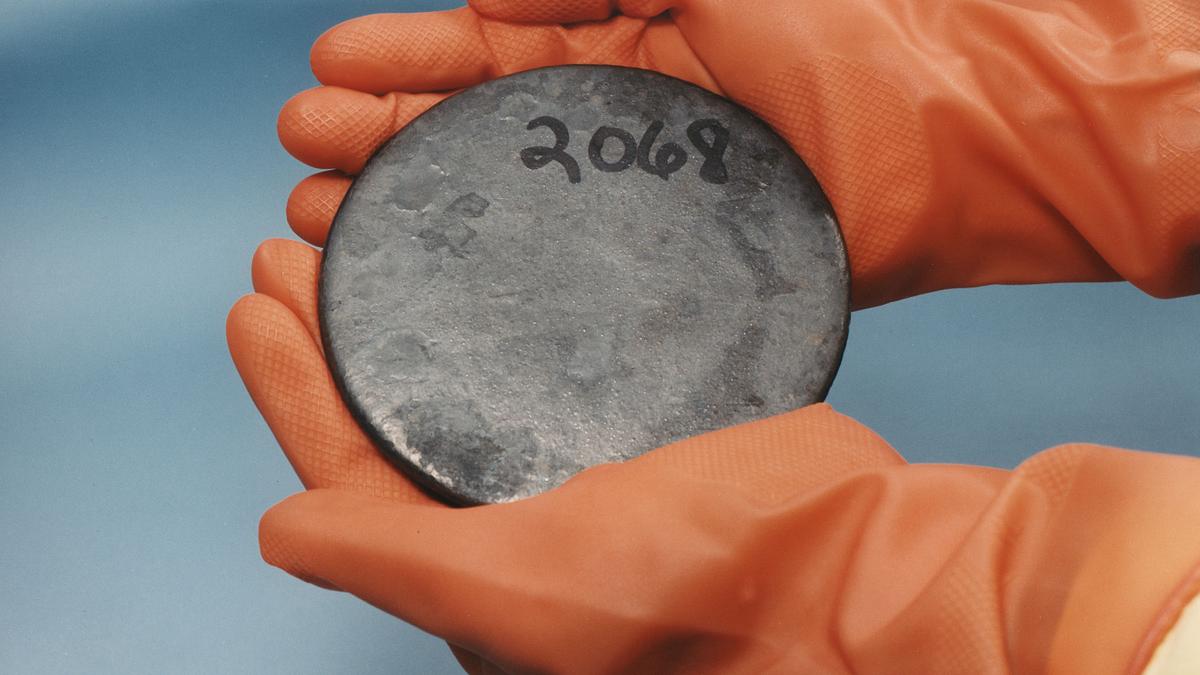
Downblending is a technology used to make uranium less pure. It is difficult to purify uranium, and highly pure uranium can be used to make nuclear bombs. So downblending removes the amount of uranium-235 available to make a bomb and increases the time required to do so. This duration, called the breakout time, is a cornerstone of modern nuclear non-proliferation.

Thus, the international community’s trust in Iran’s promise to not pursue a nuclear weapon depends on how well it implements downblending in the coming months, among other factors.

Uranium in nature consists mainly of two isotopes: uranium-238 and uranium-235. Of these, only uranium-235 is fissile, meaning it can sustain a nuclear chain reaction. However, the natural concentration of uranium-235 in uranium is only 0.72%. The remaining 99.28% is uranium-238. Purification means enriching the concentration of uranium-235 to higher levels.

Downblending is the opposite of enrichment. Here, enriched uranium is mixed with depleted (opposite of enriched) or natural uranium to produce uranium with less than 5% uranium-235. E.g. the 2015 Iran deal allowed Iran to enrich uranium up to 3.67%. Uranium of this purity can be used in some simple reactors to produce electricity but not to make a bomb.

The enriched uranium feedstock is usually stored as the compound uranium hexafluoride (UF6), which is a solid at room temperature. In the first step, the steel cylinders containing UF6 are placed in an industrial oven called an autoclave and heated to 80-110° C, turning the compound to gas. Gases are easier to mix than solids.

Second, another source of uranium called the blendstock is prepared. It can have 0.7% uranium-235 (natural uranium), 0.2-0.3% (depleted uranium), 1% uranium-235 (slightly enriched) or a different level. The level is based on need. For instance, downblending 90% enriched uranium to 5% will need a larger quantity of depleted uranium than natural uranium. The blendstock is also gaseous.

The enriched feedstock and the blendstock are pumped into a junction called a blending tee. The main challenge here is mass flow control: to achieve a target enrichment, the ratio of the two gases must be perfect. If too much feedstock gets in, the final gas will be too high in uranium-235.

Engineers use thermal mass flow meters, which determine the masses by measuring the heat transfer characteristics of the flowing gases. Then automated values adjust the flow. To ensure the gases mix, the blending tee uses internal mixers, called baffles, to create turbulence.

When the mixed gas exits the blending tee, it passes through an online enrichment monitor (OLEM). The OLEM uses sodium iodide to sense the amount of gamma rays emitted by the gas. Uranium-235 has an energy signature at 186 keV (around 3 × 10^-14 joules). OLEM tracks the intensity of gamma rays with this signature. If it exceeds an agreed-upon limit, the system will trigger failsafe valves that shut off the entire flow. This is done to keep the facility from producing more of the non-compliant material.

In fact, the facility is also fit with cameras housed in tamper-proof casings and which record 24/7.

The gas is then solidified by cooling it in a product cylinder.

This is not the last step, however. The downblended uranium still exists as UF6 — which is also the feedstock for the process that enriches uranium. Since the purpose of downblending is to increase the amount of effort needed to make a bomb, the UF6 is finally moved to a reconversion plant, where the gas reacts with steam and hydrogen. The reaction replaces the fluorine atoms with oxygen, producing uranium dioxide (UO2), a dark powder.

The uranium in UO2 can’t be enriched directly. It has to be converted to UF6 first in a conversion plant. The emissions from such a plant can be detected by satellites and on ground inspections.

The very last step is IAEA verification. IAEA inspectors collect a small physical sample of the UO2 powder and ship it to their laboratory in Seibersdorf, Austria, where thermal ionisation mass spectrometry is used to confirm the level of uranium-235 to four decimal places. Second, the IAEA applies seals on the cylinders that can’t be tampered without leaving back signs.

While the crux of downblending is the physical mixing, downblending the process includes the control systems so that it can provide verifiable proof that the uranium has indeed become less pure. And that in turn is why the U.S.-Iran memorandum will rest as much on diplomatic assurances as on the technical implementation.

Published – June 19, 2026 09:14 am IST



Source link

Science

Post navigation

Previous Post: Pawar replaces Patil as Mumbai chief selector, Salvi retained as head coach
Next Post: JD Vance slams Israeli officials who criticised U.S.-Iran deal, deepening rift between allies

Related Posts

  • Artemis II: Indian-American Amit Kshatriya, senior NASA official behind U.S.’s moon mission
    Artemis II: Indian-American Amit Kshatriya, senior NASA official behind U.S.’s moon mission Science
  • Bird flu reaches mainland Antarctica for first time, scientists say
    Bird flu reaches mainland Antarctica for first time, scientists say Science
  • How much salt should you take every day?
    How much salt should you take every day? Science
  • Scientists identify molten layer deep within interior of Mars
    Scientists identify molten layer deep within interior of Mars Science
  • In a single finger bone, scientists find signs of Britain’s largest flying animal
    In a single finger bone, scientists find signs of Britain’s largest flying animal Science
  • As COP30 opens, report warns climate finance is failing global health systems
    As COP30 opens, report warns climate finance is failing global health systems Science

More Related Articles

Providing support to women dealing with the unbearable pain of vaginismus Providing support to women dealing with the unbearable pain of vaginismus Science
Major study opens window to the brain when an emotion first appears Major study opens window to the brain when an emotion first appears Science
Whales can live way longer than scientists had thought, new research shows Whales can live way longer than scientists had thought, new research shows Science
Scientist bottles smell of bones to help solve cold cases Scientist bottles smell of bones to help solve cold cases Science
Reproduce or it didn’t happen: why replicable science is better science Reproduce or it didn’t happen: why replicable science is better science Science
 Australia, New Zealand brace for looming bird flu threat  Australia, New Zealand brace for looming bird flu threat Science
SiteLock

Archives

  • June 2026
  • May 2026
  • April 2026
  • March 2026
  • February 2026
  • January 2026
  • December 2025
  • November 2025
  • October 2025
  • September 2025
  • August 2025
  • July 2025
  • June 2025
  • May 2025
  • April 2025
  • March 2025
  • February 2025
  • January 2025
  • December 2024
  • November 2024
  • October 2024
  • September 2024
  • August 2024
  • July 2024
  • June 2024
  • May 2024
  • April 2024
  • March 2024
  • February 2024
  • January 2024
  • December 2023
  • November 2023
  • October 2023
  • September 2023
  • August 2023
  • July 2023
  • June 2023
  • May 2023
  • April 2023
  • March 2023
  • February 2023
  • January 2023
  • December 2022
  • November 2022
  • October 2022
  • September 2022
  • August 2022
  • July 2022
  • June 2022
  • May 2022

Categories

  • Business
  • Nation
  • Science
  • Sports
  • World

Recent Posts

  • Traditional traders seek policy support amid rise of e-commerce, quick-commerce
  • Times Square gunfire sends bystanders scrambling to safety
  • JD Vance slams Israeli officials who criticised U.S.-Iran deal, deepening rift between allies
  • What is downblending, the process at the heart of Trump’s Iran agreement?
  • Pawar replaces Patil as Mumbai chief selector, Salvi retained as head coach

Recent Comments

  1. AlfredFaits on UP Teacher Who Asked Students To Slap Muslim Classmate
  2. DavidDob on UP Teacher Who Asked Students To Slap Muslim Classmate
  3. GilbertOceam on UP Teacher Who Asked Students To Slap Muslim Classmate
  4. StevenBoB on UP Teacher Who Asked Students To Slap Muslim Classmate
  5. Thomasrip on UP Teacher Who Asked Students To Slap Muslim Classmate
  • Where is the ‘rainbow capital’ of the world?
    Where is the ‘rainbow capital’ of the world? Science
  • Rajnath Singh Meets US Secretary Of Defence On Sidelines Of 11th ASEAN Meet
    Rajnath Singh Meets US Secretary Of Defence On Sidelines Of 11th ASEAN Meet Nation
  • Vedanta CFO Sonal Shrivastava resigns
    Vedanta CFO Sonal Shrivastava resigns Business
  • “Won’t Change My Tune”: England Great On His Stance On 4-Day Test Matches
    “Won’t Change My Tune”: England Great On His Stance On 4-Day Test Matches Sports
  • Swiggy cuts IPO valuation again, to .3 billion, BlackRock and CPPIB to invest: report
    Swiggy cuts IPO valuation again, to $11.3 billion, BlackRock and CPPIB to invest: report Business
  • 3 Louisiana officers wounded by gunfire in standoff with shooting suspect, police say
    3 Louisiana officers wounded by gunfire in standoff with shooting suspect, police say World
  • Access Denied World
  • Access Denied
    Access Denied Nation

Editor-in-Chief:
Mohammad Ariff,
MSW, MAJMC, BSW, DTL, CTS, CNM, CCR, CAL, RSL, ASOC.
editor@artifex.news

Associate Editors:
1. Zenellis R. Tuba,
zenelis@artifex.news
2. Haris Daniyel
daniyel@artifex.news

Photograher:
Rohan Das
rohan@artifex.news

Artifex.News offers Online Paid Internships to college students from India and Abroad. Interns will get a PRESS CARD and other online offers.
Send your CV (Subjectline: Paid Internship) to internship@artifex.news

Links:
Associate Journalism
About Us
Privacy Policy

News Links:
Breaking News
World
Nation
Sports
Business
Entertainment
Lifestyle

Registered Office:
72/A, Elliot Road, Kolkata - 700016
Tel: 033-22277777, 033-22172217
Email: office@artifex.news

Editorial Office / News Desk:
No. 13, Mezzanine Floor, Esplanade Metro Rail Station,
12 J. L. Nehru Road, Kolkata - 700069.
(Entry from Gate No. 5)
Tel: 033-46011099, 033-46046046
Email: editor@artifex.news

Copyright © 2023 Artifex.News Newsportal designed by Artifex Infotech.